Advertisements
Advertisements
प्रश्न
A boy get into a floating boat.
What happens to the buoyant force on the boat ?
Advertisements
उत्तर
The buoyant force acting on the boat increases. The new buoyant force is equal to sum of weight of boy and weight of boat.
APPEARS IN
संबंधित प्रश्न
State whether the following statement is true or false :
The buoyant force depends on the nature of object immersed in the liquid
A piece of wood floats on water. The buoyant force on wood will be
State whether thrust is a scalar or vector?
Explain the following statement:
Sleepers are laid below the rails.
The diagram below in Fig. 4.12 shows a device which makes the use of the principle of transmission of pressure.
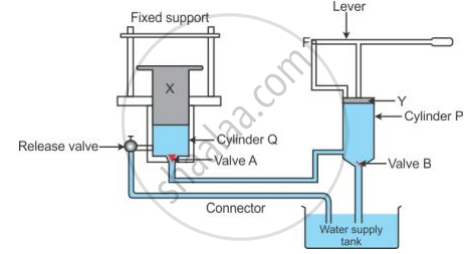
- Name the parts labelled by the letters X and Y.
- Describe what happens to valves A and B and to the quantity of water in the two cylinders when the lever arm is moved down.
- Give reasons for what happens to valves A and B in part (ii).
- What happens when the release valve is opened?
- What happens to valve B in cylinder P when the lever arm is moved up?
- Give a reason for your answer in part (v).
- State one use of the above device.
Complete the following sentence :
Pressure at a depth h in a liquid of density p is ......................
A beaker contains a liquid of density ‘ρ’ up to height ‘h’ such that ‘PA’ is atmospheric pressure and ‘g’ is the acceleration due to gravity. Answer the following questions:
- What is the pressure on the free surface of the liquid?
- What is the pressure on the base of the beaker?
- What is the lateral pressure at the base on the inner walls of the beaker?
The magnitude of buoyant force acting on an object immersed in a liquid depends on ______ of the liquid.
Salt water provides less buoyant force than freshwater.
Assertion (A): The buoyant force on a submerged rigid object can be considered to be acting at the center of mass of the object.
Reason (R): In rigid body, force distributed uniformly through its volume can be considered to be acting at the centre of mass of the body.
