Advertisements
Advertisements
प्रश्न
A bird flies through a distance in a straight line given by the vector `hati + 2hatj + hatk`. A man standing beside a straight metro rail track given by `vecr = (3 + λ)hati + (2λ − 1)hatj + 3λhatk` is observing the bird. The projected length of its flight on the metro track is ______.
पर्याय
`6/sqrt(14)` units
`14/sqrt(6)` units
`8/sqrt(14)` units
`5/sqrt(6)` units
Advertisements
उत्तर
A bird flies through a distance in a straight line given by the vector `hati + 2hatj + hatk`. A man standing beside a straight metro rail track given by `vecr = (3 + λ)hati + (2λ − 1)hatj + 3λhatk` is observing the bird. The projected length of its flight on the metro track is `underlinebb(8/sqrt(14) units)`.
Explanation:
Given, bird vector = `hati + 2hatj + hatk`
And, man standing on line:
`vecr = (3 + λ)hati + (2λ − 1)hatj + 3λhatk`
`vecr = (3hati - hatj) + λ(hati + 2hatj + 3hatk)`
We need to find the projection of the bird vector on the line.
Thus, we need to find the projection of the bird vector `(hati + 2hatj + hatk)` on the parallel vector of the line `(hati + 2hatj + 3hatk)`.
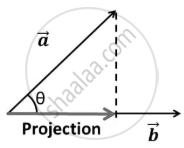
Here, `veca = hati + 2hatj + hatk`
`vecb = hati + 2hatj + 3hatk`
Now, projection of `veca` along `vecb` = `(veca*vecb)/|vecb|`
= `((hati + 2hatj + hatk) * (hati + 2hatj + 3hatk))/(|hati + 2hatj + 3hatk|)`
= `((hati + 2hatj + hatk) * (hati + 2hatj + 3hatk))/(sqrt(1^2 + 2^2 + 3^3))`
= `(1 xx 1 + 2 xx 2 + 1 xx 3)/(sqrt(1^2 + 2^2 + 3^3))`
= `(1 + 4 + 3)/(sqrt(1 + 4 + 9))`
= `8/sqrt14` units
