Advertisements
Advertisements
प्रश्न
A battery of emf 4 volt and internal resistance 1 Ω is connected in parallel with another battery of emf 1 V and internal resistance 1 Ω (with their like poles connected together). The combination is used to send current through an external resistance of 2 Ω. Calculate the current through the external resistance.
Advertisements
उत्तर
Let I1 and l2 be the currents through the two branches as shown in the following figure. The current through the 2 Ω resistance will be (I1 + I2) [Kirchhoffs current law].
Applying Kirchhoff's voltage law to loop ABCDEFA, we get,
-2(I1 + I2) - 1(I1) + 4 = 0
∴ 3I1 + 2I2 = 4 .....(1)
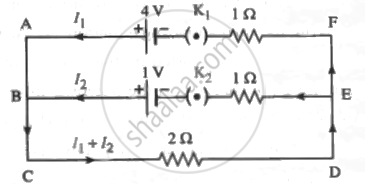
Applying Kirchhoff's voltage law to loop BCDEB, we get,
-2(I1 + I2) - 1(I2) + 1 = 0
2I1 + 3I2 = 1 ....(2)
Multiplying Eq. (1) by 2 and Eq. (2) by 3, we get,
6I1 + 4I2 = 8 .....(3)
and 6I1 + 9I2 = 3 ....(4)
Subtracting Eq. (4) from Eq. (3), we get,
- 5I2 = 5
∴ I2 = - 1A
The minus sign shows that the direction of current I2 is opposite to that assumption. Substituting this value of I2 in Eq. (1), we get,
3I1 + 2(-1) = 4
∴ 3I1 - 4 + 2 = 6
∴ I1 = 2A
Current through the 2 Ω resistance = I1 + I2 = 2 - 1 = 1 A.
APPEARS IN
संबंधित प्रश्न
Accuracy of potentiometer can be easily increased by ______.
Write two factors by which current sensitivity of a potentiometer can be increased.
State the advantages of potentiometer over voltmeter.
SI unit of potential gradient is _______.
(a) V cm
(b) `V/"cm"`
(c) Vm
(d) `V/m`
State the principle of a potentiometer. Define potential gradient. Obtain an expression for potential gradient in terms of resistivity of the potentiometer wire.
Figure shows a long potentiometer wire AB having a constant potential gradient. The null points for the two primary cells of emfs ε1 and ε2 connected in the manner shown are obtained at a distance of l1 = 120 cm and l2 = 300 cm from the end A. Determine (i) ε1/ε2 and (ii) position of null point for the cell ε1 only.

Describe briefly, with the help of a circuit diagram, how a potentiometer is used to determine the internal resistance of a cell.
Would you prefer a voltmeter or a potentiometer to measure the emf of a battery?
The net resistance of a voltmeter should be large to ensure that ______________ .
The potentiometer wire AB shown in the figure is 40 cm long. Where should the free end of the galvanometer be connected on AB, so that the galvanometer may show zero deflection?

Figure below shows two resistors R1 and R2 connected to a battery having an emf of 40V and negligible internal resistance. A voltmeter having a resistance of. 300 Ω is used to measure the potential difference across R1 Find the reading of the voltmeter.

Define potential gradient of the potentiometer wire.
Why should not the jockey be slided along the potentiometer wire?
Distinguish between a potentiometer and a voltmeter.
Describe with the help of a neat circuit diagram how you will determine the internal resistance of a cell by using a potentiometer. Derive the necessary formula.
Find the equivalent resistance between the terminals of A and B in the network shown in the figure below given that the resistance of each resistor is 10 ohm.

What will be the effect on the position of zero deflection if only the current flowing through the potentiometer wire is decreased?
When two cells of emf's E1 and E2 are connected in series so as to assist each other, their balancing length on a potentiometer wire is found to be 2.7 m. When the cells are connected in series so as to oppose each other, the balancing length is found to be 0.3 m. Compare the emf's of the two cells.
If the potential gradient of a wire decreases, then its length ______
What is the SI unit of potential gradient?
State any one use of a potentiometer.
A cell of e.m.f 1.5V and negligible internal resistance is connected in series with a potential meter of length 10 m and the total resistance of 20 Ω. What resistance should be introduced in the resistance box such that the potential drop across the potentiometer is one microvolt per cm of the wire?
The emf of a standard cell is 1.5V and is balanced by a length of 300 cm of a potentiometer with a 10 m long wire. Find the percentage error in a voltmeter that balances at 350 cm when its reading is 1.8 V.
Which of the following instruments is not a direct reading instrument?
Select the WRONG statement:
The length of a potentiometer wire is L. A cell of e.m.f E is balanced at length L/3 from the positive end of the wire. If the length of wire increases by L/2, then the same cell will give balance point at length ____________.
Which of the following is true for a potentiometer?
A potentiometer is used to measure the potential difference between A and B, the null point is obtained at 0.9 m. Now the potential difference between A and C is measured, the null point is obtained at 0.3 m. The ratio `E_2/E_1` is (E1 > E2) ______
A potentiometer wire has a length of 4m and resistance of 5Ω. It is connected in series with 495 Ω resistance and a cell of e.m.f. 4V. The potential gradient along the wire is ______
A potentiometer wire is 4 m long and a potential difference of 3 V is maintained between the ends. The e.m.f. of the cell which balances against a length of 100 cm of the potentiometer wire is ______
In the potentiometer experiment, the balancing length with a cell E1 of unknown e.m.f. is 'ℓ1' cm. By shunting the cell with resistance R Ω, the balancing length becomes `ℓ_1/2` cm, the internal resistance (r) of a cell is ______
In the potentiometer experiment, cells of e.m.f. E1 and E2 are connected in series (E1 > E2). the balancing length is 64 cm of the wire. If the polarity of E2 is reversed, the balancing length becomes 32 cm. The ratio `E_1/E_2` is ______
A potentiometer is an accurate and versatile device to make electrical measurements of E.M.F. because the method involves ______.
The best instrument for accurate measurement of EMF of a cell is ____________.
A 10 m long wire of uniform cross-section and 20 Ω resistance is used in a potentiometer. The wire is connected in series with a battery of 5 V along with an external resistance of 480 Ω. If an unknown emf E is balanced at 6.0 m length of the wire, then the value of unknown emf is ______.

Three resistance each of 4Ω are connected to from a triangle. The resistance b / w two terminal is
The conductivity of super - conductor is
The value of current I in the network shown in fig.

Specific resistance of a conductor increase with.
In a potentiometer circuit, a cell of EMF 1.5 V gives balance point at 36 cm length of wire. If another cell of EMF 2.5 V replaces the first cell, then at what length of the wire, the balance point occurs?
In a potentiometer circuit a cell of EMF 1.5 V gives balance point at 36 cm length of wire. If another cell of EMF 2.5 V replaces the first cell, then at what length of the wire, the balance point occurs?
Consider a simple circuit shown in figure
stands for a variable resistance R′. R′ can vary from R0 to infinity. r is internal resistance of the battery (r << R << R0).

- Potential drop across AB is nearly constant as R ′ is varied.
- Current through R′ is nearly a constant as R ′ is varied.
- Current I depends sensitively on R′.
- `I ≥ V/(r + R)` always.
While doing an experiment with potentiometer (Figure) it was found that the deflection is one sided and (i) the deflection decreased while moving from one end A of the wire to the end B; (ii) the deflection increased. while the jockey was moved towards the end B.
- Which terminal + or – ve of the cell E1, is connected at X in case (i) and how is E1 related to E?
- Which terminal of the cell E1 is connected at X in case (ii)?

For the circuit shown, with R1 = 1.0 Ω, R2 = 2.0 Ω, E1 = 2 V, and E2 = E3 = 4 V, the potential difference between the points 'a' and 'b' is approximately (in V) ______.

A Daniel cell is balanced on 125 cm lengths of a potentiometer wire. Now the cell is short circuited by a resistance 2 Ω and the balance is obtained at 100 cm. The internal resistance of the Daniel cell is ______.
As a cell age, its internal resistance increases. A voltmeter of resistance 270 Ω connected across an old dry cell reads 1.44 V. However, a potentiometer at the balance point gives a voltage measurement of the cell as 1.5 V. Internal resistance of the cell is ______ Ω.
Two identical thin metal plates has charge q1 and q2 respectively such that q1 > q2. The plates were brought close to each other to form a parallel plate capacitor of capacitance C. The potential difference between them is ______.
A cell of internal resistance r is connected across an external resistance nr. Then the ratio of the terminal voltage to the emf of the cell is ______.
A potentiometer wire AB having length L and resistance 12r is joined to a cell D of emf ε and internal resistance r. A cell C having emt `ε/2` and internal resistance 3r is connected. The length AJ at which the galvanometer as shown in the figure shows no deflection is ______.
What is the effect of decreasing the current through the potentiometer on the null point?
A particle carrying 8 electron charges starts from rest and is accelerated through a potential difference of 9000 V. Calculate the KE acquired by it in keV.
Draw a neat labelled diagram of Internal resistance of a cell using a potentiometer.
State dimension of potential gradient.
