हिंदी

A battery of emf 4 volt and internal resistance 1 Ω is connected in parallel with another battery of emf 1 V and internal resistance 1 Ω (with their like poles connected together). - Physics

Advertisements
Advertisements

प्रश्न

A battery of emf 4 volt and internal resistance 1 Ω is connected in parallel with another battery of emf 1 V and internal resistance 1 Ω (with their like poles connected together). The combination is used to send current through an external resistance of 2 Ω. Calculate the current through the external resistance.

संक्षेप में उत्तर
Advertisements

उत्तर

Let I1 and l2 be the currents through the two branches as shown in the following figure. The current through the 2 Ω resistance will be (I1 + I2) [Kirchhoffs current law].

Applying Kirchhoff's voltage law to loop ABCDEFA, we get,

-2(I1 + I2) - 1(I1) + 4 = 0

∴ 3I1 + 2I2 = 4             .....(1)
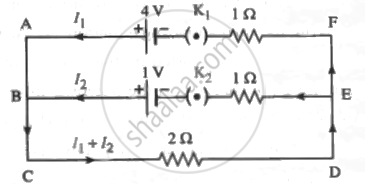
Applying Kirchhoff's voltage law to loop BCDEB, we get,

-2(I1 + I2) - 1(I2) + 1 = 0

2I1 + 3I2 = 1     ....(2)

Multiplying Eq. (1) by 2 and Eq. (2) by 3, we get,

6I1 + 4I2 = 8      .....(3)

and 6I1 + 9I2 = 3        ....(4)

Subtracting Eq. (4) from Eq. (3), we get,

- 5I2 = 5 

∴ I2 = - 1A

The minus sign shows that the direction of current I2 is opposite to that assumption. Substituting this value of I2 in Eq. (1), we get,

3I1 + 2(-1) = 4

∴ 3I1 - 4 + 2 = 6

∴ I1 = 2A

Current through the 2 Ω resistance = I1 + I2 = 2 - 1 = 1 A.

shaalaa.com
Potentiometer
  क्या इस प्रश्न या उत्तर में कोई त्रुटि है?
अध्याय 9: Current Electricity - Exercises [पृष्ठ २२९]

APPEARS IN

बालभारती Physics [English] Standard 12 Maharashtra State Board
अध्याय 9 Current Electricity
Exercises | Q 10 | पृष्ठ २२९

संबंधित प्रश्न

Accuracy of potentiometer can be easily increased by ______.


SI unit of potential gradient is _______.

(a) V cm

(b) `V/"cm"`

(c) Vm

(d) `V/m`


Would you prefer a voltmeter or a potentiometer to measure the emf of a battery?


The net resistance of an ammeter should be small to ensure that _______________ .


The potentiometer wire AB shown in the figure is 40 cm long. Where should the free end of the galvanometer be connected on AB, so that the galvanometer may show zero deflection?


Draw a labelled circuit diagram of a potentiometer to measure the internal resistance ‘r’ of a cell. Write the working formula (derivation is not required). 


Figure below shows two resistors R1 and R2 connected to a battery having an emf of 40V and negligible internal resistance. A voltmeter having a resistance of. 300 Ω is used to measure the potential difference across R1 Find the reading of the voltmeter.


How is potential gradient measured? Explain.


State the uses of a potentiometer.


A potentiometer wire has a length of 1.5 m and a resistance of 10 Ω. It is connected in series with the cell of emf 4 Volt and internal resistance 5 Ω. Calculate the potential drop per centimeter of the wire.


A potential drop per unit length along a wire is 5 × 10⁻³ V/m. If the emf of a cell balances against length 216 cm of this potentiometer wire, find the emf of the cell.


The SI unit of the potential gradient is ______  


If the potential gradient of a wire decreases, then its length ______  


The instrument which can measure terminal potential difference as well as electromotive force (emf) is ______ 


What is the SI unit of potential gradient?


A potentiometer wire is 4m long and potential difference of 3V is maintained between the ends. The emf of the cell, which balances against a length of 100 cm of the potentiometer wire is ____________.


A 10 m long wire of resistance 20 Q is connected in series with a battery of emf 3 V and a resistance of 10 Ω. The potential gradient along the wire in V/m is ________.


In a potentiometer experiment, when the galvanometer shows no deflection, then no current flows through ____________.


The potentiometer is more sensitive, when ______.


The resistivity of potentiometer wire is 40 × 10-8 ohm - metre and its area of cross-section is 8 × 10⁻⁶ m2. If 0.2 ampere current is flowing through the wire, the potential gradient of the wire is ______.


A potentiometer is an ideal device for measuring potential difference because ______.


If the e.m.f of a cell is not constant in the metre bridge experiment, then the ____________.


Which of the following is true for a potentiometer?


To determine the internal resistance of a cell by using potentiometer, the null point is at 1 m when cell is shunted by 3 Ω resistance and at a length 1.5 m when cell is shunted by 6 Ω resistance. The internal resistance of the cell is ______.


A potentiometer wire of length 100 cm has a resistance of 10 `Omega.` It is connected in series with a resistance and an accumulator of e.m.f 2 V and of negligible internal resistance. A source of e.m.f 10 mV is balanced against a 40 cm length of the potentiometer wire. The value of the external resistance is ____________.


The length of a wire of a potentiometer is 100 cm, and the e.m.f of its standard cell is E volt. It is employed to measure the e.m.f of a battery whose internal resistance is 0.5 `Omega` If the balance point is obtained at `l`= 30 cm from the positive end, the e.m.f of the battery is ____________.

where 'i' is the current in the potentiometer


A potentiometer is used to measure the potential difference between A and B, the null point is obtained at 0.9 m. Now the potential difference between A and C is measured, the null point is obtained at 0.3 m. The ratio `E_2/E_1` is (E1 > E2) ______


In the potentiometer experiment, cells of e.m.f. E1 and E2 are connected in series (E1 > E2). the balancing length is 64 cm of the wire. If the polarity of E2 is reversed, the balancing length becomes 32 cm. The ratio `E_1/E_2` is ______   


In a potentiometer experiment, for measuring internal resistance of a cell, the balance point has been obtained on the fourth wire. The balance point can be shifted to fifth wire by ______.


A potentiometer is an accurate and versatile device to make electrical measurements of E.M.F. because the method involves ______.


A potentiometer wire is 100 cm long and a constant potential difference is maintained across it. Two cells are connected in series first to support one another and then in opposite direction. The balance points are obtained at 50 cm and 10 cm from the positive end of the wire in the two cases. The ratio of emf's is ______.


Sensitivity of potentiometer can be increased by ______.

AB is a wire of potentiometer with the increase in value of resistance R, the shift in the balance point J will be:


Three resistance each of 4Ω are connected to from a triangle. The resistance b / w two terminal is


A wire of resistance R is cut into two equal part. There parts are then connected in parallel. The equivalent resistance of the combination will be


What is the current I in the circuit as show in fig.


In a potentiometer circuit, a cell of EMF 1.5 V gives balance point at 36 cm length of wire. If another cell of EMF 2.5 V replaces the first cell, then at what length of the wire, the balance point occurs?


In a potentiometer circuit a cell of EMF 1.5 V gives balance point at 36 cm length of wire. If another cell of EMF 2.5 V replaces the first cell, then at what length of the wire, the balance point occurs? 


Consider a simple circuit shown in figure   stands for a variable resistance R′. R′ can vary from R0 to infinity. r is internal resistance of the battery (r << R << R0).

  1. Potential drop across AB is nearly constant as R ′ is varied.
  2. Current through R′ is nearly a constant as R ′ is varied.
  3. Current I depends sensitively on R′.
  4. `I ≥ V/(r + R)` always.

AB is a potentiometer wire (Figure). If the value of R is increased, in which direction will the balance point J shift?


In an experiment with a potentiometer, VB = 10V. R is adjusted to be 50Ω (Figure). A student wanting to measure voltage E1 of a battery (approx. 8V) finds no null point possible. He then diminishes R to 10Ω and is able to locate the null point on the last (4th) segment of the potentiometer. Find the resistance of the potentiometer wire and potential drop per unit length across the wire in the second case.


In a potentiometer arrangement, a cell of emf 1.20 V gives a balance point at 36 cm length of wire. This cell is now replaced by another cell of emf 1.80 V. The difference in balancing length of potentiometer wire in above conditions will be ______ cm.


Two identical thin metal plates has charge q1 and q2 respectively such that q1 > q2. The plates were brought close to each other to form a parallel plate capacitor of capacitance C. The potential difference between them is ______.


Two cells of same emf but different internal resistances r1 and r2 are connected in series with a resistance R. The value of resistance R, for which the potential difference across second cell is zero, is ______.


If you are provided a set of resistances 2Ω, 4Ω, 6Ω and 8Ω. Connect these resistances so as to obtain an equivalent resistance of `46/3`Ω.


The emf of the cell of internal resistance 1.275 Ω balances against a length of 217 cm of a potentiometer wire. Find the balancing length when the cell is shunted by a resistance of 15 Ω.


What will a voltmeter of resistance 200 Ω read when connected across a cell of emf 2 V and internal resistance 2 Ω?


State dimension of potential gradient.


Share
Notifications

Englishहिंदीमराठी


      Forgot password?
Use app×