Advertisements
Advertisements
प्रश्न
A and B can do a piece of work in 12 days; B and C in 15 days; C and A in 20 days. How much time will A alone take to finish the work?
Advertisements
उत्तर
\[\text{ Time taken by } \left( A + B \right) \text{ to do the work = 12 days } \]
\[\text{ Time taken by } \left( B + C \right) \text{ to do the work = 15 days } \]
\[ \text{ Time taken by } \left( A + C \right) \text{ to do the work = 20 days } \]
\[ \text{ Now, } \]
\[\text{ Work done by } \left( A + B \right) = \frac{1}{12}\]
\[ \text{ Work done by } \left( B + C \right) = \frac{1}{15}\]
\[ \text{ Work done by } \left( A + C \right) = \frac{1}{20}\]
\[ \therefore \text{ Work done together } = \left( A + B \right) + \left( B + C \right) + \left( A + C \right)\]
\[ = \frac{1}{12} + \frac{1}{15} + \frac{1}{20}\]
\[ = \frac{5 + 4 + 3}{60} = \frac{12}{60}\]
\[ = \frac{1}{5}\]
\[ \therefore \text{ Work done together } = 2\left( A + B + C \right) = \frac{1}{5}\]
\[ \therefore \text{ Work done by } \left( A + B + C \right) = \frac{1}{10}\]
\[ \therefore \text{ Work done by A alone } = \left( A + B + C \right) - \left( B + C \right)\]
\[ = \frac{1}{10} - \frac{1}{15} = \frac{3 - 2}{30} = \frac{1}{30}\]
\[\text{ Thus, A alone can do the work in 30 days } .\]
संबंधित प्रश्न
A machine in a soft drink factory fills 840 bottles in six hours. How many bottles will it fill in five hours?
A woker is paid Rs 200 for 8 days work. If he works for 20 days, how much will he get?
Anil can do a piece of work in 5 days and Ankur in 4 days. How long will they take to do the same work, if they work together?
Aasheesh can paint his doll in 20 minutes and his sister Chinki can do so in 25 minutes. They paint the doll together for five minutes. At this juncture they have a quarrel and Chinki withdraws from painting. In how many minutes will Aasheesh finish the painting of the remaining doll?
If x = 5y, then x and y vary ______ with each other.
From the following table, determine if x and y are in direct proportion or not.
| x | 4 | 7 | 10 | 16 |
| y | 24 | 42 | 60 | 96 |
Campus and Welfare Committee of school is planning to develop a blue shade for painting the entire school building. For this purpose various shades are tried by mixing containers of blue paint and white paint. In the following mixtures, decide which is a lighter shade of blue and also find the lightest blue shade among all of them.
| Mixture C | Mixture D |
 |
 |
If one container has one litre paint and the building requires 105 litres for painting, how many container of each type is required to paint the building by darkest blue shade?
Ravi starts for his school at 8:20 a.m. on his bicycle. If he travels at a speed of 10 km/h, then he reaches his school late by 8 minutes but on travelling at 16 km/h he reaches the school 10 minutes early. At what time does the school start?
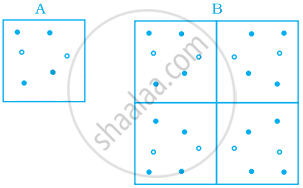
Pattern B consists of four tiles like pattern A. Write a proportion involving red dots and blue dots in pattern A and B. Are they in direct proportion? If yes, write the constant of proportion.
The students of Anju’s class sold posters to raise money. Anju wanted to create a ratio for finding the amount of money her class would make for different numbers of posters sold. She knew they could raise Rs 250 for every 60 posters sold.
- How much money would Anju’s class make for selling 102 posters?
- Could Anju’s class raise exactly Rs 2,000? If so, how many posters would they need to sell? If not, why?
