Advertisements
Advertisements
प्रश्न
A 150 W lamp emits light of the mean wavelength of 5500 Å. If the efficiency is 12%, find out the number of photons emitted by the lamp in one second.
Advertisements
उत्तर
P = 150 W
λ = 5500 × 10−10 m
Efficiency = 12%
N = `("P"λ)/"hc"`
= `(150 xx 5500 xx 10^-10)/(6.626 xx 10^-34 xx 3 xx 10^8)`
= `(825 xx 10^-7)/(19.878 xx 10^-26)`
= 41.5 × 10¹⁹
Number of photons emitted is with 12% efficiency = `41.5 xx 10^19 xx 12/100`
N = 4.98 × 10¹⁹
APPEARS IN
संबंधित प्रश्न
Find the (a) maximum frequency and (b) minimum wavelength of X-rays produced by 30 kV electrons.
The work function of the following metals is given : Na 2.75 ev, K = 2.3 eV, Mo = 4.17 eV and Ni = 5.15 eV. Which of these metals will not cause photoelectric emission for radiation of wavelength 3300 Å from a laser source placed 1 m away from these metals? What happens if the laser source is brought nearer and placed 50 cm away?
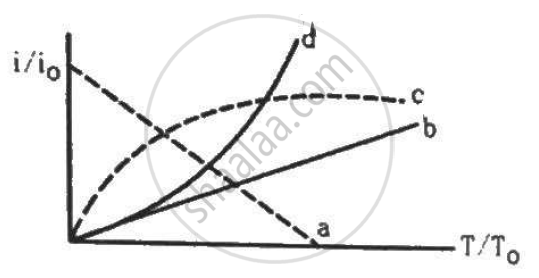
Let i0 be the thermionic current from a metal surface when the absolute temperature of the surface is T0. The temperature is slowly increased and the thermionic current is measured as a function of temperature. Which of the following plots may represent the variation in (i/i0) against (T/T0)?
The constant A in the Richardson−Dushman equation for tungsten is 60 × 104 A m−2K−2. The work function of tungsten is 4.5 eV. A tungsten cathode with a surface area 2.0 × 10⁻⁵ m2 is heated by a 24 W electric heater. In steady state, the heat radiated by the heater and the cathode equals the energy input by the heater and the temperature becomes constant. Assuming that the cathode radiates like a blackbody, calculate the saturation current due to thermions. Take Stefan's Constant = 6 × 10⁻⁸ W m−2 K−1. Assume that the thermions take only a small fraction of the heat supplied.
The wave associated with a moving particle of mass 3 × 10⁻⁶ g has the same wavelength as an electron moving with a velocity 6 × 10⁶ ms–1. The velocity of the particle is
Why do metals have a large number of free electrons?
In which case is electron emission from a metal not known?
What prevents electrons from escaping a metal surface under ordinary conditions?
What must supplied energy enable a metal electron to overcome for electron emission to occur?
Which particles at the surface hold free electrons inside the metal?
