Advertisements
Advertisements
प्रश्न
4.0 g of helium occupies 22400 cm3 at STP. The specific heat capacity of helium at constant pressure is 5.0 cal K−1 mol−1. Calculate the speed of sound in helium at STP.
Advertisements
उत्तर
Given:
Specific heat capacity at constant pressure, Cp = 5.0 cal/mol-K
Cp = 5.0 × 4.2 J/mol-K
Cp = 21 J/mol-K
Volume of helium, V = 22400 cm3 = 0.0224 m3
At STP, P = 1 atm = 105 Pa
The speed of sound in gas,
`"v" = sqrt((gamma"p")/ρ) =sqrt((gamma "R" "T")/"M") = sqrt ( (gamma "P""V")/"M")`
`"C"_"p" = ("R"gamma)/(gamma -1)`
Or 21(γ − 1) = 8.3γ
⇒ 21γ − 8.3γ = 21
⇒ 12.7γ = 21
`therefore gamma = 21/12.7 = 1.653``"v" = sqrt ((1.653 xx 1.0 xx 10^5 xx 0.0224)/ (4 xx 10 ^-3))`
v = 960 m/s
APPEARS IN
संबंधित प्रश्न
The specific heat capacity of water is
Can we define specific heat capacity for an adiabatic process?
Does a solid also have two kinds of molar heat capacities Cp and Cv? If yes, is Cp > Cv? Or is Cp − Cv = R?
In a real gas, the internal energy depends on temperature and also on volume. The energy increases when the gas expands isothermally. Examining the derivation of Cp − Cv = R, find whether Cp − Cv will be more than R, less than R or equal to R for a real gas.
Can two states of an ideal gas be connected by an isothermal process as well as an adiabatic process?
Two samples A and B are initially kept in the same state. Sample A is expanded through an adiabatic process and the sample B through an isothermal process. The final volumes of the samples are the same. The final pressures in A and B are pA and pBrespectively.
Let ∆Wa and ∆Wb be the work done by the systems A and B, respectively, in the previous question.
Three identical adiabatic containers A, B and C contain helium, neon and oxygen, respectively, at equal pressure. The gases are pushed to half their original volumes.
(a) The final temperatures in the three containers will be the same.
(b) The final pressures in the three containers will be the same.
(c) The pressures of helium and neon will be the same but that of oxygen will be different.
(d) The temperatures of helium and neon will be the same but that of oxygen will be different.
An ideal gas expands from 100 cm3 to 200 cm3 at a constant pressure of 2.0 × 10⁵ Pa when 50 J of heat is supplied to it. Calculate (a) the change in internal energy of the gas (b) the number of moles in the gas if the initial temperature is 300 K (c) the molar heat capacity Cp at constant pressure and (d) the molar heat capacity Cv at constant volume.
In Joly's differential steam calorimeter, 3 g of an ideal gas is contained in a rigid closed sphere at 20°C. The sphere is heated by steam at 100°C and it is found that an extra 0.095 g of steam has condensed into water as the temperature of the gas becomes constant. Calculate the specific heat capacity of the gas in J g−1 K−1. The latent heat of vaporisation of water = 540 cal g−1
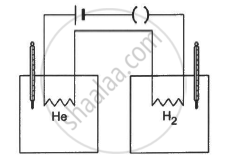
The figure shows two vessels with adiabatic walls, one containing 0.1 g of helium (γ = 1.67, M = 4 g mol−1) and the other containing some amount of hydrogen (γ = 1.4, M = 2 g mol−1). Initially, the temperatures of the two gases are equal. The gases are electrically heated for some time during which equal amounts of heat are given to the two gases. It is found that the temperatures rise through the same amount in the two vessels. Calculate the mass of hydrogen.
The speed of sound in hydrogen at 0°C is 1280 m s−1. The density of hydrogen at STP is 0.089 kg m−3. Calculate the molar heat capacities Cp and Cv of hydrogen.
Molar specific heat of water is C = 74.7 J/mol K, its value in cal/g K is ______.
An engine takes in 5 moles of air at 20°C and 1 atm, and compresses it adiabatically to `1/10^"th"` of the original volume. Assuming air to be a diatomic ideal gas made up of rigid molecules, the change in its internal energy during this process comes out to be X kJ. The value of X to the nearest integer is ______.
A diatomic molecule can be modelled as two rigid balls connected with spring such that the balls can vibrate with respect to centre of mass of the system (spring + balls). Consider a diatomic gas made of such diatomic molecule. If the gas performs 20 Joule of work under isobaric condition, then heat given to the gas is ______ J.
If at same temperature and pressure, the densities for two diatomic gases are respectively d1 and d2 then the ratio of velocities of sound in these gases will be ______.
