Topics
Nutrition in Plants
The Ever-Evolving World of Science
Nutrition in Animals
- Different Ways of Taking Food
- Human Digestive System
- The Mouth and Buccal Cavity
- The Teeth and Its Structure
- The Salivary Glands
- The Food Pipe/Oesophagus
- The Stomach
- The Small Intestine
- Absorption of Food
- The Large Intestine
- Assimilation of Food
- Human Digestive System
- Digestion in Grass-eating Animal
- Feeding and Digestion in Amoeba
Exploring Substances: Acidic, Basic, and Neutral
Fibre to Fabric
- Fibre
- Fabrics
- Animal Fibres: Wool
- Animal Fibre: Silk
- Fibre to Yarn to Fabric
Electricity: Circuits and their Components
Heat
- Heat
- Heat Exchange
- The Temperature and a Thermometer
- Thermometer and Its Types
- Measuring Temperature
- Transfer of Heat
- Conduction
- Convection
- Radiation
- Kinds of Clothes Wear in Summer and Winter
The World of Metals and Non-metals
Acids, Bases and Salts
- Acids
- Bases
- Indicators
- Types of Double Displacement: Neutralization Reaction
- Neutralization Reactions in Our Daily Life
- Similarities and Differences Between Acids and Bases
Physical and Chemical Changes
- Classification of Change: Physical Changes
- Experiment of Chemical Change
- Corrosion of Metals
- Crystallisation Method
Changes Around Us: Physical and Chemical
Adolescence: A Stage of Growth and Change
Respiration in Organisms
- Breathing in Other Animals
- Breathing Under Water
- Respiration in Plant
Heat Transfer in Nature
Transportation in Animals and Plants
- Blood
- Heart Beat
- Blood Circulatory System
- Circulation of Blood in the Heart (Functioning of Heart)
- Excretion
- Human Excretory System
- Transport System in Plants
- Complex Permanent Tissues
- Complex Permanent Tissue: Phloem Structure and Function (Conducting Tissue)
- Complex Permanent Tissue: Xylem Structure and Function (Conducting Tissue)
Weather, Climate and Adaptations of Animals to Climate
- Weather and Climate
- Climate
- Climate and Adaptation
- Adaptation in Animals
- Adaptation in animals of snowy regions
- Adaptations in Tropical Rainforests
Wind Storms and Cyclones
- Atmospheric Pressure
- High Speed Winds Are Accompanied by Reduced Air Pressure
- Air Expands on Heating
- Wind Currents Are Generated Due to Uneven Heating on the Earth
- Thunderstorms
- Cyclones
- Thunderstorm and Cyclone: Destruction Causes, Safety Measures and Role of Advanced Technology
Measurement of Time and Motion
Reproduction in Plants
- Sexual Reproduction in Plants
- Fruit
- Dispersal of Seeds
Life Processes in Animals
Soil
- Properties of Soil
- Soil Profile
- Types of Soil
- Moisture in Soil
- Water Retention in Soil
- Soil and Crops
Motion and Time
- Speed
- Types of Speed
- Measurement of Time
- Devices for Measuring Time
- Simple Pendulum
- A Time Period of Oscillation and Frequency
- Measuring Speed
- Displacement - Time Graph Or Distance - Time Graph
Electric Current and Its Effects
Life Processes in Plants
Light: Shadows and Reflections
Light
- The propagation of light
- Reflection of Light
- Mirrors
- Plane Mirror
- Lateral Inversion
- Divergence and Convergence of Light
- Spherical Mirrors
- Formation of Image by Reflection: Real and Virtual Image
- Spherical Mirror > Concave Mirror
- Spherical Mirror > Convex Mirror
- Concept of Lenses
- Images Formed by Sperical Lenses
- Colour
- Prism
- Dispersion of Light Through a Prism
Forests: Our Lifeline
- Forests: Our Lifeline
- Forest Biome
- Classification of Plants
- The Oxygen Cycle
- Water Cycle
- Importance of Forests
Earth, Moon, and the Sun
Wastewater Story
- Water: Our Lifeline
- Sewage Management
- Purification of Water
- Wastewater Treatment Plant (WWTP)
- Better Housekeeping Practices
- Controlling the Wastage of Water
- Sanitation and Disease
Water: A Precious Resource
- Water: Our Lifeline
- Availability of Water
- Water Cycle
- Sources of Water
- Scarcity of Water
- Distribution of Water in India
- Water Management (Conservation of Water)
- Fresh Water Management
- Controlling the Wastage of Water
- Scarcity of Water
- Introduction
- Classification Based on Size and Shape
- Classification Based on Support (Vines)
- Classification Based on Lifespan
- Classification Based on Habitat (Where Plants Grow)
Maharashtra State Board: Class 6
Introduction:
Plants exist in a variety of shapes and sizes, and they can be grouped based on factors such as their height, size, lifespan, or the habitat in which they grow.
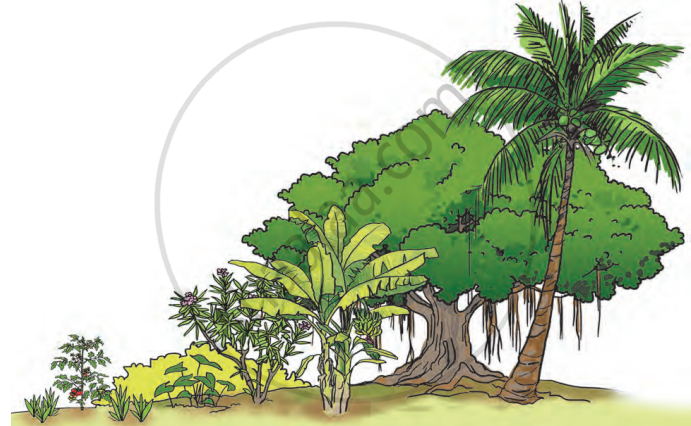
Diversity in plants
Maharashtra State Board: Class 6
Classification Based on Size and Shape:
Plants are classified into three main types: trees, shrubs, and herbs, based on their height and the thickness of their stems.
- Trees: Trees are tall and big and live for many years (they are perennial). They have a strong, hard stem called a trunk and branches growing high above the ground. For years, trees like mango, neem, and banyan have been bearing flowers and fruits.
- Shrubs: Shrubs are smaller than trees and grow close to the ground. They have a thick, hard stem but are shorter, usually growing up to 2 to 3 meters. Examples include oleander, hibiscus, rose, and lantana.
- Herbs: Herbs are small plants that grow up to 1 to 1.5 meters tall. Their stems are green, soft, and flexible. Herbs live for a shorter time, usually a few months to two years. Examples of herbs include mint, basil, and spinach.
Maharashtra State Board: Class 6
Classification Based on Support (Vines):
Some plants need support to grow or spread across the ground. These plants are called vines.
- Climbers: Climbers, like the money plant, grow by climbing on support using aerial roots or tendrils (spring-like structures that help them hold onto support). They have soft, flexible stems and need something to climb on, like a wall or a trellis.
- Creepers: Creepers, like pumpkins and watermelons, have soft, green stems that spread on the ground instead of growing upward.
Maharashtra State Board: Class 6
Classification Based on Lifespan:
Plants can also be classified based on how long they live. There are three main categories:
- Annuals: These plants complete their life cycle in one year. They grow, flower, produce seeds, and die within one year. Examples include jowar, sunflower, and wheat.
- Biennials: Biennials have a two-year life cycle. In the first year, they grow leaves and roots; in the second year, they flower and produce seeds. Examples include carrots and beetroot.
- Perennials: Perennials live for several years and produce flowers and fruit year after year. Examples include mango, hibiscus, and gulmohur.
Flowering and Non-Flowering Plants:
- Flowering Plants: These are plants that produce flowers. Most of the plants we see around us, like trees, shrubs, and herbs, are flowering plants.
- Non-Flowering Plants: Some plants do not produce flowers and may not have typical organs like roots, stems, or leaves. Examples include ferns and mosses.
Maharashtra State Board: Class 6
Classification Based on Habitat (Where Plants Grow):
Plants can also be classified based on the type of environment they grow in. This is called their habitat.
- Land Plants: These plants grow on land, like trees, shrubs, and herbs.
- Water Plants: Aquatic plants grow in water, like water lilies and lotus.
- Marshy Area Plants: Plants that grow in swampy, waterlogged areas are called marsh plants, like mangroves.
- Desert Plants: Cacti and other plants that grow in dry, desert areas are called desert plants.
- Plants Growing on Big Trees: Some plants, called epiphytes, grow on big trees without harming them. Examples include some types of orchids.
