Viraf J. Dalal solutions for सिम्प्लिफाइड केमिस्ट्री [अंग्रेजी] कक्षा १० आईसीएसई chapter 2 - Chemical Bonding [Latest edition]
Online Mock Tests
Chapters
1: Periodic Table – Periodic Properties and Variations of Properties
▶ 2: Chemical Bonding
Chapter 3. A: Acids, Bases and Salts
Chapter 3. B: Analytical Chemistry Use of Ammonium and Sodium Hydroxide
Mole Concept & Stoichiometry
Chapter 4. A: Gay Lussac’s Law-Avogadro’s Law-Mole concept
Chapter 4. B: Percentage Composition – Empirical and Molecular formula Calculations Based on Chemical Equations
Chapter 5: Electrolysis
Chapter 6: Metallurgy
Study of Compounds
Chapter 7. A: Hydrogen Chloride
Chapter 7. B: Ammonia
Chapter 7. C: Nitric Acid
Chapter 7. D: Sulphuric Acid
Chapter 8: Organic Chemistry
Chapter 9: Practical Chemistry
Chapter 10: Additional Charts
Advertisements
Advertisements
Solutions for Chapter 2: Chemical Bonding
Below listed, you can find solutions for Chapter 2 of CISCE Viraf J. Dalal for सिम्प्लिफाइड केमिस्ट्री [अंग्रेजी] कक्षा १० आईसीएसई.
Advertisements
Viraf J. Dalal solutions for सिम्प्लिफाइड केमिस्ट्री [अंग्रेजी] कक्षा १० आईसीएसई 2 Chemical Bonding 1. PREVIOUS QUESTIONS [Page 36]
Give the appropriate term defined by the statement given below:
The covalent bond in which the electrons are shared equally between the combining atoms.
Draw the electron dot diagram and structure of nitrogen molecule.
A compound with low boiling point is:
NaCl
CaCl2
KCl
CCl4
Give one word or a phrase for the following statement:
The chemical bond formed by a shared pair of electrons, each bonding atom contributing one electron to the pair.
The polar covalent compound in gaseous state does not conduct electricity is ______.
carbon tetrachloride
ammonia
methane
Draw the electron dot diagram for the compound given below. Represent the electrons by (.) and (x) in the diagram.
[Atomic No.: Ca = 20, O = 8]
Calcium oxide
Draw the electron dot diagram for the compound given below. Represent the electrons by (.) and (x) in the diagram.
[Atomic No.: Cl = 17]
Chlorine molecule
Draw the electron dot diagram for the compound given below. Represent the electrons by (.) and (x) in the diagram.
[Atomic No.: O = 8, H = 11]
Water molecule
Which of the following compounds neither dissociate nor ionise in water?
Hydrochloric acid
Sodium hydroxide
Potassium nitrate
Carbon tetrachloride
Which of the following has two sets of lone pair of electrons in them?
Ammonia
Methane
Water
Ammonium ion
Which electron arrangement for the outer shell electrons in a covalent compound is correct?


The type of bonding present in hydrogen chloride is ______.
metallic
ionic
covalent
coordinate
State the oxidation reaction from-
\[\ce{Fe^{3+} + 3e- -> Fe}\]
\[\ce{Fe^{2+} - 1e- -> Fe^{3+}}\]
\[\ce{Cl2 + 2e- -> 2Cl^{1-}}\]
\[\ce{Cu^{2+} + 2e- -> Cu}\]
Match the Column A - i] Sodium chloride; ii] Hydrogen chloride gas; iii] Oxidation reaction; iv] Water with Column B - a] has two shared pair of electrons; b] has high melting & boiling points; c] has low melting & boiling points; d] \[\ce{Zn - 2e- -> Zn^{2+}}\] e] \[\ce{S + 2e- -> S^{2-}}\]
Fill in the blanks -
Non-polar covalent compounds are ______ conductors of heat and electricity.
Good
Bad
Draw the electron dot structure for the following:
Ammonium ion
[At. no.: N = 7, H = 1]
Draw the electron dot structure of :
Nitrogen molecule [N = 7]
Give reason for the following:
Ionic compounds do not conduct electricity in solid state.
In the molecule of water, oxygen atom has ______ of electrons.
One shared pair
Three shared pairs
Two lone pairs
One lone pair
Draw the electron dot structure of Methane molecule.
[Atomic number: N = 7, C = 6, H = 1]
Draw the electron dot structure of nitrogen molecule.
[Atomic number: N = 7, C = 6, H = 1]
Give reason for the following:
Covalent compounds have a low melting and boiling point.
Carbon tetrachloride is a ______ covalent molecule.
Polar
Non-polar
The diagram given below shows the bonding in the covalent molecule AB.
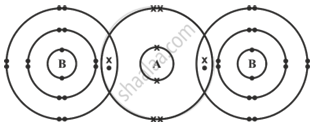
Which option represents the correct electronic configuration of atoms A and B before combining together to form the above molecule?
A - 2, 4, B - 2, 8, 6
A - 2, 4, B - 2, 8, 7
A - 2, 8, B - 2, 8, 8
A - 2, 6, B - 2, 8, 7
Given below are four ions:
Cl−, Li+, Al3+, K+
Identify the pair of ions which have the same electronic configuration.
[Atomic number: Cl = 17, Li = 3, Al = 13, K = 19]
Cl− & Li+
Al3+ & Ki+
Cl− & K+
Li+ & K+
State the term for the following:
The type of covalent bond in which electrons are shared unequally between the combining atoms.
Draw the dot and cross structure of the following:
An ionic compound formed when Mg reacts with the dilute HCl.
[Atomic number: Mg = 12, Cl = 17, H = 1, N = 7]
Draw the dot and cross structure of the following:
A covalent compound formed when H2 reacts with Cl2.
[Atomic number: Mg = 12, Cl = 17, H = 1, N = 7]
Draw the dot and cross structure of the following:
The positive ion produced when ammonia gas is dissolved in water.
[Atomic number: Mg = 12, Cl = 17, H = 1, N = 7]
Define a coordinate bond.
Viraf J. Dalal solutions for सिम्प्लिफाइड केमिस्ट्री [अंग्रेजी] कक्षा १० आईसीएसई 2 Chemical Bonding 2. MULTIPLE CHOICE QUESTIONS [MCQ]- Select the correct answer [Page 36]
Assertion (A): Ionic compounds are hard solids, at room temperature.
Reason (R): The charged particles in them are closely packed, with strong force of attraction.
Both A & R are true – and R is the correct explanation of A.
Both A & R are true – but R is not the correct explanation of A.
A is true – but R is false.
A is false – but R is true.
The compound which does not contain - one single, a double or a triple - covalent bond in its molecule.
Nitrogen
Chlorine
Methane
Oxygen
A compound containing an electrovalent, covalent & a coordinate bond.
\[ \mathrm{C} \!\overset{\leftarrow}{=}\! \mathrm{O} \]
\[ \begin{array}{c c c c c c c} \mathrm{H} & \!-\! & \mathrm{O} & \!-\! & \mathrm{N} & \!=\! & \mathrm{O} \\[-2pt] & & & & \big\downarrow & & \\[-2pt] & & & & \mathrm{O} & & \end{array} \]
\[ \mathrm{Na^{+}}\ [\mathrm{O}\!-\!\mathrm{H}] \]
\[ \left[ \begin{array}{c c c c c} & & \mathrm{H} & & \\[-2pt] & & \big| & & \\[-2pt] \mathrm{H} & \!-\! & \mathrm{N} & \!\rightarrow\! & \mathrm{H} \\[-2pt] & & \big| & & \\[-2pt] & & \mathrm{H} & & \end{array} \right]^{+} \ \mathrm{Cl^{-}} \]
The ion containing - one lone pair of electrons.
\[\ce{OH^1-}\]
\[\ce{H3O^1+}\]
\[\ce{NH4^1+}\]
\[\ce{H^1+}\]
The property which is true - for covalent hydrogen chloride gas.
Good conductor of heat.
Constituent units in compounds - ions.
Soluble in water & solution conducts electricity.
Undergoes electrolytic dissociation.
Viraf J. Dalal solutions for सिम्प्लिफाइड केमिस्ट्री [अंग्रेजी] कक्षा १० आईसीएसई 2 Chemical Bonding 3. ADDITIONAL & HIGH ORDER THINKING QUESTIONS [Page 37]
Differentiate between the following - with appropriate illustrations.
Chemical bond & chemical bonding.
Differentiate between the following - with appropriate illustrations.
Stable & unstable electronic configuration.
Differentiate between the following - with appropriate illustrations.
Duplet rule & octet rule.
Differentiate between the following - with appropriate illustrations.
Electron transfer & electron sharing.
Give reasons for the following:
Noble gases - are unreactive, while atoms of elements other than noble gases, are chemically reactive.
Give reasons for the following:
Chemical bonding between atoms - results in formation of a molecule.
Formation of electrovalent compounds - involves transfer of valence electrons generally from - metallic to non-metallic atom. Answer the following, based on the information given - giving reasons.
\[\ce{A - 2e- -> A^2+}\]; \[\ce{B + 2e- -> B^2-}\]; \[\ce{A^2+ B^2- -> AB}\]
- State which of the following -
- A or B - is a metal
- A2+ or B2− - is an anion.
- Oppositely charged ions - cations & anions - attract one another to form an electrovalent bond leading to formation of an electrovalent compound. Define the terms - in italics.
- Give reasons for the following -
- Na [at.no. 11] has an electropositive valency of +1 & Cl [at. no. 17] an electronegative valency of −1.
- Atoms are electrically neutral particles, while ions are charged particles & exist independently in solution.
State whether the following reaction is oxidation or reduction:
\[\ce{Cu -> Cu^{2+} + 2e-}\]
State whether the following conversion is oxidation or reduction:
Cu2+ + 2 e-→ Cu
State whether the following reaction is oxidation or reduction:
\[\ce{Sn^{4+} + 2e- -> Sn^{2+}}\]
State whether the following reaction is oxidation or reduction:
\[\ce{2Cl- -> Cl2 + 2e-}\]
State whether the following reaction is oxidation or reduction:
\[\ce{Fe^{2+} -> Fe^{3+} + 1e-}\]
State whether the following reaction is oxidation or reduction:
\[\ce{X + 2e- -> X^{2-}}\]
State whether the following reaction is oxidation or reduction:
\[\ce{Y - 1e- -> Y^{1+}}\]
State whether the following reaction is oxidation or reduction:
\[\ce{Z^{3+} + 1e- -> Z^{2+}}\]
State whether the following reaction is oxidation or reduction:
\[\ce{Zn -> Zn^{2+}}\]
State whether the following reaction is oxidation or reduction:
\[\ce{S -> S^{2-}}\]
State whether the following reaction is oxidation or reduction:
\[\ce{Sn^{2+} -> Sn}\]
Sodium chloride [NaCl] - an electrovalent compounds is formed as a result of - transfer of ______ [one, two, three] valence electrons from metallic sodium to non-metallic chlorine atom.
Calcium oxide [CaO] - is similarly formed as a result of - transfer of ______ [one, two, three] valence electron/s from metallic calcium to non-metallic oxygen.
Magnesium chloride [MgCl2] - is also formed by transfer of - ______ [one, two, three] valence electron/s from ______ [one, two] magnesium atom/s to ______ [one, two] chlorine atom/s.
Formation of covalent compounds - involve sharing of electron pairs between - non-metallic atoms.
Match Column A with Column B.
| Column A - Non-metallic atoms sharing | Column B - | ||
| i] | 5 Valence electrons | 1. | Share 2 pair of electrons - between the atoms |
| ii] | 7 Valence electrons | 2. | Form a covalent compound - with triple covalent bond |
| iii] | 6 Valence electrons | 3. | Share 1 pair of electrons - between the atoms |
Define:
Covalent bond
Define a covalent compound.
Formation of covalent compounds - involve sharing of electron pairs between - non-metallic atoms.
Define the following term:
Covalency
Formation of covalent compounds - involve sharing of electron pairs between - non-metallic atoms.
Define the following term:
Shared pair of electrons
Formation of covalent compounds - involve sharing of electron pairs between - non-metallic atoms.
Choose the polar covalent compounds from - H2, H2O, Cl, CCl4, N2, NH3, O2, CH4, HCl.
Formation of covalent compounds - involve sharing of electron pairs between - non-metallic atoms.
Differentiate polar covalent compounds from non-polar covalent compounds with reference to distribution of shared pair of electrons between atoms.
Formation of covalent compounds - involve sharing of electron pairs between - non-metallic atoms.
Differentiate polar covalent compounds from non-polar covalent compounds with reference to charge separation between atoms.
Draw electron dot structure and line structure for a given molecule.
Hydrogen
Draw the electron dot diagram - for the formation of the following covalent compound.
Chlorine
[at. nos. H = 1, C = 6, N = 7, O = 8, Cl = 17].
Draw electron dot structure and line structure for a given molecule.
Oxygen
Draw the electron dot structure of nitrogen molecule.
[Atomic number: N = 7, C = 6, H = 1]
Draw the electron-dot structure of water (H2O).
Draw the electron dot structure of Methane molecule.
[Atomic number: N = 7, C = 6, H = 1]
Draw the electron dot diagram - for the formation of the following covalent compound.
Carbon tetrachloride
[at. nos. H = 1, C = 6, N = 7, O = 8, Cl = 17].
Draw the electron dot diagram - for the formation of the following covalent compound.
Ammonia
[at. nos. H = 1, C = 6, N = 7, O = 8, Cl = 17].
Draw the electron dot diagram - for the formation of the following covalent compound.
Carbon dioxide
[at. nos. H = 1, C = 6, N = 7, O = 8, Cl = 17].
Give reasons - for the following:
Molecules of hydrogen have single covalent bond between their atoms.
Give reasons - for the following:
Molecules of chlorine - have single covalent bond between their atoms.
Give reasons - for the following:
Molecules of oxygen has a double covalent bond between their atoms.
Give reasons - for the following:
Molecules of nitrogen a triple covalent bond between their atoms.
What is a lone pair of electrons?
Explain in brief with one example of coordinate bond.
Explain diagrammatically - the lone pair effect of:
The nitrogen atom of the ammonia molecule - leading to the formation of - ammonium ion [NH4]+.
Explain diagrammatically - the lone pair effect of:
The oxygen atom of the H2O molecule - leading to formation of - hydronium [H3O]+ & hydroxyl ions [OH]−.
Give specific reasons - for the following point:
Electrovalent compounds - are soluble in water, insoluble in organic solvents.
Give specific reasons - for the following points:
Electrovalent compounds - are good conductors of electricity in molten or aq. soln. state.
Give specific reasons - for the following point:
Electrovalent compounds have high melting points.
Give specific reasons - for the following points:
Electrovalent compounds undergo electrolytic dissociation on passage of electric current.
Give specific reasons - for the following point:
Covalent compounds - are soluble in organic solvents, insoluble in water.
Give specific reasons - for the following point:
Covalent compounds - are non-conductors of electricity.
Give specific reasons - for the following point:
Covalent compounds - have low melting points.
Give specific reasons - for the following point:
Covalent compounds undergo ionisation on passage of electric current.
Viraf J. Dalal solutions for सिम्प्लिफाइड केमिस्ट्री [अंग्रेजी] कक्षा १० आईसीएसई 2 Chemical Bonding 4. TEST - HIGH ORDER & CRITICAL THINKING QUESTIONS [Page 38]
Give reasons for the following:
NH3 gas a covalent compound does not conduct electricity but its aq. soln. NH4OH is a weak electrolyte.
Give reasons for the following:
MgCl2 is soluble in water but insoluble in acetone.
Give reasons for the following:
Methane is insoluble in water, but soluble in acetone.
Give reasons for the following:
Iron displaces copper from a solution of a copper salt. The reaction is deemed as a redox reaction.
Give reasons for the following:
A non-metallic atom [at. no. 9] forms a molecule of the same, containing a single covalent bond.
Give reasons for the following:
In the formation of MgO the magnesium atom [at. no. 12] loses two electrons from its valence shell.
With reference to a molecule of water, fill in the blanks with the correct word. [at. no. of H = 1, O = 8]
Water is a ______ [non-polar/polar] covalent molecule in which the atom of ______ [hydrogen/oxygen] attracts electrons more strongly towards itself. The water molecule shows the presence of ______ [double/one single/two single] covalent bond/s and ______ [one/two] lone pair of electrons present in the ______ [hydrogen/oxygen] atom.
Complete the table given below:
| Element | Element | Type of bond likely in molecule of | Formula of compound |
| A: At. no. = 20 | B: At. no. = 8 | A and B | |
| A: At. no. = 20 | C: At. no. = 17 | A and C | |
| D: At. no. = 9 | D: At. no. = 9 | D and D | |
| E: At. no. = 12 | F: At. no. = 16 | E and F | |
| G: At. no. = 1 | F: At. no. = 16 | G and F |
Fill in the blanks with the correct word from the brackets:
The bond between two elements in group 17[VIIA] of the periodic table is likely to be ______. [ionic/covalent]
In the reaction of \[\ce{Cl2 + 2KI -> 2KCl + I2}\] the conversion of 2I to I2 is deemed as ______. [oxidation/reduction]
The covalent molecule containing three single covalent bonds is ______ [water/methane/ammonia].
The molecule of water combines with a ______ [hydrogen atom/proton/hydrogen molecule] to form a hydronium ion.
For formation of an electrovalent bond between elements ‘X’ and ‘Y’ which are a metal and nonmetal respectively, X should have a ______ [high/low] ionization potential and ‘Y’ a ______ [high/low] electron affinity.
Electronic configuration of the following elements are given:
- Sodium - Na = 2,8,1
- Hydrogen - H = 1
- Carbon - C = 2,4
- Chlorine - Cl = 2,8,7
- Lithium - Li = 2,1
State which of the compounds given below:
- have high/low boiling points,
- are soluble/insoluble in organic solvents.
- Hydrogen chloride.
- Sodium chloride.
- Sodium hydride.
- Lithium chloride.
- Carbon tetrachloride.
A compound has a formula = “H2Y”. Y denotes a non-metal. State the following:
- The electronic configuration of Y.
- The valency of Y.
- The bonding present in “H2Y”.
- The bonding present in the compound formed between potassium \[\ce{^{39}_{19}K}\] and ‘Y’.
- The formula of the compound formed between calcium \[\ce{^{40}_{20}Ca}\] and Y.
Solutions for 2: Chemical Bonding
Viraf J. Dalal solutions for सिम्प्लिफाइड केमिस्ट्री [अंग्रेजी] कक्षा १० आईसीएसई chapter 2 - Chemical Bonding
Shaalaa.com has the CISCE Mathematics सिम्प्लिफाइड केमिस्ट्री [अंग्रेजी] कक्षा १० आईसीएसई CISCE solutions in a manner that help students grasp basic concepts better and faster. The detailed, step-by-step solutions will help you understand the concepts better and clarify any confusion. Viraf J. Dalal solutions for Mathematics सिम्प्लिफाइड केमिस्ट्री [अंग्रेजी] कक्षा १० आईसीएसई CISCE 2 (Chemical Bonding) include all questions with answers and detailed explanations. This will clear students' doubts about questions and improve their application skills while preparing for board exams.
Further, we at Shaalaa.com provide such solutions so students can prepare for written exams. Viraf J. Dalal textbook solutions can be a core help for self-study and provide excellent self-help guidance for students.
Concepts covered in सिम्प्लिफाइड केमिस्ट्री [अंग्रेजी] कक्षा १० आईसीएसई chapter 2 Chemical Bonding are Non-Polar Covalent Compounds, Types of Covalent Bonds, Properties and Comparison of Electrovalent and Covalent Compounds, Coordinate Bond, The Covalent Bond, Ionic or Electrovalent Bond, Concept of Chemical Bonding, Effect of Electricity on Electrovalent and Covalent Compounds, Conditions for the Formation of an Electrovalent (or ionic) Bond, Structures of Some Electrovalent Compounds, The Element of the First three Periods of the Periodic Table, Covalent Vs Electrovalent Compounds, Covalent Molecules and their Structures, Polar Covalent Compounds, Polar Vs Non-polar Covalent Molecules, Formation and Structures of some Coordinate Molecules.
Using Viraf J. Dalal सिम्प्लिफाइड केमिस्ट्री [अंग्रेजी] कक्षा १० आईसीएसई solutions Chemical Bonding exercise by students is an easy way to prepare for the exams, as they involve solutions arranged chapter-wise and also page-wise. The questions involved in Viraf J. Dalal Solutions are essential questions that can be asked in the final exam. Maximum CISCE सिम्प्लिफाइड केमिस्ट्री [अंग्रेजी] कक्षा १० आईसीएसई students prefer Viraf J. Dalal Textbook Solutions to score more in exams.
Get the free view of Chapter 2, Chemical Bonding सिम्प्लिफाइड केमिस्ट्री [अंग्रेजी] कक्षा १० आईसीएसई additional questions for Mathematics सिम्प्लिफाइड केमिस्ट्री [अंग्रेजी] कक्षा १० आईसीएसई CISCE, and you can use Shaalaa.com to keep it handy for your exam preparation.
