Advertisements
Chapters
![Samacheer Kalvi solutions for Social Science - Term 2 [English] Class 6 TN Board chapter 1.2 - Great Thinkers and New Faiths - Shaalaa.com](/images/social-science-term-2-english-class-6-tn-board_6:5f2b1b2038084cf381bfa42c826a928c.jpg "Samacheer Kalvi solutions for Social Science - Term 2 [English] Class 6 TN Board chapter 1.2 - Great Thinkers and New Faiths")
Advertisements
Solutions for Chapter 1.2: Great Thinkers and New Faiths
Below listed, you can find solutions for Chapter 1.2 of Tamil Nadu Board of Secondary Education Samacheer Kalvi for Social Science - Term 2 [English] Class 6 TN Board.
Samacheer Kalvi solutions for Social Science - Term 2 [English] Class 6 TN Board 1.2 Great Thinkers and New Faiths Exercises [Pages 120 - 124]
Choose the correct answer
What is the name of the Buddhist scripture?
Angas
Tripitakas
Tirukkural
Naladiyar
Who was the first Tirthankara of Jainism?
Rishabha
Parsava
Vardhamana
Buddha
How many Tirthankaras were there in Jainism?
23
24
25
26
Where was the third Buddhist Council convened?
Rajagriha
Vaishali
Pataliputra
Kashmir
Where did Buddha deliver his first sermon?
Lumbini
Saranath
Taxila
Bodh Gaya
Match the Statement with the Reason choose the appropriate answer
Statement: A common man could not understand upanishads.
Reason: Upanishads were highly philosophical.
Statement and its Reason are correct
Statement is wrong
Statement is true, but the Reason for that is wrong
Both Statement and Reason are wrong
Statement: The Jatakas are popular tales.
Reason: Frescoes on the ceilings and walls of Ajanta caves depict the Jataka Tales.
Statement and its. Reason are correct
Statement is wrong
Statement is true, but the Reason for that is wrong
Both statement and Reason are wrong
Find out the correct answer
Buddha Viharas are used for
1. Education
2. stay of Buddhist monks
3. Pilgrims’ stay
4. Prayer hall
2 is correct
1 and 3 are correct
1, 2, 4 are correct
1 and 4 are correct
Consider the following statements regarding the causes of the origin of Jainism and Buddhism.
I. Sacrificial ceremonies were expensive.
II. Supertitious beliefs and practices confused the common man.
Which of the above statement (s) is/are correct?
Only I
Only II
Both I & II
Neither I nor II
Which of the following about Jainism is correct?
Jainism denies God as the creator of universe
Jainism accepts God as the creator of universe
The basic philosophy of Jainism is idol worship
Jains accept the belief in Last Judgement
Choose the odd one.
Parsava
Mahavira
Buddha
Rishaba
Find out the wrong pair.
Ahimsa - not to injure
Satya - to speak truth
Asteya - not to steal
Brahmacharya - married status
All the following statements are true of Siddhartha Gautama except.
He is the founder of Hinduism
He was born in Nepal
He attained Nirvana
He was known as Sakyamuni
Fill in the blanks
The doctrine of Mahavira is called ______.
_____________ is a state of freedom from suffering and rebirth.
_____________ was the founder of Buddhism.
Thiruparthikundram, a village in Kanchipuram was once called_________.
_____________ were built over the remains of Buddha’s body.
True or False
Buddha believed in Karma.
True
False
Buddha had faith in caste system.
True
False
Gautama Swami compiled the teachings of Mahavira.
True
False
Viharas are temples.
True
False
Emperor Ashoka followed Buddhism.
True
False
Match the following
| 1. Angas | Vardhamana |
| 2. Mahavira | monks |
| 3. Buddha | Buddhist shrine |
| 4. Chaitya | Sakya muni |
| 5. Bhikshus | Jain text |
Answer in one or two sentences
What are the Tri-ratnas (three jewels) of Jainism?
What are the two sects of Buddhism?
What does Jina mean?
Write any two common features of Buddhism and Jainism.
Write a note on Buddhist Sangha.
Name the Chinese traveler who visited Kancheepuram in seventh century AD(CE).
Name the female Jain monk mentioned in Silapathikaram.
Answer the following
Name the eight-fold path of Buddhism?
What are the five important rules of conduct in Jainism?
Narrate four noble truths of Buddha?
Write any three differences between Hinayana and Mahayana sects of Buddhism?
Jainism and Buddhism flourished in Sangam period. Give any two evidences for each.
HOTS
Karma – a person’s action. Name any 10 good actions (deeds).
Student Activity
Read any one story from Jatakas and write a similar story on your own.
Make a tabular column in the following headings.
| Religion | Name of the founder with picture | Name of their parents | Key Principle (anyone) | Sects | Symbol |
Place the following words in the appropriate column.
Words: Jina, Mahayana, Tirthankaras, Stupas Nirvana, Digambara, Tripitakas, Agama.
| Jainism | Buddhism |
Make informative cards for the following religions. Hinduism, Christianity, Islam, Buddhism, Jainism.
Make a Venn diagram to indicate similarities and dis-similarities of Jainism and Buddhism.

Solve the puzzle.
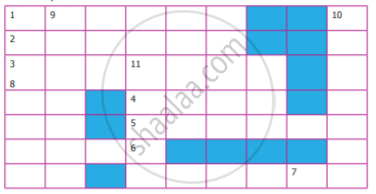
- Left to right
- One of the Tri Rathna: Right
- Buddha’s teachings are referred as
- A great center of education
- The place where Buddha attained enlightment
- Not to injure any living being
- Right to left
- Mother of Siddhartha
- The Quality of man’s life depends on his deed.
- Top to bottom
- Lumbini is in
- Buddhist prayer hall
- A state of freedom from birth
- Jain scripture compiled by Gautama Swami.
Life Skills
Create a story board for Jainism/Buddhism in a chart.

Answer Grid
The Jain monks who wear white clothes are called.
What is the meaning of Buddha?
Who is the 24th Tirthankara of Jainism?
Who delivered Dharmachakra Pravartana?
How many noble truths are there in Buddhism?
Which religion’s teachings include four noble truth and eight-fold path?
Name the earliest Buddhist literature which deals with the stories of various births of Buddha?
Name any four places where Jain monasteries were located in Tamil Nadu.
Name one of the twin Indian's Epics.
Solutions for 1.2: Great Thinkers and New Faiths
Samacheer Kalvi solutions for Social Science - Term 2 [English] Class 6 TN Board chapter 1.2 - Great Thinkers and New Faiths
Shaalaa.com has the Tamil Nadu Board of Secondary Education Mathematics Social Science - Term 2 [English] Class 6 TN Board Tamil Nadu Board of Secondary Education solutions in a manner that help students grasp basic concepts better and faster. The detailed, step-by-step solutions will help you understand the concepts better and clarify any confusion. Samacheer Kalvi solutions for Mathematics Social Science - Term 2 [English] Class 6 TN Board Tamil Nadu Board of Secondary Education 1.2 (Great Thinkers and New Faiths) include all questions with answers and detailed explanations. This will clear students' doubts about questions and improve their application skills while preparing for board exams.
Further, we at Shaalaa.com provide such solutions so students can prepare for written exams. Samacheer Kalvi textbook solutions can be a core help for self-study and provide excellent self-help guidance for students.
Concepts covered in Social Science - Term 2 [English] Class 6 TN Board chapter 1.2 Great Thinkers and New Faiths are Intellectual Awakening, Jainism, Influence of Jainism and Buddhism in Tamil Nadu, Buddhism, Jainism and Buddhism- Similarities and Dissimilarities, Jataka Story, Confucius (Kung Fu Tse) and Zoroaster.
Using Samacheer Kalvi Social Science - Term 2 [English] Class 6 TN Board solutions Great Thinkers and New Faiths exercise by students is an easy way to prepare for the exams, as they involve solutions arranged chapter-wise and also page-wise. The questions involved in Samacheer Kalvi Solutions are essential questions that can be asked in the final exam. Maximum Tamil Nadu Board of Secondary Education Social Science - Term 2 [English] Class 6 TN Board students prefer Samacheer Kalvi Textbook Solutions to score more in exams.
Get the free view of Chapter 1.2, Great Thinkers and New Faiths Social Science - Term 2 [English] Class 6 TN Board additional questions for Mathematics Social Science - Term 2 [English] Class 6 TN Board Tamil Nadu Board of Secondary Education, and you can use Shaalaa.com to keep it handy for your exam preparation.
