Advertisements
Chapters
1.2: Human Evolution
1.3: Indus Civilisation
1.4: Ancient Cities of Tamilagam
▶ 2.1: The Universe and Solar System
2.2: Land and Oceans
3.1: Understanding Diversity
3.2: Achieving Equality
![Samacheer Kalvi solutions for Social Science - Term 1 [English] Class 6 TN Board chapter 2.1 - The Universe and Solar System - Shaalaa.com](/images/social-science-term-1-english-class-6-tn-board_6:5f2b1b2038084cf381bfa42c826a928c.jpg "Samacheer Kalvi solutions for Social Science - Term 1 [English] Class 6 TN Board chapter 2.1 - The Universe and Solar System")
Advertisements
Solutions for Chapter 2.1: The Universe and Solar System
Below listed, you can find solutions for Chapter 2.1 of Tamil Nadu Board of Secondary Education Samacheer Kalvi for Social Science - Term 1 [English] Class 6 TN Board.
Samacheer Kalvi solutions for Social Science - Term 1 [English] Class 6 TN Board 2.1 The Universe and Solar System Exercise [Pages 171 - 174]
Fill in the blanks
The Universe was formed after ______ explosion.
____________ is the unit used to measure the distance between two celestial bodies.
______ is the centre of the solar system.
The word planet means ____________.
______ planet has many natural satellites.
India’s first-ever mission to the moon is ______.
Earth is inclined by ______ degrees.
The Equator faces the Sun directly on ______ and ______.
At the time of Perihelion, the Earth is ______ to the Sun.
The line which divides day and night on the Earth’s surface is ______.
Choose the best answer
The movement of the Earth on its axis is called.
Revolution
Seasons
Rotation
Circulation
The Tropic of Capricorn faces the Sun directly on.
March 21
June 21
September 23
December 22
The galaxy in which our solar system is found is.
Andromeda
Magellanic clouds
Milky Way
Starburst
The only celestial body where man has successfully landed.
Mars
Moon
Mercury
Venus
Which of the following planets can float on water?
Jupiter
Saturn
Uranus
Neptune
Choose the odd one out.
Venus
Jupiter
Neptune
Saturn
Choose the odd one out.
Sirius
Andromeda
Milky way
Magellanic clouds
Choose the odd one out.
Pluto
Eris
Ceres
Io
Choose the odd one out.
Comet
Asteroids
Meteorites
Dwarf planets
Choose the odd one out.
Rover
Orbiter
Aeroplane
Space shuttle
Match the following
| 1. | Hottest Planet | a. Mars |
| 2. | Ringed Planet | b. Neptune |
| 3. | Red Planet | c. Venus |
| 4. | Somersaulting Planet | d. Saturn |
| 5. | Coldest Planet | e. Uranus |
Consider the following statements
- Venus rotates from east to west.
- The Tropic of Cancer faces the Sun on June 21.
- Mars has rings around it.
Choose the correct answer using the codes given below.
1 and 2
2 and 3
1, 2 and 3
2 only
Which of the statement(s) is/are true?
Statement I: Earth is called a watery planet.
Statement II: The rotation of the Earth causes seasons.
I is true; II is wrong
I is wrong; II is true
Both the statements are true
Statements I and II are wrong
Name the following
Cluster of stars.
The nearest galaxy to the solar system.
The brightest planet.
The living sphere.
The year which has 366 days.
Answer in brief
Name the inner planets.
Pluto is no longer a planet. Reason out.
What is perihelion?
How many times in a year would you find the Sun overhead if you lived on 20°N Latitude?
Which celestial body shares its orbit with others?
Give an example on the celestial body shares its orbit with others?
Give reasons
Why is Uranus called the somersaulting planet?
The surface of the moon has many craters.
The velocity of the Earth’s rotation is zero at poles.
Answer in detail
Distinguish between inner and outer planets.
What are the effects of rotation and revolution?
Explain the characteristics of the various spheres of the Earth.
Picture Study
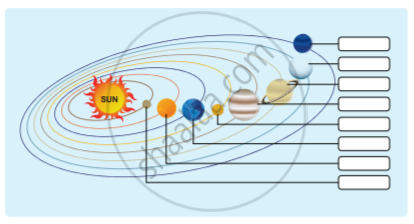
Study the picture and answer the given questions.
- Which is the closest planet to the Sun?
- Which is the largest planet?
- Which is the farthest planet from the Sun?
- Which is the second smallest planet?
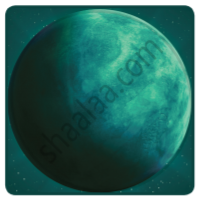
Look at the picture and answer the questions given below.
- Identify the planet.
- What is the colour of the planet?
- Why is it of this colour?
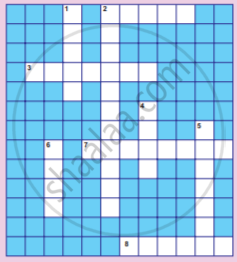
STUDENT ACTIVITY
Across
2. A dwarf planet
3. Equal days and nights
7. I am a gas found in the Sun
8. I appear once in 76 years.
Down
1. I am the morning star
2. India’s first moon mission.
4. I have two natural satellites.
5. I am the farthest planet.
6. An imaginary line passing through the centre of the Earth.
Solutions for 2.1: The Universe and Solar System
Samacheer Kalvi solutions for Social Science - Term 1 [English] Class 6 TN Board chapter 2.1 - The Universe and Solar System
Shaalaa.com has the Tamil Nadu Board of Secondary Education Mathematics Social Science - Term 1 [English] Class 6 TN Board Tamil Nadu Board of Secondary Education solutions in a manner that help students grasp basic concepts better and faster. The detailed, step-by-step solutions will help you understand the concepts better and clarify any confusion. Samacheer Kalvi solutions for Mathematics Social Science - Term 1 [English] Class 6 TN Board Tamil Nadu Board of Secondary Education 2.1 (The Universe and Solar System) include all questions with answers and detailed explanations. This will clear students' doubts about questions and improve their application skills while preparing for board exams.
Further, we at Shaalaa.com provide such solutions so students can prepare for written exams. Samacheer Kalvi textbook solutions can be a core help for self-study and provide excellent self-help guidance for students.
Concepts covered in Social Science - Term 1 [English] Class 6 TN Board chapter 2.1 The Universe and Solar System are Atmosphere and Its Layers, Galaxy and Its Types, Lithosphere, Hydrosphere, Biosphere: The Domain of Life, Other Heavenly Bodies of the Solar System, Other Heavenly Bodies of the Solar System, Planet, Our Solar System.
Using Samacheer Kalvi Social Science - Term 1 [English] Class 6 TN Board solutions The Universe and Solar System exercise by students is an easy way to prepare for the exams, as they involve solutions arranged chapter-wise and also page-wise. The questions involved in Samacheer Kalvi Solutions are essential questions that can be asked in the final exam. Maximum Tamil Nadu Board of Secondary Education Social Science - Term 1 [English] Class 6 TN Board students prefer Samacheer Kalvi Textbook Solutions to score more in exams.
Get the free view of Chapter 2.1, The Universe and Solar System Social Science - Term 1 [English] Class 6 TN Board additional questions for Mathematics Social Science - Term 1 [English] Class 6 TN Board Tamil Nadu Board of Secondary Education, and you can use Shaalaa.com to keep it handy for your exam preparation.
