Advertisements
Chapters
1.2: From Trade to Territory
1.3: Rural Life and Society
1.4: People’s Revolt
1.5: Educational Development in India
1.6: Development of Industries in India
1.7: Urban changes during the British period
1.8: Status of Women in India through the ages
2.1: Rocks and Soils
2.2: Weather and Climate
▶ 2.3: Hydrologic Cycle
2.4: Migration and Urbanisation
2.5: Hazards
2.6: Industries
2.7: Exploring Continents Africa, Australia and Antarctica
2.8: Map Reading
3.1: How the State Government Works
3.2: Citizens and Citizenship
3.3: Understanding Secularism
3.4: Human Rights and UNO
3.5: Road Safety Rules and Regulations
3.6: Defence & Foreign Policy
3.7: The Judiciary
4.1: Money, Savings and Investments
4.2: Public and Private Sectors
![Samacheer Kalvi solutions for Social Science [English] Class 8 TN Board chapter 2.3 - Hydrologic Cycle - Shaalaa.com](/images/social-science-english-class-8-tn-board_6:5f2b1b2038084cf381bfa42c826a928c.jpg "Samacheer Kalvi solutions for Social Science [English] Class 8 TN Board chapter 2.3 - Hydrologic Cycle")
Advertisements
Solutions for Chapter 2.3: Hydrologic Cycle
Below listed, you can find solutions for Chapter 2.3 of Tamil Nadu Board of Secondary Education Samacheer Kalvi for Social Science [English] Class 8 TN Board.
Samacheer Kalvi solutions for Social Science [English] Class 8 TN Board 2.3 Hydrologic Cycle Evaluation [Pages 110 - 111]
Choose the Correct answer
The process in which the water moves between the oceans, atmosphere, and land is called.
River Cycle
Hydrologic Cycle
Rock Cycle
Life Cycle
The percentage of fresh water on the earth is ______.
71
97
2.8
0.6
The process of changing of water from gaseous to liquid form is known as ______.
Condensation
Evaporation
Sublimation
Rainfall
Water that flows in the sub-soil or through the ground into the streams, rivers, lakes, and oceans is termed as.
Condensation
Evaporation
Transpiration
Runoff
The evaporation of water from the leaves of plants is called.
Transpiration
Condensation
Water vapour
Precipitation
Water that is good enough to drink is called.
Groundwater
Surface water
Potable water
Artesian water
Fill in the blanks
The degree of water vapour present in the atmosphere is known as__________.
There are _____________ phases in the water cycle.
The falling of water towards the earth surface from atmosphere in any form is known as ____________.
The precipitation with the rain drop size of < 0.5 mm in diameter is known as _______________.
Mist is denser than ______.
Match the following
| 1. | Vegetation | Clouds |
| 2. | Condensation | Sleet |
| 3. | Snow and raindrops | At the surface |
| 4. | Infiltration | Transpiration |
Choose the correct statement
Evaporation refers to
- The process in which the gaseous form of water changes into liquid form
- It refers to the process in which the liquid form of water changes into a gaseous form.
- Water boils at 100o C temperature but, it actually begins to evaporate at 0o C.
- It is responsible for the formation of clouds.
I and IV are correct
II only correct
II and III are correct
All are correct
State whether the following statements are True or False
Water boils at 212° F temperature but, it begins to evaporate at 32° F.
True
False
Mist is not the tiny droplets of water hanging in the air.
True
False
The sub-surface runoff is usually referred as interflow.
True
False
Answer briefly
Write a short note on aquifer.
Define “ hydrological cycle”.
How is the dew formation takes place?
Write a short note on surface run-off.
Give reasons
Infiltration of water is low in the region of non-porous soil.
Fresh water is less on the earth.
Snowfall is common in the polar region and mountainous regions.
Answer in a paragraph
Explain the different stages involved in the hydrological cycle.
Distinguish between evaporation and transpiration.
Give a detailed explanation on different forms of precipitation.
Explain the run-off.
Explain the types of run-off.
Activity
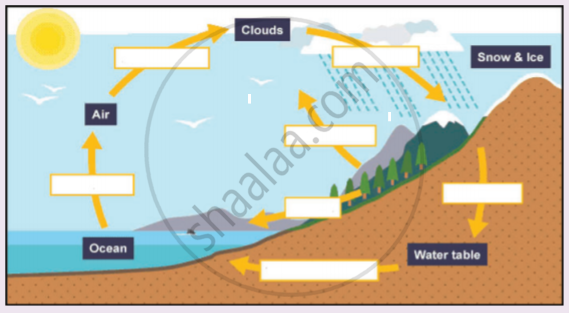
Find out the missing components of hydrologic cycle in the given diagram and fill it up appropriately.
Solutions for 2.3: Hydrologic Cycle
Samacheer Kalvi solutions for Social Science [English] Class 8 TN Board chapter 2.3 - Hydrologic Cycle
Shaalaa.com has the Tamil Nadu Board of Secondary Education Mathematics Social Science [English] Class 8 TN Board Tamil Nadu Board of Secondary Education solutions in a manner that help students grasp basic concepts better and faster. The detailed, step-by-step solutions will help you understand the concepts better and clarify any confusion. Samacheer Kalvi solutions for Mathematics Social Science [English] Class 8 TN Board Tamil Nadu Board of Secondary Education 2.3 (Hydrologic Cycle) include all questions with answers and detailed explanations. This will clear students' doubts about questions and improve their application skills while preparing for board exams.
Further, we at Shaalaa.com provide such solutions so students can prepare for written exams. Samacheer Kalvi textbook solutions can be a core help for self-study and provide excellent self-help guidance for students.
Concepts covered in Social Science [English] Class 8 TN Board chapter 2.3 Hydrologic Cycle are Hydrologic Cycle Or Water Cycle, Water on the Earth, Hydrologic Cycle Or Water Cycle, Components of Hydrologic Cycle.
Using Samacheer Kalvi Social Science [English] Class 8 TN Board solutions Hydrologic Cycle exercise by students is an easy way to prepare for the exams, as they involve solutions arranged chapter-wise and also page-wise. The questions involved in Samacheer Kalvi Solutions are essential questions that can be asked in the final exam. Maximum Tamil Nadu Board of Secondary Education Social Science [English] Class 8 TN Board students prefer Samacheer Kalvi Textbook Solutions to score more in exams.
Get the free view of Chapter 2.3, Hydrologic Cycle Social Science [English] Class 8 TN Board additional questions for Mathematics Social Science [English] Class 8 TN Board Tamil Nadu Board of Secondary Education, and you can use Shaalaa.com to keep it handy for your exam preparation.
