Advertisements
Online Mock Tests
Chapters
1: Power-sharing
▶ 2: Federalism
Unit II
3: Gender, Religion and Caste
Unit III
4: Political Parties
Unit IV
5: Outcomes of Democracy
![NCERT solutions for सोशल साइंस डेमोक्रेटिक पॉलिटिक्स २ [अंग्रेजी] कक्षा १० chapter 2 - Federalism - Shaalaa.com](/images/social-science-democratic-politics-2-english-class-10_6:a07500aaf6d7438ba0e0990bd779983e.jpg "NCERT solutions for सोशल साइंस डेमोक्रेटिक पॉलिटिक्स २ [अंग्रेजी] कक्षा १० chapter 2 - Federalism")
Advertisements
Solutions for Chapter 2: Federalism
Below listed, you can find solutions for Chapter 2 of CBSE NCERT for सोशल साइंस डेमोक्रेटिक पॉलिटिक्स २ [अंग्रेजी] कक्षा १०.
NCERT solutions for सोशल साइंस डेमोक्रेटिक पॉलिटिक्स २ [अंग्रेजी] कक्षा १० 2 Federalism Intext Questions [Pages 14 - 26]
What do we call the Indian government? Is it Union, Federal or Central?
Though only 25 of the world’s 193 countries have federal political systems, their citizens make up 40 per cent of the world’s population. Most of the large countries of the world are federations. Can you notice an exception to this rule in this map?
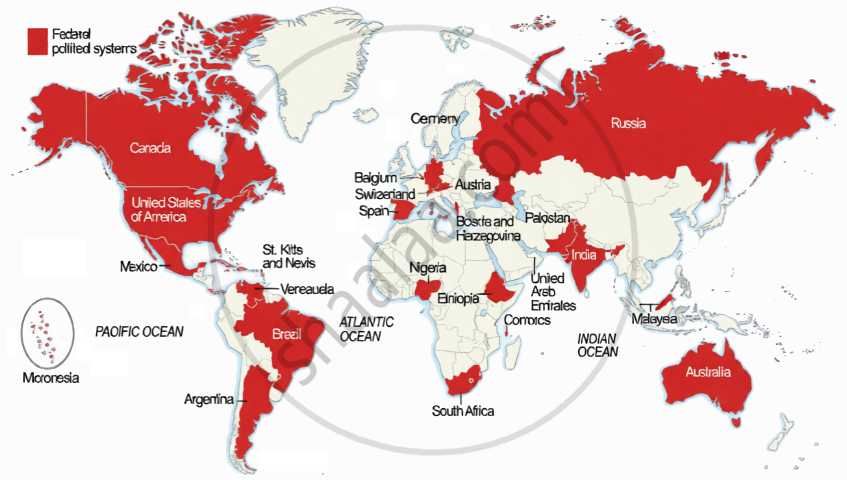
If federalism works only in big countries, why did Belgium adopt it?
Let us revise
Some Nepalese citizens were discussing the proposals on the adoption of federalism in their new constitution. This is what some of them said:
| Khag Raj: | I don’t like federalism. It would lead to reservation of seats for different caste groups as in India. |
| Sarita: | Ours in not a very big country. We don’t need federalism. |
| Babu Lal: | I am hopeful that the Terai areas will get more autonomy if they get their own state government. |
| Ram Ganesh: | I like federalism because it will mean that powers that were earlier enjoyed by the king will now be exercised by our elected representatives. |
- If you were participating in this conversation, what would be your response to each of these?
- Which of these reflect a wrong understanding of what federalism is?
- What makes India a federal country?
Isn’t that strange? Did our constitution makers not know about federalism? Or did they wish to avoid talking about it?
If agriculture and commerce are state subjects, why do we have ministers of agriculture and commerce in the Union cabinet?
Let us listen to radio
Listen to one national and one regional news bulletin broadcast by All India Radio daily for one week. Make a list of news items related to government policies or decisions by classifying these into the following categories:
- News items that relate only to the Central Government,
- News items that relate only to your or any other State Government,
- News items about the relationship between the Central and State Governments.
Let us revise
Pokharan, the place where India conducted its nuclear tests, lies in Rajasthan. Suppose the Government of Rajasthan was opposed to the Central Government’s nuclear policy, could it prevent the Government of India from conducting the nuclear tests?
Suppose the Government of Sikkim plans to introduce new textbooks in its schools. But the Union Government does not like the style and content of the new textbooks. In that case, does the state government need to take permission from the Union Government before these textbooks can be launched?
Suppose the Chief Ministers of Andhra Pradesh, Chhattisgarh and Orissa have different policies on how their state police should respond to the naxalites. Can the Prime Minister of India intervene and pass an order that all the Chief Ministers will have to obey?
Has your village/town/city remained under the same State since Independence? If not, what was the name of the earlier State?
Can you identify names of three States in 1947 that have been changed later?
Identify any three States which have been carved out of bigger States.
Use Hindi. Why Hindi? Why not Bangla or Telugu?
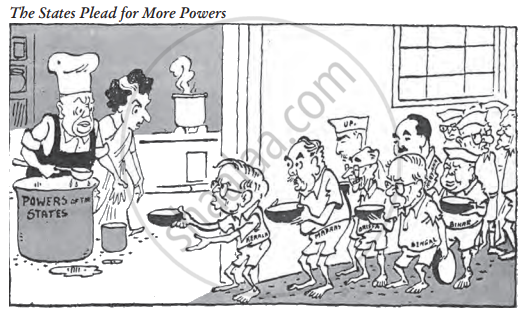
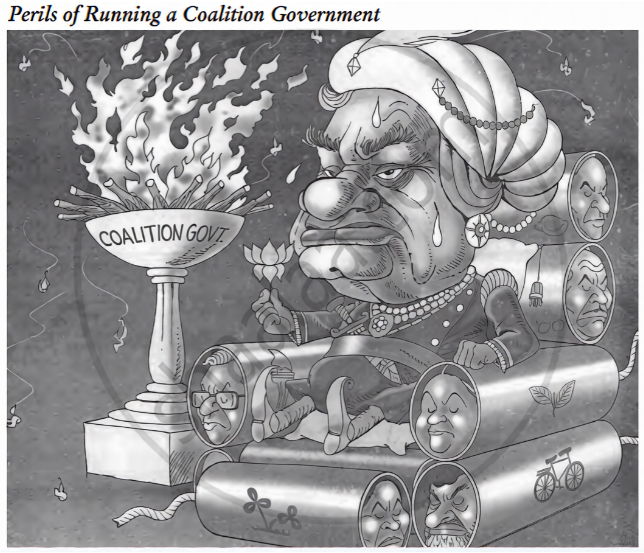
Here are two cartoons showing the relationship between Centre and States. Should the State go to the Centre with a begging bowl? How can the leader of a coalition keep the partners of government satisfied?
Are you suggesting that regionalism is good for our democracy? Are you serious?
Read this table carefully, but you need not memorise it. Just do the following:
| Scheduled Languages of India | |
| Language | Proportion of speakers (%) |
| Assamese | 1.26 |
| Bengali | 8.03 |
| Bodo | 0.12 |
| Dogri | 0.21 |
| Gujarati | 4.58 |
| Hindi | 43.63 |
| Kannada | 3.61 |
| Kashmiri | 0.56 |
| Konkani | 0.19 |
| Maithili | 1.12 |
| Malayalam | 2.88 |
| Manipuri | 0.15 |
| Marathi | 6.86 |
| Nepali | 0.24 |
| Odia | 3.10 |
| Punjabi | 2.74 |
| Sanskrit | N |
| Santali | 0.61 |
| Sindhi | 0.23 |
| Tamil | 5.70 |
| Telugu | 6.70 |
| Urdu | 4.19 |
- Make a bar or pie chart on the basis of this information.
- Prepare a map of linguistic diversity of India by shading the region where each of these languages is spoken on the map of India.
- Find out about any three languages that are spoken in India but are not included in this table.
Take the example of your own state or any other state that was affected by linguistic reorganisation. Write a short note for or against the argument given by the author here on the basis of that example.
Prime Minister runs the country. Chief Minister runs the state. Logically, then, the chairperson of Zilla Parishad should run the district. Why does the D.M. or Collector administer the district?
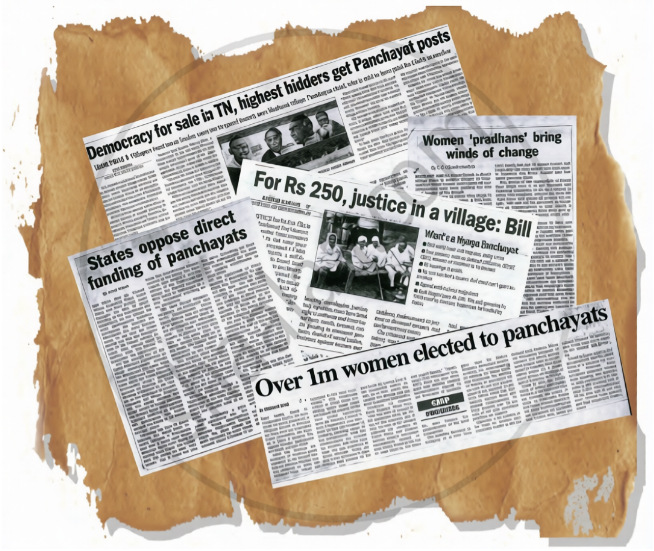
What do these newspaper clippings have to say about efforts of decentralisation in India?
Let's find out
Find out about the local government in the village or town you live in.
If you live in a village, find out the names of the following: your panch or ward member, your sarpanch, your panchayat samiti, the chairperson of your zilla parishad. Also find out when did the last meeting of the gram sabha take place and how many people took part in that.
If you live in urban areas, find out the name of your municipal councillor, and the municipal chairperson or mayor. Also find out about the budget of your municipal corporation, municipality and the major items on which money was spent.
NCERT solutions for सोशल साइंस डेमोक्रेटिक पॉलिटिक्स २ [अंग्रेजी] कक्षा १० 2 Federalism Exercises [Pages 27 - 28]
Locate the following States on a blank outline political map of India:
Manipur, Sikkim, Chhattisgarh and Goa
Identify and shade three federal countries (other than India) on a blank outline political map of the world.
Point out one feature in the practice of federalism in India that is similar to and one feature that is different from that of Belgium.
What is the main difference between a federal form of government and a unitary one? Explain with an example.
State any two differences between the local government before and after the constitutional amendment in 1992.
Fill in the blanks:
Since the United States is a ______ type of federation, all the constituent States have equal powers and States are ______ vis-à-vis the federal government. But India is a ______ type of federation and some States have more power than others. In India, the ______ government has more powers.
Here are three reactions to the language policy followed in India. Give an argument and an example to support any of these positions.
| Sangeeta: | The policy of accommodation has strengthened national unity. |
| Arman: | Language-based States have divided us by making everyone conscious of their language. |
| Harish: | This policy has only helped to consolidate the dominance of English over all other languages. |
The distinguishing feature of a federal government is:
National government gives some powers to the provincial governments.
Power is distributed among the legislature, executive and judiciary.
Elected officials exercise supreme power in the government.
Governmental power is divided between different levels of government.
A few subjects in various Lists of the Indian Constitution are given here. Group them under the Union, State and Concurrent Lists as provided in the table below.
- Defence
- Police
- Agriculture
- Education
- Banking
- Forests
- Communications
- Trade
- Marriages
| Union List | |
| State List | |
| Concurrent List |
Examine the following pairs that give the level of government in India and the powers of the government at that level to make laws on the subjects mentioned against each. Which of the following pairs is not correctly matched?
State government State List Central government Union List Central and State government Concurrent List Local governments Residuary powers
Match List I with List II and select the correct answer using the codes given below the lists:
| List I | List II |
| 1. Union of India | A. Prime Minister |
| 2. State | Β. Sarpanch |
| 3. Municipal | C. Governor |
| 4. Gram Panchayat | D. Mayor |
1 - D, 2 - A, 3 - B, 4 - C
1 - B, 2 - C, 3 - D, 4 - A
1 - A, 2 - C, 3 - D, 4 - B
1 - C, 2 - D, 3 - A, 4 - B
Consider the following statements.
- In a federation the powers of the federal and provincial governments are clearly demarcated.
- India is a federation because the powers of the Union and State Governments are specified in the Constitution and they have exclusive jurisdiction on their respective subjects.
- Sri Lanka is a federation because the country is divided into provinces.
- India is no longer a federation because some powers of the states have been devolved to the local government bodies.
Which of the statements given above are correct?
A, B and C
A, C and D
A and B only
B and C only
Solutions for 2: Federalism
NCERT solutions for सोशल साइंस डेमोक्रेटिक पॉलिटिक्स २ [अंग्रेजी] कक्षा १० chapter 2 - Federalism
Shaalaa.com has the CBSE Mathematics सोशल साइंस डेमोक्रेटिक पॉलिटिक्स २ [अंग्रेजी] कक्षा १० CBSE solutions in a manner that help students grasp basic concepts better and faster. The detailed, step-by-step solutions will help you understand the concepts better and clarify any confusion. NCERT solutions for Mathematics सोशल साइंस डेमोक्रेटिक पॉलिटिक्स २ [अंग्रेजी] कक्षा १० CBSE 2 (Federalism) include all questions with answers and detailed explanations. This will clear students' doubts about questions and improve their application skills while preparing for board exams.
Further, we at Shaalaa.com provide such solutions so students can prepare for written exams. NCERT textbook solutions can be a core help for self-study and provide excellent self-help guidance for students.
Concepts covered in सोशल साइंस डेमोक्रेटिक पॉलिटिक्स २ [अंग्रेजी] कक्षा १० chapter 2 Federalism are Concept of Federalism, India a Federal Country, Practice of Federalism in India, Decentralisation in India, Overview of Federalism, Concept of Federalism, India as a Federal Country, Practice of Federalism in India, Decentralisation in India, Linguistic Diversity of India, Concept of Federalism, India a Federal Country, Practice of Federalism in India, Decentralisation in India, Overview of Federalism, Concept of Federalism, India as a Federal Country, Practice of Federalism in India, Decentralisation in India, Linguistic Diversity of India.
Using NCERT सोशल साइंस डेमोक्रेटिक पॉलिटिक्स २ [अंग्रेजी] कक्षा १० solutions Federalism exercise by students is an easy way to prepare for the exams, as they involve solutions arranged chapter-wise and also page-wise. The questions involved in NCERT Solutions are essential questions that can be asked in the final exam. Maximum CBSE सोशल साइंस डेमोक्रेटिक पॉलिटिक्स २ [अंग्रेजी] कक्षा १० students prefer NCERT Textbook Solutions to score more in exams.
Get the free view of Chapter 2, Federalism सोशल साइंस डेमोक्रेटिक पॉलिटिक्स २ [अंग्रेजी] कक्षा १० additional questions for Mathematics सोशल साइंस डेमोक्रेटिक पॉलिटिक्स २ [अंग्रेजी] कक्षा १० CBSE, and you can use Shaalaa.com to keep it handy for your exam preparation.
