Advertisements
Chapters
2: Cell: The Building Block of Life
3: Tissues in Action
4: Describing Motion Around Us
5: Exploring Mixtures and their Separation
6: How Forces Affect Motion
7: Work, Energy, and Simple Machines
▶ 8: Journey Inside the Atom
9: Atomic Foundations of Matter
Chapter 10: Sound Waves: Characteristics and Applications
Chapter 11: Reproduction: How Life Continues
Chapter 12: Patterns in Life: Diversity and Classification
Chapter 13: Earth as a System: Energy, Matter, and Life

Advertisements
Solutions for Chapter 8: Journey Inside the Atom
Below listed, you can find solutions for Chapter 8 of CBSE NCERT for इंग्लिश एक्स्प्लॉरैशन [अंग्रेजी] कक्षा ९.
NCERT solutions for इंग्लिश एक्स्प्लॉरैशन [अंग्रेजी] कक्षा ९ 8 Journey Inside the Atom Intext Questions [Pages 140 - 156]
Think It Over
Are atoms the smallest indivisible particles?
Why do electrons not fall into the nucleus even though they are attracted to protons in it?
Why did scientists keep modifying atomic models?
Following Dalton's theory, scientist were curious to know the answer of the question:
What are atoms made up of?
Following Dalton’s theory, scientist were curious to know the answer of the question:
What would atoms look like if we could see them?
Following Dalton’s theory, scientist were curious to know the answer of the question:
What makes the atoms of one element different from the atoms of another element?
Pause and Ponder
Suppose you made up your own ‘atom’, as Thomson described, using clay for the positive charge and small beads for the electrons spread through it. What will happen if the positive charge on the clay is lesser than the total negative charge of the beads?
Suppose you made up your own ‘atom’, as Thomson described, using clay for the positive charge and small beads for the electrons spread through it. What will happen if by mistake, the clay itself carries a bit of negative charge? Would your model still represent a neutral atom?
Could an orange or a lemon, which also contain seeds inside soft pulp, be a good comparison? In what ways does it match Thomson's idea and where does it fall short?
Why did Thomson conclude that electrons are present in all atoms?
Think as a Scientist
Observe Fig. of the gold foil experiment. Predict the observations you would expect if the gold foil in the experiment were made thicker. Also, draw a simple diagram to show the observations you expect.
Hint: Compare thin foil vs thick foil. How does the thickness affect the chances of hitting a nucleus?
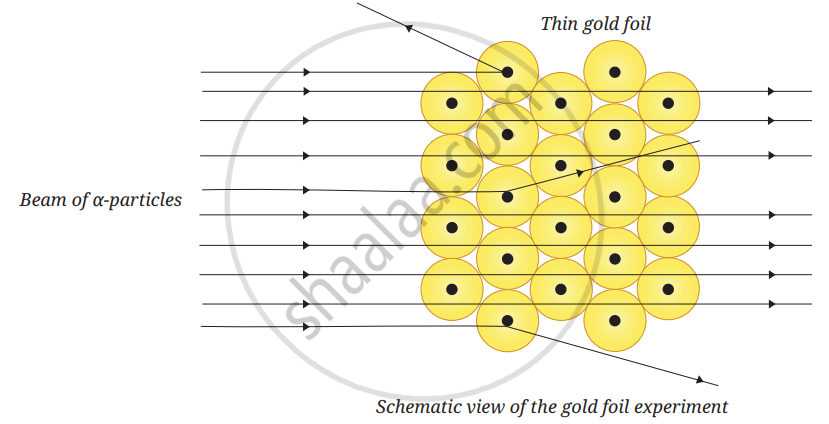
Pause and Ponder
What do you think would happen if α-particles were replaced with negatively charged particles in Rutherford's gold foil experiment?
Rutherford found that a few α-particles bounced back sharply. How does this single surprising result completely rule out Thomson’s ‘plum pudding model’ of the atom?
If you could ask Rutherford one question about his work, what would it be?
Pause and Ponder
Assertion (A): Rutherford concluded that most of the mass of an atom is concentrated in a small region at the centre called the nucleus.
Reason (R): According to Thomson's model, electrons are embedded in a uniformly distributed positive charge sphere.
Both A and R are true, and R is the correct explanation of A.
Both A and R are true, but R is not the correct explanation of A.
A is true, but R is false.
A is false, but R is true.
What if ...
an atom had no empty space? How would this have affected the size of various objects?
Pause and Ponder
Imagine you are a scientist who has discovered a new element. Name this element after yourself and justify that the symbol you have chosen follows the IUPAC rules.
What problems could arise if every scientist used different symbols for the same element?
Pause and Ponder
An atom with an atomic number of 26 has 56 nucleons. Find out its number of electrons, protons and neutrons.
The nucleus of an atom contains 20 protons. If its mass number is 41, find the number of neutrons in it.
An atom has 18 neutrons and an atomic number of 17. What is its mass number?
An atom \begin{array}{l} {}^{23}\mathrm{A} \end{array} has 11 electrons. Find the number of neutrons in it.
Pause and Ponder
Identify the number of electrons in the outermost shell of the following elements:
\begin{array}{ll} \text{(i)} & {}^{12}_{6}\mathrm{C} \\[4pt] \text{(ii)} & {}^{19}_{9}\mathrm{F} \\[4pt] \text{(iii)} & {}^{28}_{14}\mathrm{Si} \end{array}
Write the electronic configuration of the elements having atomic numbers 12, 16 and 18.
Solve this riddle: I am an atom with a mass number of 23 and 11 protons. I am a soft metal and react vigorously with water. Who am I and how many neutrons do I have? You can also create one such riddle.
Two different atoms have 11 protons each, but one has 12 neutrons, and the other has 13 neutrons. How do their atomic numbers and mass numbers compare? Are they the same element or different elements?
If a bromine atom is available in the form of, say two isotopes, $$(^{79}_{35}\mathrm{Br}) (49.7\%)$$ and $$(^{81}_{35}\mathrm{Br}) (50.3\%)$$, calculate the average atomic mass of the bromine atom.
NCERT solutions for इंग्लिश एक्स्प्लॉरैशन [अंग्रेजी] कक्षा ९ 8 Journey Inside the Atom Revise, Reflect, Refine [Pages 158 - 160]
Choose the correct options and explain the reason for the correct and incorrect options in the context of Ernest Rutherford's gold foil experiment:
The experiment clearly showed the existence of neutrons in the nucleus.
The results disproved the plum pudding model and led to the idea of a nucleus at the centre of the atom.
The large deflection of a few alpha particles indicated that most of the mass of the atom and positive charge are packed into a tiny centre.
The way alpha particles were deflected showed that electrons move around the nucleus.
Following statement is correct or incorrect according to the Bohr’s atomic model? Give a reason for the statement.
Electrons lose energy while moving in fixed orbits and slowly fall into the nucleus.
Following statement is correct or incorrect according to the Bohr’s atomic model? Give a reason for the statement.
Electrons can exist anywhere around the nucleus with no fixed energy.
Following statement is correct or incorrect according to the Bohr’s atomic model? Give a reason for the statement.
Electrons revolve around the nucleus in orbits of fixed energy without losing energy.
Following statement is correct or incorrect according to the Bohr’s atomic model? Give a reason for the statement.
Electrons can be found between energy levels as they move around the nucleus.
The composition of the nuclei of three atomic species X, Y, and Z are given as follows.
| X | Y | Z | |
|---|---|---|---|
| Number of protons | 18 | 17 | 17 |
| Number of neutrons | 19 | 18 | 20 |
Explain the relation between the following:
Y and Z
The composition of the nuclei of three atomic species X, Y, and Z are given as follows.
| X | Y | Z | |
|---|---|---|---|
| Number of protons | 18 | 17 | 17 |
| Number of neutrons | 19 | 18 | 20 |
Explain the relation between the following:
Z and X
What conclusion did Rutherford draw about the position and characteristics of the atom's positively charged part based on the few alpha particles that bounced back or were deflected at large angles in the gold foil experiment?
Explain and arrange the following statements in the correct chronological order to show how atomic models have evolved over time.
- Bohr’s model proposed that electrons move in fixed orbits around the nucleus, each with a definite energy.
- Thomson’s model depicted the atom as a 'plum pudding' with electrons embedded in a sphere of positive charge.
- Rutherford's model proposed that atoms have a dense central nucleus.
- Dalton’s model described atoms as indivisible particles.
Electrons move around the nucleus in orbits. Why do they not fly away from the atom? Explain what keeps them attracted to the nucleus.
Assertion (A): The discovery of subatomic particles helped in understanding the atomic structure.
Reason (R): The number of electrons is equal to the number of protons in an atom.
Both A and R are true, and R is the correct explanation of A.
Both A and R are true, but R is not the correct explanation of A.
A is true, but R is false.
A is false, but R is true.
Magnesium is essential for many biological processes, including muscle contraction. For an atom of magnesium with a mass number of 24 and atomic number 12, determine the number of (i) protons, (ii) neutrons, (iii) electrons, and also illustrate the arrangement of electrons in a magnesium atom.
Find the following information for the elements shown in Fig.:
- Name of the element
- Symbol
- Total number of electrons
- Number of valence electrons
- Valency of the element
- Number of protons
- Atomic number
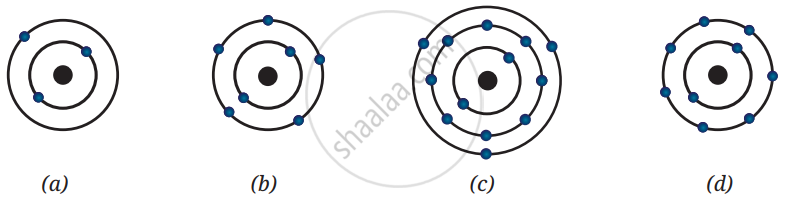
Both Rutherford's and Bohr's models have electrons orbiting the nucleus. Why did Rutherford's model fail to explain atomic stability, while Bohr's model succeeded?
An atom 70X has 31 electrons. How many neutrons are there in its nucleus?
An atom has 79 protons and a mass number of 197. Calculate
- the number of neutrons, and
- the number of electrons.
Complete the Table:
| Atomic number | Mass number | Number of neutrons | Number of protons | Number of electrons | Name of the elements |
| 5 | - | 6 | - | - | - |
| - | 14 | - | - | 7 | Nitrogen |
| - | 24 | - | 12 | - | - |
| 15 | - | 16 | - | - | - |
| - | 1 | 0 | - | - | - |
Aman was discussing the structure of atom with his classmates. During the discussion, he learnt that an element X has a mass number of 35 and contains 18 neutrons. Based on this information, answer the following questions:
- How many electrons and protons does element X have?
- What is its atomic number?
- Identify the element X.
- Write its electronic configuration.
- How many valence electrons does it have?
- What will be the mass number if two neutrons are added to its nucleus?
- What will be the relation of X with the new atom?
In an atom, there are 12 protons and 12 neutrons in the nucleus. Now, imagine that all the electrons are replaced with some hypothetical particles that have the same charge as electrons but are 500 times heavier. What effect will this replacement have on the atom’s:
- Atomic number
- Atomic mass
- Mass number
- Overall charge
NCERT solutions for इंग्लिश एक्स्प्लॉरैशन [अंग्रेजी] कक्षा ९ 8 Journey Inside the Atom The Journey Beyond [Page 161]
Create an ‘Atomic Prediction Board’ game based on atomic number, mass number, number of electrons, protons, neutrons and valency.
Students may predict elements using atomic clues.
Prepare a report on how the properties of atoms impact us in everyday life across fields such as healthcare, energy, agriculture and technology.
Create a role-play stage play or story about the ‘Journey Inside the Atom’ and the scientists who discovered and contributed to the identification of atomic structure.
Use selected software or digital tools and try to create animations or simulations of various atomic models, and share them in the class.
Watch a film or documentary about the structure of the atom and write a report answering the following questions.
- Which film or documentary did you watch, and what was its main idea or topic?
- What did the film or documentary teach you about the structure of the atom and the atomic model(s)?
- Which scientists were mentioned in the film or documentary, and what were their contributions?
- What part of the film or documentary did you find most interesting, and what question do you still have?
Draw a bar graph showing the number of electrons in each energy level for any three elements.
The Quest Continues...
Is it possible to completely understand everything that happens inside an atom?
Solutions for 8: Journey Inside the Atom
NCERT solutions for इंग्लिश एक्स्प्लॉरैशन [अंग्रेजी] कक्षा ९ chapter 8 - Journey Inside the Atom
Shaalaa.com has the CBSE Mathematics इंग्लिश एक्स्प्लॉरैशन [अंग्रेजी] कक्षा ९ CBSE solutions in a manner that help students grasp basic concepts better and faster. The detailed, step-by-step solutions will help you understand the concepts better and clarify any confusion. NCERT solutions for Mathematics इंग्लिश एक्स्प्लॉरैशन [अंग्रेजी] कक्षा ९ CBSE 8 (Journey Inside the Atom) include all questions with answers and detailed explanations. This will clear students' doubts about questions and improve their application skills while preparing for board exams.
Further, we at Shaalaa.com provide such solutions so students can prepare for written exams. NCERT textbook solutions can be a core help for self-study and provide excellent self-help guidance for students.
Concepts covered in इंग्लिश एक्स्प्लॉरैशन [अंग्रेजी] कक्षा ९ chapter 8 Journey Inside the Atom are .
Using NCERT इंग्लिश एक्स्प्लॉरैशन [अंग्रेजी] कक्षा ९ solutions Journey Inside the Atom exercise by students is an easy way to prepare for the exams, as they involve solutions arranged chapter-wise and also page-wise. The questions involved in NCERT Solutions are essential questions that can be asked in the final exam. Maximum CBSE इंग्लिश एक्स्प्लॉरैशन [अंग्रेजी] कक्षा ९ students prefer NCERT Textbook Solutions to score more in exams.
Get the free view of Chapter 8, Journey Inside the Atom इंग्लिश एक्स्प्लॉरैशन [अंग्रेजी] कक्षा ९ additional questions for Mathematics इंग्लिश एक्स्प्लॉरैशन [अंग्रेजी] कक्षा ९ CBSE, and you can use Shaalaa.com to keep it handy for your exam preparation.
