Advertisements
Chapters
*: The Wit that Won Hearts
*: A Concrete Example
*: Wisdom Paves the Way
Unit 2: Values and Dispositions
*: A Tale of Valour: Major Somnath Sharma and the Battle of Badgam
*: Somebody’s Mother
*: Verghese Kurien - I Too Had A Dream
Unit 3: Mystery and Magic
*: The Case of the Fifth Word
▶ *: The Magic Brush of Dreams
*: Spectacular Wonders
Unit 4: Environment
*: The Cherry Tree
*: Harvest Hymn
*: Waiting for the Rain
Unit 5: Science and Curiosity
*: Feathered Friend
*: Magnifying Glass
*: Bibha Chowdhuri: The Beam of Light that Lit the Path for Women in Indian Science
Advertisements
Solutions for Chapter *: The Magic Brush of Dreams
Below listed, you can find solutions for Chapter * of CBSE NCERT for इंग्लिश पूर्वी कक्षा ८.
NCERT solutions for इंग्लिश पूर्वी कक्षा ८ * The Magic Brush of Dreams Intex Questions [Page 122]
Let us do these activities before we read.
Work in pairs. Discuss the following question. Share your answer with your classmates and teacher.
Mention a magical object that you would like to have. Give a reason for your choice.
Work in pairs. Discuss the following question. Share your answer with your classmates and teacher.
What would you draw for yourself, if you had a magic paint brush? Why?
Work in pairs. Discuss the following question. Share your answer with your classmates and teacher.
Would you use the magic paint brush to draw for someone else? If yes, why? If no, why not?
Work in pairs. Discuss instances of acts of kindness that you have heard, read, or experienced. Share your answers with your classmates and teacher.
Work in pairs and guess the meanings of the words given below and draw pictures depicting their meanings. Share with your classmates and teacher.
| paintbrush | joy | fortress | feast | fear |
| winding | twig | bows | drawing | cold |
Now, arrange these words intodifferent categories as given below.
Things: ........................
Actions: ........................
Emotions: ........................
NCERT solutions for इंग्लिश पूर्वी कक्षा ८ * The Magic Brush of Dreams Exercise [Pages 127 - 136]
Let us discuss:
Arrange the events in order of occurrence in the poem. The last one has been marked for you. Share your answers with your classmates and teacher.
| 1. Gopi paints a bowl of khichdi, which becomes real and amazes the villagers. | |
| 2. The Zamindar orders Gopi to paint treasures for him. | |
| 3. Gopi is told to gather food but instead sits drawing pictures in the sand. | |
| 4. Gopi returns to the village with the Zamindar and his men chasing her. | |
| 5. The Zamindar throws Gopi into prison. | |
| 6. Gopi paints a road and a horse to escape. | |
| 7. Gopi uses the magic brush to paint useful items for the villagers. | |
| 8. Gopi paints a wide river, stopping the Zamindar and his men. | |
| 9. A man gives a magic brush to Gopi to paint only for the poor. | |
| 10. Gopi scares the Zamindar away, and celebrates with the villagers. | 10 |
Fill in the blanks by choosing the correct answer from the box given below.
| triumphant and celebratory | tension and suspense |
| playful and innocent |
The tone of the poem shifts throughout, reflecting the different moods of the story. Initially, the tone is 1. ______ as Gopi uses her imagination to draw in the sand, and later when the Zamindar enters the story, the tone shifts to one of 2. ______. In the final part of the poem, the tone becomes 3. ______ as Gopi escapes, the Zamindar is defeated, and the villagers rejoice.
Fill in the blank by choosing the correct option from within the bracket.
The poem mostly follows a simple rhyme scheme, ______, which adds a rhythmic flow. (ABCB, ABBA, ABAB)
Fill in the blank by choosing the correct option from within the bracket.
This poem belongs to the ______ poetry genre, which tells a story through verse. (descriptive, narrative or ballad, free style)
Give an example from the poem for the following explanation.
The poem is rich in imagery, creating clear pictures in the reader’s mind. For example, ______.
What is the effect of repetition in the line—‘On you, and you and you!’?
Match the phrases from the poem in Column 1 with what they symbolise in Column 2.
| Column 1 | Column 2 |
| 1. The magic paintbrush | (i) greed and the desire for wealth |
| 2. The grand fortress | (ii) barriers to protect Gopi from the Zamindar’s anger |
| 3. The river and the beast | (iii) the power of art and imagination to change the world |
Identify whether the following statement is true or false.
While Gopi uses the magic brush to help others, the Zamindar wants to use it for personal gain. This contrast drives the moral of the story.
Let us think and reflect:
Read the given extract and answer the questions that follow.
|
But on a stone there sits a man,
|

(i) Fill in the blank by selecting the correct option from those given in the brackets.
The man is whispering and telling Gopi to keep the brush a secret reflects his ______ (careful and secretive/magical and delightful) nature.
(ii) What is the significance of the man slipping the brush into Gopi’s hand?
(iii) Complete the following sentence with a suitable reason.
The most likely reason the man instructs Gopi to ‘Paint not for wealthy ones but only for the poor’ is because he ______.
(iv) Select the most appropriate title for the extract from the two given below.
- The Magic Brush’s Secret
- Gopi’s Special Gift
Read the given extract and answer the questions that follow.
|
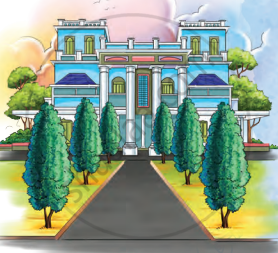
And soon the news spreads far and wide, “I order you to paint for me,
|
(i) Complete the following sentence with the correct reason.
The news of Gopi’s magic brush spreads ‘through forests, fields, and plains’ because of its ______.
(ii) Why does the poet refer to things painted by Gopi’s paintbrush as ‘magic gains’?
(iii) Which of the following statements given below is false? Rectify the false statement.
- Gopi’s magic brush draws the attention of the powerful Zamindar.
- The Zamindar requests Gopi to paint a grand fortress and jewels.
(iv) What does the Zamindar’s demand for a grand fortress and jewels reveal about his character?
Answer the following questions.
Explain why Gopi made the right decision by refusing to paint for the Zamindar.
Gopi threatens to draw a beast to scare away the Zamindar. Justify her action. How would you have dealt with the situation differently?
What is the significance of Gopi celebrating with the villagers at the end of the poem?
Compare Gopi’s use of the magic brush to how the Zamindar would have used it.
What can be inferred about Gopi’s character based on her refusal to follow the Zamindar’s orders?
Justify the appropriateness of the title of the poem “The magic brush of dreams”.
If you had the magic brush, how would you use it in today’s world?
Let us learn:
The verb ‘draw’ has different meanings in different contexts. Match the sentences in Column 1 with their appropriate meanings in Column 2.
| Column 1 | Column 2 |
|---|---|
| 1. His speech drew loud applause from the audience. | (i) opened |
| 2. The event will draw huge crowds from all neighbouring places. | (ii) pulled out |
| 3. Plants draw water from the soil. | (iii) got a reaction |
| 4. I reached the station when the train was drawing into the station. | (iv) attract |
| 5. The room was dark, so she drew the curtains to let the sunlight in. | (v) moving |
| 6. He drew a piece of paper from the folder. | (vi) absorb |
Fill in the crossword. Clues have been given below. You will find the words in the poem.
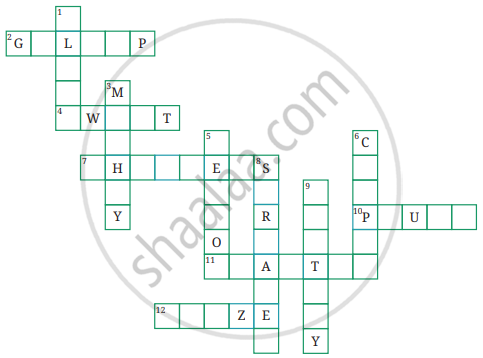
| Across | Down |
| 2. the fastest pace of a horse | 1. runs away from a place |
| 4. happen fast | 3. possessing a great deal of strength or power |
| 7. speaks very softly | 5. a deep loud shout in pain or anger |
| 10. take hold of (something) and quickly remove it from its place | 6. to act according to rules |
| 11. having a lot of money; rich | 8. moved in a continuous flow in a specified direction |
| 12. take hold of something suddenly and forcibly | 9. a win after overcoming an enemy |
Match the expressions in Column 1 with what emotions or reactions they convey, in Column 2.
| Column 1 | Column 2 |
| 1. Phew! | (i) surprise |
| 2. Eek! | (ii) pain |
| 3. Ouch! | (iii) mistake |
| 4. Yippee! | (iv) attract attention |
| 5. Whoa! | (v) relief |
| 6. Oops! | (vi) delight |
| 7. Hey! | (vii) alarm |
Now, create sentences using any five expressions from Column 1.
Let us listen:
You will listen to five speakers speak about a magical power they wish for. As you listen, match statements 1–7 with speakers (i)–(v). There are two statements you do not need.
| Statements | Speaker No. |
| 1. Power of healing ailments | |
| 2. Ability to end poverty in the world | |
| 3. Power to control the weather as per need | |
| 4. Ability to make wise business decisions | |
| 5. Power to predict one’s own future clearly | |
| 6. Ability to remember information quickly | |
| 7. Power to move around without using vehicles |
Let us speak:
Read the following sentences from the text with the falling tone.
- Come here! ↘
- Seize this magic brush... ↘
- Paint my fortress tall! ↘
- Go and fetch some rice. ↘
Work in pairs. Take turns to make requests for the following formal and informal situations.
Formal Requests
| Situation 1 | Situation 2 | Situation 3 |
| You request your teacher to organise a class picnic. | You request your class teacher for an extra sports period, since you missed it last week. | You request your Activity incharge teacher to include you in the upcoming inter-school event. |
Informal Requests
| Situation 1 | Situation 2 | Situation 3 |
| You request your sibling to help you with the completion of your project. | You request your mother to enroll you in a dance class. | You request your cousin to come over to spend the weekend with you. |
You may use the following phrases when you make the request.
| Formal | Informal |
|
|
Let us write:
Imaginative essay is a type of creative writing where the writers use their imagination. An imaginative essay can be based on real-life events, observation, or experiences. It is usually a descriptive piece or a personal reflection.
Read the sample of an imaginative essay.
Complete the given checklist based on your observations and understanding of what an imaginative essay includes. Share the answers with your classmates and teacher.
- Title — A relevant title
- Introduction
- Captivating opening sentence to catch the reader’s attention
- Clear statement of the setting, situation, or main idea
- Establishes the tone (e.g., playful, serious, and adventurous)
- Introduces the narrator briefly (if applicable)
- Setting and Context
- Description of the setting to create a mental picture
- Clear time frame (past, present, or future)
- Brief explanation of any unique or imaginative elements (e.g., powers, fantasy world)
- Characters
- Main character introduced with unique traits
- Supporting characters briefly described (if relevant)
- Central Idea
- Clear focus on a single powerful idea or narrative
- Logical flow of events, even if the story involves imagination or fantasy
- Language and Style
- Use of sensory details (sight, sound, touch, smell, and taste) to enhance the narrative
- Creative metaphors or similes to enrich descriptions
- Resolution
- Key turning point or moment of realisation
- Resolution of the main idea
- Clear takeaway message
- Conclusion
- Ends on a reflective or thought-provoking note
- Summarises the main message or leaves the reader with a strong final impression
Write an imaginative essay on the following.
Imagine you were a scarf that flew away from a clothesline. Describe the places you travelled to and how you came back. Also write about what you thought was the most valuable experience.
Write an imaginative essay on the following.
Imagine you stumbled upon a magical book in the library. The book transported you to a different time period. Describe your experience and an important learning.
Let us explore:
Have you heard of India’s famous magician, P. C. Sorcar Sr.? He is known as one of the ‘World’s Greatest Magician’ and performed live magic shows in front of audiences and on television, internationally.
He was awarded Padma Shri on 26 January 1964 for his contribution to the world of magic.

Words can also play tricks. Read the riddles about things that seem to be unreal and find what they refer to.
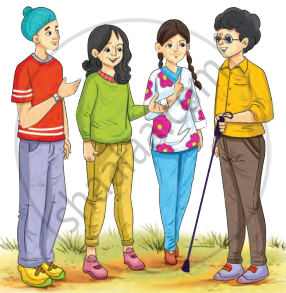
- I can fill a room, but I take up no space. I’m often heard, but never seen. What am I?
- The more you take, the more you leave behind. What am I?
- I have cities but no houses, I have forests but no trees. What am I?
- I’m tall when I’m young and short when I’m old, in a dark room, my story is told.
You are asked to create a magical object. What object would you create? Make a drawing with all its details and mention its special quality on the same sheet. Put up the sheet on the display board.
Solutions for *: The Magic Brush of Dreams
NCERT solutions for इंग्लिश पूर्वी कक्षा ८ chapter * - The Magic Brush of Dreams
Shaalaa.com has the CBSE Mathematics इंग्लिश पूर्वी कक्षा ८ CBSE solutions in a manner that help students grasp basic concepts better and faster. The detailed, step-by-step solutions will help you understand the concepts better and clarify any confusion. NCERT solutions for Mathematics इंग्लिश पूर्वी कक्षा ८ CBSE * (The Magic Brush of Dreams) include all questions with answers and detailed explanations. This will clear students' doubts about questions and improve their application skills while preparing for board exams.
Further, we at Shaalaa.com provide such solutions so students can prepare for written exams. NCERT textbook solutions can be a core help for self-study and provide excellent self-help guidance for students.
Concepts covered in इंग्लिश पूर्वी कक्षा ८ chapter * The Magic Brush of Dreams are Grammar, English Compositon.
Using NCERT इंग्लिश पूर्वी कक्षा ८ solutions The Magic Brush of Dreams exercise by students is an easy way to prepare for the exams, as they involve solutions arranged chapter-wise and also page-wise. The questions involved in NCERT Solutions are essential questions that can be asked in the final exam. Maximum CBSE इंग्लिश पूर्वी कक्षा ८ students prefer NCERT Textbook Solutions to score more in exams.
Get the free view of Chapter *, The Magic Brush of Dreams इंग्लिश पूर्वी कक्षा ८ additional questions for Mathematics इंग्लिश पूर्वी कक्षा ८ CBSE, and you can use Shaalaa.com to keep it handy for your exam preparation.
