Advertisements
Chapters
2: Structure of Atom
3: Classification of Elements and Periodicity in Properties
4: Chemical Bonding and Molecular Structure
5: States of Matter
▶ 6: Thermodynamics
7: Equilibrium
8: Redox Reactions
9: Hydrogen
10: The s-block Elements
11: The p-block Elements
12: Organic Chemistry Some Basic Principles and Techniques
13: Hydrocarbons
14: Environmental Chemistry
![NCERT Exemplar solutions for Chemistry [English] Class 11 chapter 6 - Thermodynamics - Shaalaa.com](/images/chemistry-english-class-11_6:5f2b1b2038084cf381bfa42c826a928c.jpg "NCERT Exemplar solutions for Chemistry [English] Class 11 chapter 6 - Thermodynamics")
Advertisements
Solutions for Chapter 6: Thermodynamics
Below listed, you can find solutions for Chapter 6 of CBSE, Karnataka Board PUC NCERT Exemplar for Chemistry [English] Class 11.
NCERT Exemplar solutions for Chemistry [English] Class 11 6 Thermodynamics Multiple Choice Questions (Type - I) [Pages 68 - 77]
Thermodynamics is not concerned about ______.
Energy changes involved in a chemical reaction.
The extent to which a chemical reaction proceeds.
The rate at which a reaction proceeds.
The feasibility of a chemical reaction
Which of the following statements is correct?
The presence of reacting species in a covered beaker is an example of open system.
There is an exchange of energy as well as matter between the system and the surroundings in a closed system.
The presence of reactants in a closed vessel made up of copper is an example of a closed system.
The presence of reactants in a thermos flask or any other closed insulated vessel is an example of a closed system.
The state of a gas can be described by quoting the relationship between ______.
Pressure, Volume, Temperature
Temperature, Amount, Pressure
Amount, Volume, Temperature
Pressure, Volume, Temperature, Amount
The volume of gas is reduced to half from its original volume. The specific heat will be ______.
reduce to half
be doubled
remain constant
increase four times
During complete combustion of one mole of butane, 2658 kJ of heat is released. The thermochemical reaction for above change is ______.
\[\ce{2C4H10 (g) + 1302 (g) -> 8CO2 (g) + 10H2O (l) ∆_cH = - 2658.0 kJ mol^{-1}}\]
\[\ce{ C4H10 (g) + 13/2 O2 (g) -> 4CO2 (g) + 5H2O (g) ∆_CH = -1329.0 kJ mol^{-1}}\]
\[\ce{C4H10 (g) + 13/2 O2 (g) -> 4CO2 (g) + 5H2O (l) ∆_cH = - 2658.0 kJ mol^{-1}}\]
\[\ce{C4H10 (g) + 13/2 O2 (g) -> 4CO2 (g) + 5H2O (l) ∆_cH = + 2658.0 kJ mol^{-1}}\]
\[\ce{∆_f U^Θ}\] of formation of \[\ce{CH4 (g)}\] at certain temperature is – 393 kJ mol–1. The value of \[\ce{∆_f H^Θ}\] is ______.
zero
\[\ce{< ∆_f U^Θ}\]
\[\ce{> ∆_f U^Θ}\]
equal to \[\ce{∆_f U^Θ}\]
In an adiabatic process, no transfer of heat takes place between system and surroundings. Choose the correct option for free expansion of an ideal gas under adiabatic condition from the following.
q = 0, ∆T ≠ 0, w = 0
q ≠ 0, ∆T = 0, w = 0
q = 0, ∆T = 0, w = 0
q = 0, ∆T < 0, w ≠ 0
The pressure-volume work for an ideal gas can be calculated by using the expression w = `- int_(v_i)^(v_f) p_(ex) dV`. The work can also be calculated from the pV– plot by using the area under the curve within the specified limits. When an ideal gas is compressed (a) reversibly or (b) irreversibly from volume Vi to Vf. choose the correct option.
w (reversible) = w (irreversible)
w (reversible) < w (irreversible)
w (reversible) > w (irreversible)
w (reversible) = w (irreversible) + `P_(ex).∆V`
The entropy change can be calculated by using the expression ∆S = `q_(rev)/T`. When water freezes in a glass beaker, choose the correct statement amongst the following :
∆S (system) decreases but ∆S (surroundings) remains the same.
∆S (system) increases but ∆S (surroundings) decreases.
∆S (system) decreases but ∆S (surroundings) increases.
∆S (system) decreases and ∆S (surroundings) also decreases.
On the basis of thermochemical equations (a), (b) and (c), find out which of the algebric relationships given in options (i) to (iv) is correct.
(a) \[\ce{C (graphite) + O2 (g) -> CO2 (g) ; ∆_rH = xkJ mol^{-1}}\]
(b) \[\ce{C (graphite) + 1/2 O2 (g) -> CO (g) ; ∆_rH = ykJ mol^{-1}}\]
(c) \[\ce{CO (g) + 1/2 O2 (g) -> CO2 (g) ; ∆_r H = zkJ mol^{-1}}\]
z = x + y
x = y – z
x = y + z
y = 2z – x
Consider the reactions given below. On the basis of these reactions find out which of the algebric relations given in options (i) to (iv) is correct?
(a) \[\ce{C (g) + 4 H (g) -> CH4 (g); ∆_rH = xkJ mol^{-1}}\]
(b) \[\ce{C (graphic) + 2H2 (g) -> CH4 (g); ∆_rH = ykJ mol^{-1}}\]
x = y
x = 2y
x > y
x < y
The enthalpies of elements in their standard states are taken as zero. The enthalpy of formation of a compound ______.
is always negative
is always positive
may be positive or negative
is never negative
Enthalpy of sublimation of a substance is equal to ______.
Enthalpy of fusion + Enthalpy of vapourisation
Enthalpy of fusion
Enthalpy of vapourisation
Twice the enthalpy of vapourisation
Which of the following is not correct?
∆G is zero for a reversible reaction
∆G is zero for a reversible reaction
∆G is negative for a spontaneous reaction
∆G is positive for a non-spontaneous reaction
Thermodynamics mainly deals with:
(i) interrelation of various forms of energy and their transformation from one form to another.
(ii) energy changes in the processes which depend only on initial and final states of the microscopic systems containing a few molecules.
(iii) how and at what rate these energy transformations are carried out.
(iv) the system in equilibrium state or moving from one equilibrium state to another equilibrium state.
In an exothermic reaction, heat is evolved, and system loses heat to the surrounding. For such system:
(i) qp will be negative
(ii) ∆rH will be negative
(iii) qp will be positive
(iv) ∆rH will be positive
The spontaneity means, having the potential to proceed without the assistance of external agency. The processes which occur spontaneously are:
(i) Flow of heat from colder to warmer body.
(ii) Gas in a container contracting into one corner.
(iii) Gas expanding to fill the available volume.
(iv) Burning carbon in oxygen to give carbon dioxide.
For an ideal gas, the work of reversible expansion under isothermal condition can be calculated by using the expression w = `- nRT` In `V_f/V_i`. A sample containing 1.0 mol of an ideal gas is expanded isothermally and reversibly to ten times of its original volume, in two separate experiments. The expansion is carried out at 300 K and at 600 K respectively.
(i) Work done at 600 K is 20 times the work done at 300 K.
(ii) Work done at 300 K is twice the work done at 600 K.
(iii) Work done at 600 K is twice the work done at 300 K.
(iv) ∆U = 0 in both cases.
Consider the following reaction between zinc and oxygen and choose the correct options out of the options given below:
\[\ce{2 Zn (s) + O2 (g) -> 2 ZnO (s); ∆H = - 693.8 kJ mol^{-1}}\]
(i) The enthalpy of two moles of \[\ce{ZnO}\] is less than the total enthalpy of two moles of \[\ce{Zn}\] and one mole of oxygen by 693.8 kJ.
(ii) The enthalpy of two moles of \[\ce{ZnO}\] is more than the total enthalpy of two moles of \[\ce{Zn}\] and one mole of oxygen by 693.8 kJ.
(iii) 693.8 kJ mol–1 energy is evolved in the reaction.
(iv) 693.8 kJ mol–1 energy is absorbed in the reaction.
18.0 g of water completely vapourises at 100°C and 1 bar pressure and the enthalpy change in the process is 40.79 kJ mol–1. What will be the enthalpy change for vapourising two moles of water under the same conditions? What is the standard enthalphy of vapourisation for water?
One mole of acetone requires less heat to vapourise than 1 mol of water. Which of the two liquids has higher enthalpy of vapourisation?
Standard molar enthalpy of formation, ∆fHΘ is just a special case of enthalpy of reaction, ∆rHΘ. Is the ∆rHΘ for the following reaction same as ∆fHΘ? Give reason for your answer.
\[\ce{CaO(s) + CO2(g) -> CaCO3(s); ∆_fH^Θ = - 178.3 kJ mol^{-1}}\]
The value of ∆fHΘ for \[\ce{NH3}\] is – 91.8 kJ mol–1. Calculate enthalpy change for the following reaction:
\[\ce{2NH3(g) -> N2(g) + 3H2(g)}\]
Enthalpy is an extensive property. In general, if enthalpy of an overall reaction A→B along one route is ∆rH and ∆rH1, ∆rH2, ∆rH3 ..... represent enthalpies of intermediate reactions leading to product B. What will be the relation between ∆rH for overall reaction and ∆rH1, ∆rH2 ..... etc. for intermediate reactions.
The enthalpy of atomisation for the reaction \[\ce{CH4(g) -> C(g) + 4H(g)}\] is 1665 kJ mol–1. What is the bond energy of \[\ce{C – H}\] bond?
Use the following data to calculate \[\ce{∆_{lattice}H^Θ}\] for \[\ce{NaBr}\].
\[\ce{∆_{sub}H^Θ}\] for sodium metal = 108.4 kJ mol–1
Ionization enthalpy of sodium = 496 kJ mol–1
Electron gain enthalpy of bromine = – 325 kJ mol–1
Bond dissociation enthalpy of bromine = 192 kJ mol–1
\[\ce{∆_fH^Θ}\] for \[\ce{NaBr (s)}\] = – 325 kJ mol–1
Given that ∆H = 0 for mixing of two gases. Explain whether the diffusion of these gases into each other in a closed container is a spontaneous process or not?
Heat has randomising influence on a system and temperature is the measure of average chaotic motion of particles in the system. Write the mathematical relation which relates these three parameters.
Increase in enthalpy of the surroundings is equal to decrease in enthalpy of the system. Will the temperature of system and surroundings be the same when they are in thermal equilibrium?
At 298 K. Kp for the reaction \[\ce{N2 O4 (g) ⇌ 2NO2 (g)}\] is 0.98. Predict whether the reaction is spontaneous or not.
A sample of 1.0 mol of a monoatomic ideal gas is taken through a cyclic process of expansion and compression as shown in figure 6.1. What will be the value of ∆H for the cycle as a whole?
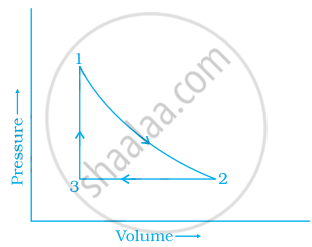
The standard molar entropy of \[\ce{H2O (l)}\] is 70 JK–1 mol–1. Will the standard molar entropy of \[\ce{H2O (s)}\] be more, or less than 70 JK–1 mol–1?
Identify the state and path functions out of the following:
- Enthalpy
- Entropy
- Heat
- Temperature
- Work
- Free energy
The molar enthalpy of vapourisation of acetone is less than that of water. Why?
Which quantity out of ∆rG and ∆rGΘ will be zero at equilibrium?
Predict the change in internal energy for an isolated system at constant volume.
Although heat is a path function but heat absorbed by the system under certain specific conditions is independent of path. What are those conditions? Explain.
Expansion of a gas in vacuum is called free expansion. Calculate the work done and the change in internal energy when 1 litre of ideal gas expands isothermally into vacuum until its total volume is 5 litre?
Heat capacity (Cp) is an extensive property but specific heat (c) is an intensive property. What will be the relation between Cp and c for 1 mol of water?
The difference between CP and CV can be derived using the empirical relation H = U + pV. Calculate the difference between CP and CV for 10 moles of an ideal gas.
If the combustion of 1g of graphite produces 20.7 kJ of heat, what will be molar enthalpy change? Give the significance of sign also.
The net enthalpy change of a reaction is the amount of energy required to break all the bonds in reactant molecules minus amount of energy required to form all the bonds in the product molecules. What will be the enthalpy change for the following reaction.
\[\ce{H2(g) + Br(g) -> 2HBr(g)}\]
Given that Bond energy of \[\ce{H2, Br2}\] and \[\ce{HBr}\] is 435 kJ mol–1, 192 kJ mol–1 and 368 kJ mol–1 respectively.
The enthalpy of vapourisation of \[\ce{CCl4}\] is 30.5 kJ mol–1. Calculate the heat required for the vapourisation of 284 g of \[\ce{CCl4}\] at constant pressure. (Molar mass of \[\ce{CCl4}\] = 154 g mol–1).
The enthalpy of reaction for the reaction: \[\ce{2H2 (g) + O2(g) -> 2H2O (l)}\] is ∆rHΘ = – 572 kJ mol–1. What will be standard enthalpy of formation of \[\ce{H2O (l)}\]?
What will be the work done on an ideal gas enclosed in a cylinder, when it is compressed by a constant external pressure, pext in a single step as shown in figure. Explain graphically.
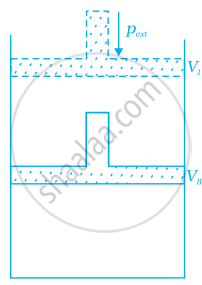
How will you calculate work done on an ideal gas in a compression, when change in pressure is carried out in infinite steps?
Represent the potential energy/enthalpy change in the following processes graphically.
(a) Throwing a stone from the ground to roof.
(b) \[\ce{1/2 H2(g) + 1/2 Cl2 (g) ⇌ HCl (g) Δ_rH^Θ = - 92.32 kJ mol^{-1}}\]
In which of the processes potential energy/enthalpy change is contributing factor to the spontaneity?
Enthalpy diagram for a particular reaction is given in figure. Is it possible to decide spontaneity of a reaction from given diagram. Explain.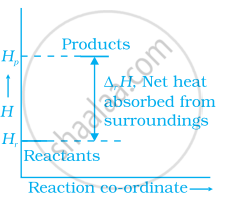
1.0 mol of a monoatomic ideal gas is expanded from state (1) to state (2) as shown in figure. Calculate the work done for the expansion of gas from state (1) to state (2) at 298 K.
An ideal gas is allowed to expand against a constant pressure of 2 bar from 10 L to 50 L in one step. Calculate the amount of work done by the gas. If the same expansion were carried out reversibly, will the work done be higher or lower than the earlier case? (Given that 1 L bar = 100 J)
Match the following :
| A | B |
| (i) Adiabatic process | (a) Heat |
| (ii) Isolated system | (b) At constant volume |
| (iii) Isothermal change | (c) First law of thermodynamics |
| (iv) Path function | (d) No exchange of energy and matter |
| (v) State function | (e) No transfer of heat |
| (vi) ΔU = q | (f) Constant temperature |
| (vii) Law of conservation of energy | (g) Internal energy |
| (viii) Reversible process | (h) Pext = o |
| (ix) Free expansion | (i) At constant pressure |
| (x) ΔH = q | (j) Infinitely slow process which proceeds through a series of equilibrium states. |
| (xi) Intensive property | (k) Entropy |
| (xii) Extensive property | (l) Pressure |
| (m) Specific heat |
Match the following processes with entropy change:
| Reaction | Entropy change |
| (i) A liquid vapourises | (a) ∆S = 0 |
| (ii) Reaction is non-spontaneous at all temperatures and ∆H is positive |
(b) ∆S = positive |
| (iii) Reversible expansion of an ideal gas | (c) ∆S = negative |
Match the following parameters with description for spontaneity
| ∆ (Parameters) \[\ce{∆_rH^Θ, ∆_rS^Θ, ∆_rG^Θ}\] |
Description |
| (i) \[\ce{+ – +}\] | (a) Non-spontaneous at high temperature |
| (ii) \[\ce{– – + at high T}\] | (b) Spontaneous at all temperatures |
| (iii) \[\ce{– + –}\] | (c) Non-spontaneous at all temperatures |
Match the following :
| Column I | Column II |
| (i) Entropy of vapourisation | (a) decreases |
| (ii) K for spontaneous process | (b) is always positive |
| (iii) Crystalline solid state | (c) lowest entropy |
| (iv) ∆U in adiabatic expansion of ideal gas | (d) `(∆H_(vap))/T_b` |
Assertion (A): Combustion of all organic compounds is an exothermic reaction.
Reason (R): The enthalpies of all elements in their standard state are zero.
Both A and R are true and R is the correct explanation of A.
Both A and R are true but R is not the correct explanation of A.
A is true but R is false.
A is false but R is true.
Assertion (A): Spontaneous process is an irreversible process and may be reversed by some external agency.
Reason (R): Decrease in enthalpy is a contributory factor for spontaneity.
Both A and R are true and R is the correct explanation of A.
Both A and R are true but R is not the correct explanation of A.
A is true but R is false.
A is false but R is true.
Assertion (A): A liquid crystallises into a solid and is accompanied by decrease in entropy.
Reason (R): In crystals, molecules organise in an ordered manner.
Both A and R are true and R is the correct explanation of A.
Both A and R are true but R is not the correct explanation of A.
A is true but R is false.
A is false but R is true.
Derive the relationship between ∆H and ∆U for an ideal gas. Explain each term involved in the equation.
Extensive properties depend on the quantity of matter but intensive properties do not. Explain whether the following properties are extensive or intensive.
The lattice enthalpy of an ionic compound is the enthalpy when one mole of an ionic compound present in its gaseous state, dissociates into its ions. It is impossible to determine it directly by experiment. Suggest and explain an indirect method to measure lattice enthalpy of \[\ce{NaCl(s)}\].
\[\ce{∆G}\] is net energy available to do useful work and is thus a measure of “free energy”. Show mathematically that ∆G is a measure of free energy. Find the unit of \[\ce{∆G}\]. If a reaction has positive enthalpy change and positive entropy change, under what condition will the reaction be spontaneous?
Graphically show the total work done in an expansion when the state of an ideal gas is changed reversibly and isothermally from \[\ce{(p_i, V_i)}\] to \[\ce{(p_f , V_f )}\]. With the help of a pV plot compare the work done in the above case with that carried out against a constant external pressure \[\ce{p_f}\].
Solutions for 6: Thermodynamics
NCERT Exemplar solutions for Chemistry [English] Class 11 chapter 6 - Thermodynamics
Shaalaa.com has the CBSE, Karnataka Board PUC Mathematics Chemistry [English] Class 11 CBSE, Karnataka Board PUC solutions in a manner that help students grasp basic concepts better and faster. The detailed, step-by-step solutions will help you understand the concepts better and clarify any confusion. NCERT Exemplar solutions for Mathematics Chemistry [English] Class 11 CBSE, Karnataka Board PUC 6 (Thermodynamics) include all questions with answers and detailed explanations. This will clear students' doubts about questions and improve their application skills while preparing for board exams.
Further, we at Shaalaa.com provide such solutions so students can prepare for written exams. NCERT Exemplar textbook solutions can be a core help for self-study and provide excellent self-help guidance for students.
Concepts covered in Chemistry [English] Class 11 chapter 6 Thermodynamics are Thermodynamic Terms, The State of the System, The Internal Energy as a State Function - Work, The Internal Energy as a State Function - Heat, The Internal Energy as a State Function - the General Case, Work, Calorimetric Measurement of ΔU and ΔH, Standard Enthalpy of Reactions, Enthalpy Changes During Phase Transformations, Standard Enthalpy of Formation, Thermochemical Equations, Hess’ Law of Constant Heat Summation, Is Decrease in Enthalpy a Criterion for Spontaneity, Entropy and Spontaneity, Gibbs Energy and Spontaneity, Enthalpy (H), Entropy and Second Law of Thermodynamics, Absolute Entropy and Third Law of Thermodynamics, Gibbs Energy Change and Equilibrium.
Using NCERT Exemplar Chemistry [English] Class 11 solutions Thermodynamics exercise by students is an easy way to prepare for the exams, as they involve solutions arranged chapter-wise and also page-wise. The questions involved in NCERT Exemplar Solutions are essential questions that can be asked in the final exam. Maximum CBSE, Karnataka Board PUC Chemistry [English] Class 11 students prefer NCERT Exemplar Textbook Solutions to score more in exams.
Get the free view of Chapter 6, Thermodynamics Chemistry [English] Class 11 additional questions for Mathematics Chemistry [English] Class 11 CBSE, Karnataka Board PUC, and you can use Shaalaa.com to keep it handy for your exam preparation.
