Advertisements
Online Mock Tests
Chapters
1: The First War of Independence, 1857
2: Growth of Nationalism
3: First Phase of the Indian National Movement
4: Second Phase of the Indian National Movement
5: The Muslim League
2. MASS PHASE OF THE NATIONAL MOVEMENT (1915-1947)
6: Mahatma Gandhi and the National Movement
7: Quit India Movement
8: Forward Bloc and The INA
9: Independence and Partition of India
3. THE CONTEMPORARY WORLD
▶ 10: The First World War
11: Rise of Dictatorships
12: The Second World War
13: United Nations
14: Major Agencies of the United Nations
15: Non-Aligned Movement
SECTION B - CIVICS : 1. THE UNION LEGISLATURE
1: The Union Parliament
II. THE UNION EXECUTIVE
3: The President and The Vice-President
4: Prime Minister and Council of Ministers
III. THE JUDICIARY
5: The Supreme Court
6: The High Courts and Subordinate Courts
Chapter 2: The Union Parliament-II
![Morning Star solutions for टोटल हिस्ट्री एण्ड सिविक्स [अंग्रेजी] कक्षा १० आईसीएसई chapter 10 - The First World War - Shaalaa.com](/images/total-history-and-civics-english-class-10-icse_6:f32d3458d7ba4c159209b7405ae151c7.jpg "Morning Star solutions for टोटल हिस्ट्री एण्ड सिविक्स [अंग्रेजी] कक्षा १० आईसीएसई chapter 10 - The First World War")
Advertisements
Solutions for Chapter 10: The First World War
Below listed, you can find solutions for Chapter 10 of CISCE Morning Star for टोटल हिस्ट्री एण्ड सिविक्स [अंग्रेजी] कक्षा १० आईसीएसई.
Morning Star solutions for टोटल हिस्ट्री एण्ड सिविक्स [अंग्रेजी] कक्षा १० आईसीएसई 10 The First World War Exercises [Pages 120 - 123]
Multiple-Choice Questions
What refers to the sense of unity felt by people who share a common history and culture that came to fore in beginning of the 20th century?
Communism
Fascism
Nationalism
Imperialism
At the end of the 19th century British and French government policies were NOT focussed on ______.
Increasing trade
Exploiting their colony's resources
Encouraging nationalism in Asia
Protecting their colonies
The Franco-Prussian war led to which of the following?
Race for armaments
Scramble for colonies
Rise of nationalism in Asia
Communist movement in Russia
Which of the following was NOT a Nation-State?
France
Russia
Germany
Holland
Which of the following had vast colonies in Asia and Africa?
Germany
Italy
USA
Britain
Which of the following is incorrect?
Triple Entente: France, Russia, Japan
Allied Powers: Britain, France, Russia
Triple Alliance: Germany, Italy, Austria-Hungary
Central Powers: Germany, Austria, Italy
Who left the ‘Triple Alliance’?
Germany
Russia
France
Italy
Which countries, along with their allies were called the "Allied Powers"?
Britain, France, Germany
Italy, Russia, Germany
Britain, France, Russia
Turkey, Britain, Italy
Which countries, along with their allies were called the "Central Powers"?
Germany, Britain
Russia, Bulgaria
Italy, Turkey
Germany, Austria
What happened at Sarajevo that triggerd the War?
Failure of talks between Germany and Austria-Hungary
Fall of the Russian Empire
Assassination of the heir to the throne of Austria-Hungary
None of the above
Arrange the following in chronological order:
- Formation of Tripple Entente
- Assassination of Archduke Ferdinand
- Formation of Tripple Alliance
- Austria declaring the war on Serbia
- Britain declaring war on Germany
(i), (ii), (iii), (iv) and (v)
(iii), (i), (ii), (iv), and (v)
(iii), (ii), (i), (v) and (iv)
(i), (iii), (ii), (v) and (iv)
When and where did the First World War begin?
1912; Europe
1914; Asia
1914; Europe
1912; Africa
The First World War was fought on many ______.
Trenches
Fronts
Borders
Ports
Which event led the United States to declare war on Germany?
The attack on Pearl Harbour.
The assassination of Archduke Francis Ferdinand.
The sinking of the Lusitania by U-boats.
None of the above.
When was the Treaty of Versailles signed?
June 26, 1918
June 28, 1919
July 14, 1918
June 26, 1919
The Treaty of Versailles was signed as a result of the discussions at the ______.
Paris conference
Moscow conference
London conference
New York conference
As per the Treaty of Versailles, Alsace-Lorraine and Danzig were respectively restored to ______.
Denmark and Belgium
France and Poland
Russia and Hungary
Germany and France
The League of Nations was created as a World organisation of all independent states in ______.
1918
1920
1912
1922
The Treaty of Versailles was based on ______.
Woodrow Wilson’s Fourteen points
The French Charter
The Eleven demands of Serbia
The conditions of the October Revolution
The terms of the Treaty of Versailles were decided by ______.
Woodrow Wilson
Lloyd George
George Clemenceau
All of the above
Which of the following was one of aims of the League of Nations?
Prohibition of Secret Treaties and Alliances between members.
Prohibition of the maintenance of large armed forces by member-states.
Promotion of local, cultural and economic cooperation.
All of the above.
Short Answer Questions
State two features of Imperialism.
What was the cause of Franco-German rivalry?
What was the cause of Anglo-German rivalry?
How did the Sarajevo crisis in 1914 lead to the First World War?
Which country was blamed for the assassination of the Archduke Francis Ferdinand?
Which country declared war on Serbia and when?
Which country declared war on Serbia? Name two countries which supported it.
Why did Britain declare war on Germany and when?
Name the five major powers, which got involved in World War I.
Why is the war fought between 1914 and 1918 called the First World War?
Which country withdrew from the First World War and why?
Explain briefly the Treaty of Versailles.
Name the country which emerged as a world power after the war.
What happened to the Austrian Empire after the First World War?
Mention any two important consequences of the First World War.
What was the effect of the First World War on the colonial possessions of industrialised countries?
How was Denmark affected by the Treaty of Versailles?
When was the League of Nations formed?
Why was the League of Nations established?
Mention any two objectives of the League of Nations.
Name the two major countries which were not allowed to become the members of the League of Nations.
Structured Questions
The First World War was unique in history. In this context, answer the following:
- Any three causes that led to the war.
- The extent and methods used in this war.
- Economic consequences of this war.
With reference to the First World War, answer the following questions:
- State any three consequences of the war.
- Mention three points under the Treaty of Versailles which affected Germany.
- What were the objectives of the League of Nations? Name the organisation formed in October 1945 with objectives similar to those of the League of Nations.
Picture Study
Study the picture and answer the questions that follow:
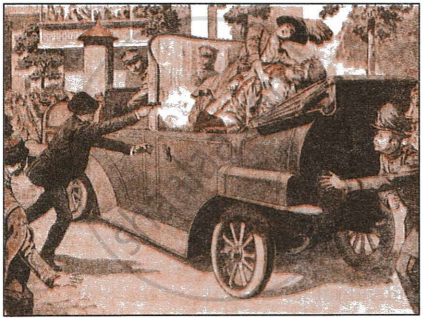
- Identify the event in the picture and state how it became the immediate cause of the First World War.
- State any three other causes of the First World War.
- Mention any three clauses of the Treaty of Versailles.
Thinking Skills
More than national pride, it was the greed to acquire colonies and thereby more money and resources that led to the First World War. Explain.
Do you think that the First World War could have been avoided? Give reasons to support your answer.
Solutions for 10: The First World War
Morning Star solutions for टोटल हिस्ट्री एण्ड सिविक्स [अंग्रेजी] कक्षा १० आईसीएसई chapter 10 - The First World War
Shaalaa.com has the CISCE Mathematics टोटल हिस्ट्री एण्ड सिविक्स [अंग्रेजी] कक्षा १० आईसीएसई CISCE solutions in a manner that help students grasp basic concepts better and faster. The detailed, step-by-step solutions will help you understand the concepts better and clarify any confusion. Morning Star solutions for Mathematics टोटल हिस्ट्री एण्ड सिविक्स [अंग्रेजी] कक्षा १० आईसीएसई CISCE 10 (The First World War) include all questions with answers and detailed explanations. This will clear students' doubts about questions and improve their application skills while preparing for board exams.
Further, we at Shaalaa.com provide such solutions so students can prepare for written exams. Morning Star textbook solutions can be a core help for self-study and provide excellent self-help guidance for students.
Concepts covered in टोटल हिस्ट्री एण्ड सिविक्स [अंग्रेजी] कक्षा १० आईसीएसई chapter 10 The First World War are Results of the First World War, Causes of First World War, The First World War and Its Global Impact, Events of the First World War, Events of the First World War, League of Nations, Results of the First World War, Causes of First World War, The First World War and Its Global Impact, Events of the First World War, Events of the First World War, League of Nations, Results of the First World War, Causes of First World War, The First World War and Its Global Impact, Events of the First World War, Events of the First World War, League of Nations.
Using Morning Star टोटल हिस्ट्री एण्ड सिविक्स [अंग्रेजी] कक्षा १० आईसीएसई solutions The First World War exercise by students is an easy way to prepare for the exams, as they involve solutions arranged chapter-wise and also page-wise. The questions involved in Morning Star Solutions are essential questions that can be asked in the final exam. Maximum CISCE टोटल हिस्ट्री एण्ड सिविक्स [अंग्रेजी] कक्षा १० आईसीएसई students prefer Morning Star Textbook Solutions to score more in exams.
Get the free view of Chapter 10, The First World War टोटल हिस्ट्री एण्ड सिविक्स [अंग्रेजी] कक्षा १० आईसीएसई additional questions for Mathematics टोटल हिस्ट्री एण्ड सिविक्स [अंग्रेजी] कक्षा १० आईसीएसई CISCE, and you can use Shaalaa.com to keep it handy for your exam preparation.
