Advertisements
Chapters
1: Interpretation of Topographical Maps
2: Contours
3: Scales and Direction
4: Map Reading and Interpretation
5: Map of India
PART II - GEOGRAPHY OF INDIA
6: Climate
▶ 7: Soil Resources
8: Natural Vegetation
9: Water Resources
10: Mineral Resources
11: Conventional Sources of Energy
12: Non-Conventional Sources of Energy
13: Agriculture - I
14: Agriculture - II: Food Crops
15: Agriculture - III: Cash Crops (1)
16: Agriculture - IV: Cash Crops (2)
17: Manufacturing Industries (Agro-Based)
18: Mineral Based Industry
19: Transport
20: Waste Management - I: Impact of Waste Accumulation
21: Waste Management - II: Safe Disposal of Waste
![Morning Star solutions for टोटल जियोग्राफी वॉल्यूम १ [अंग्रेजी] कक्षा १० आईसीएसई chapter 7 - Soil Resources - Shaalaa.com](/images/total-geography-volume-1-english-class-10-icse_6:1360961034ba453ca5adb591ff5e5f94.jpg "Morning Star solutions for टोटल जियोग्राफी वॉल्यूम १ [अंग्रेजी] कक्षा १० आईसीएसई chapter 7 - Soil Resources")
Advertisements
Solutions for Chapter 7: Soil Resources
Below listed, you can find solutions for Chapter 7 of CISCE Morning Star for टोटल जियोग्राफी वॉल्यूम १ [अंग्रेजी] कक्षा १० आईसीएसई.
Morning Star solutions for टोटल जियोग्राफी वॉल्यूम १ [अंग्रेजी] कक्षा १० आईसीएसई 7 Soil Resources EXERCISES [Pages 93 - 97]
Choose the correct option:
Which of the following would you add to your garden to increase the fertility to the soil?
Silica
Humus
Clay
Sand
Which of the following are the characteristics of fertile soil?
Adequate amount of moisture
Rich in nutrients
Organic matter
All of the above
You had gone to a village near Patna. When you enquired about the type of soil you were told, it was ex situ. Which of the following is it?
Alluvial soil
Laterite soil
Red soil
Black soil
Which of the following soils vary from place to place on the basis of the parental rocks and climatic conditions?
Black soil
Laterite soil
Alluvial soil
Red soil
Assertion (A): Transported soils do not have a well defined soil profile.
Reason (R): They constitute soils that are transported by various agents of erosion.
Both A and R are true and R is the correct explanation of A.
Both A and R are true but R does not explain A.
A is true but R is false.
A is false but R is true.
Farmers plant trees in several rows to check soil erosion by ______.
floods
winds
drought
heavy rains
Alluvial soil is rich in which of the following minerals?
Iron
Nitrogen
Phosphorus
None of the above
Assertion (A): The Northern Plains comprises riverine soil.
Reason (R): Riverine soil is a mixture of sand, clay and silt.
Both A and R are true and R is the correct explanation of A.
Both A and R are true but R does not explain A.
A is true but R is false.
A is false but R is true.
Red soil gets its name from ______.
its colour
its ferric oxide content
Both its colour and its ferric oxide content
None of the above
Black soil is also known as ______.
Bhangar
Khadar
Regur
Leached
Laterite soil is mainly found in the highland areas of ______.
the Himalayas
the Peninsular Plateau
the Aravali Range
the Karakoram Range
Why is Black soil highly moisture retentive?
It has fifty percent of clay content.
It is formed of weathered lava rocks.
It has high quantities of lime and iron.
All of the above
Which of the following soils forms the second largest soil group in India?
Black soil
Red soil
Yellow soil
Brown soil
Assertion (A): Laterite soils are rich in alumina and iron oxide, but are infertile.
Reason (R): Soluble plant food like potash are leached into the soil.
Both A and R are true and R is the correct explanation of A.
Both A and R are true but R does not explain A.
A is true but R is false.
A is false but R is true.
Which of the following is correct about the Laterite soil?
It is the residual soil.
It is formed by leaching due to tropical rains.
Humus content of the soil is removed by bacteria.
All of the above.
What is the feel and consistency of soil called?
Soil profile
Soil texture
Soil fertility
Soil arability
Answer the following questions:
What is the soil?
Name the four types of soil.
State any two factors responsible for the formation of soil.
Give geographical reasons for the following:
The colour of alluvium varies in different areas.
Give geographical reasons for the following:
Khadar is more fertile than banghar soil.
Give a reason for the following statement:
Black Soil has self-ploughing property.
How can you say that soil has evolved over millions of years?
Name one important constituent of soil that adds fertility to the soil.
How are alluvial soils formed?
Mention any two advantages of alluvial soil.
Give geographical reasons for the following:
Different regions in India have different kinds of soil for agriculture.
Give geographical reason for the following:
Alluvial soils vary in texture.
Give geographical reasons for the following:
Nearly all types of crops grow well in riverine soils.
Why is soil a valuable resource for India?
Write a note on a mechanical method for soil conservation.
Give any two characteristics or features of the soil found most suitable for growing cotton and sugarcane in Maharashtra.
Name one soil of volcanic origin commonly found in India. Name one crop widely grown on this soil.
Why is deltaic alluvium more fertile than coastal alluvium?
Give a geographical reason for the following:
Black soil is largely found in the Deccan Trap region.
Give a geographical reason for the following:
Black soil is often referred to as Cotton soil or Regur soil.
Name the process by which Laterite soil is formed.
Mention one disadvantage of Laterite soil.
Pawan and Akash have been friends since childhood. Both of them are farmers in a village near Prayagraj. They often compare their inputs so as to increase their yields. Pawan, whose farm is along the Ganges, gets better yields with lower inputs of fertilizer and irrigation than Akash whose fields are twenty kilometres away. Identify their soils. [Hint: Sub-categories of a major soil type.] Which one of them is superior to the other? Why?
| Pawan and Akash have been friends since childhood. Both of them are farmers in a village near Prayagraj. They often compare their inputs so as to increase their yields. Pawan, whose farm is along the Ganges, gets better yields with lower inputs of fertilizer and irrigation than Akash, whose fields are twenty kilometres away. |
What are the characteristics of the soil of Pawan’s and Akash’s farms?
Give geographical reasons for the following:
Laterite soil is useful for construction purpose.
Give geographical reasons for the following:
Soils of the Western Ghats are affected by wind erosion.
Give geographical reasons for the following:
The foothills of the Himalayas are prone to excessive soil erosion.
Which soil is suitable for growing coffee in Karnataka? Mention two main characteristics of this soil.
Name two states in India where Regur soil is found.
Give two points of difference between Regur and Alluvial soil.
Give a geographical reason for the following:
Jowar is grown in Maharashtra.
Give a geographical reason for the following:
Bajra is grown in Rajasthan.
Give a geographical reason for the following:
Sugarcane is grown in Uttar Pradesh.
Besides cotton, name the crops which grow well in Regur soil.
In what way does Regur soil help agriculture?
Name two states where red soil is found.
Mention two important crops grown in red soil.
You have two sacks of red coloured soil. How would you identify red soil?
Give a geographical reason for the following:
You have gone to Rishikesh and notice that the soil is dry, coarse, porous and sandy.
Give a geographical reason for the following:
The soil in your ancestral village at the outskirts of Agra has fine, smooth and moist particles.
Give a geographical reasons for the following:
You have gone to Jhansi for an excursion and notice the colour of the soil is a shade of red.
How is red soil formed?
How is red soil suitable for dry farming?
What is soil erosion?
Name the areas of soil erosion in India for wind erosion.
Name the areas of soil erosion in India for running water erosion.
Give two agricultural practises that would prevent soil erosion.
Give a geographical reason for the following:
Shelter belts reduce soil erosion in arid areas.
Give a geographical reason for the following:
Rural development will influence soil conservation.
Give a geographical reason for the following:
Water harvesting aids in soil conservation.
What is meant by soil conservation?
State two measures to conserve soil in hilly areas.
Study the picture of the Chambal Valley. What is responsible for erosion here? Briefly describe how soil is eroded in this case.
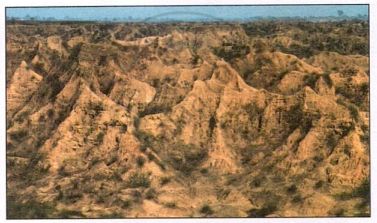
State two methods of controlling erosion of soil caused by running water.
Name two important agents of erosion. For each, state one method of controlling the erosion caused.
Explain briefly the need for conservation of soil as a natural resource.
| Harry is doing his research on different types of soil in India. He found that there is a particular soil which becomes sticky when wet and cracks when dry. |
- Identify the soil and explain how this soil is formed.
- Name two cash crops that are grown in this soil.
- India is a land of diversities and there are certain factors which influence the soil types. With reference to the given statement, mention the factors influencing their distribution in India.
A farmer bought land in an area having poor rainfall, with soil which is suitable for dry farming. Name the type of soil available in this area. Which crops will he be able to grow there?
Your uncle lives in a hilly area which gets heavy rainfall. He grows certain special crops like tea, coffee, tapioca and cashewnuts. Besides agriculture, he has a brick kiln as the area has ample raw material for making bricks. Name the area where your uncle may be residing. What type of soil is available in this area and how is it formed?
You had gone for an excursion to a mountainous region along with your teachers and classmates. On reaching there, you were shocked to see bare mountains with no vegetation or greenery. As a student of geography, what are the reasons for such deplorable conditions of the mountains? List the solutions to rectify the problem.
| More than 30% of the land in the Indian subcontinent is hilly in nature; therefore, terrace farming practices have allowed farming communities to thrive for ages. Farming communities in Uttarakhand and Himachal Pradesh have used this to cultivate maize, pulses, and wheat for both consumption and export. |
How does terrace farming ensure soil conservation?
Identify the cause of soil degradation in areas where terrace farming is practiced. Briefly explain how soil is degraded in this case.
Give a geographical reason for the following:
Strip cropping reduces erosion.
Give a geographical reason for the following:
Planting trees along fields improves soil quality.
Give a geographical reason for the following:
Zero tillage reduces soil erosion.
Soil health is essential for our survival. List the challenges we face in order to maintain soil health.
| The primary drivers of land degradation are water and wind erosion, which affect 94.87 million hectares of land in India (ICAR, 2010). |
Write short notes on any two ways that land degradation occurs by the action of water.
How does wind cause soil erosion?
How is poverty and land degradation linked through a vicious cycle?
Write a short note on any two methods to improve soil quality.
Thinking Skills
The load of the rivers such as Ganga-Brahmaputra, comprising sand, silt and gravels, is tremendous. This gets deposited in the deltas or the lower course of river over a long period forming river islands. These islands can be temporary or permanent because they may also disappear when the volume of river water or its speed increases. Majuli, Assam, in the Brahmaputra is a permanent riverine island which is rich in biodiversity.
Chars in Bangladesh are mostly islands formed in large deltas of the Ganga Brahmaputra system. Mostly these islands are not permanent as they last as long as the river is full of sediments and is slow. What do you think is the land use in chars?
| The government is preparing to upgrade the soil-testing process by empowering farmers with a handheld digital tool that can deliver real-time results with satellite technology. With this device, farmers will be able to quickly assess soil properties like texture, organic matter, pH and nutrient levels in seconds, for precision farming. - Hindustan Times 19 May, 2025 |
Explain the benefits of this scheme to your friend who is a farmer.
Solutions for 7: Soil Resources
Morning Star solutions for टोटल जियोग्राफी वॉल्यूम १ [अंग्रेजी] कक्षा १० आईसीएसई chapter 7 - Soil Resources
Shaalaa.com has the CISCE Mathematics टोटल जियोग्राफी वॉल्यूम १ [अंग्रेजी] कक्षा १० आईसीएसई CISCE solutions in a manner that help students grasp basic concepts better and faster. The detailed, step-by-step solutions will help you understand the concepts better and clarify any confusion. Morning Star solutions for Mathematics टोटल जियोग्राफी वॉल्यूम १ [अंग्रेजी] कक्षा १० आईसीएसई CISCE 7 (Soil Resources) include all questions with answers and detailed explanations. This will clear students' doubts about questions and improve their application skills while preparing for board exams.
Further, we at Shaalaa.com provide such solutions so students can prepare for written exams. Morning Star textbook solutions can be a core help for self-study and provide excellent self-help guidance for students.
Concepts covered in टोटल जियोग्राफी वॉल्यूम १ [अंग्रेजी] कक्षा १० आईसीएसई chapter 7 Soil Resources are Soil Formation and Factors Affecting It, Soil Erosion, Soil Conservation Schemes Initiated by the Government, Alluvial Soil VS Black Soil VS Red Soil VS Laterite Soil, Introduction to Soil in India, Types of Soil > Alluvial Soil, Types of Soil > Black Soil, Types of Soil > Red Soil, Types of Soil > Laterite Soils, Causes of Soil Erosion, Prevention of Soil Erosion, Soil Conservation, Soil Formation and Factors Affecting It, Soil Erosion, Soil Conservation Schemes Initiated by the Government, Alluvial Soil VS Black Soil VS Red Soil VS Laterite Soil, Introduction to Soil in India, Types of Soil > Alluvial Soil, Types of Soil > Black Soil, Types of Soil > Red Soil, Types of Soil > Laterite Soils, Causes of Soil Erosion, Prevention of Soil Erosion, Soil Conservation, Soil Formation and Factors Affecting It, Soil Erosion, Soil Conservation Schemes Initiated by the Government, Alluvial Soil VS Black Soil VS Red Soil VS Laterite Soil, Introduction to Soil in India, Types of Soil > Alluvial Soil, Types of Soil > Black Soil, Types of Soil > Red Soil, Types of Soil > Laterite Soils, Causes of Soil Erosion, Prevention of Soil Erosion, Soil Conservation.
Using Morning Star टोटल जियोग्राफी वॉल्यूम १ [अंग्रेजी] कक्षा १० आईसीएसई solutions Soil Resources exercise by students is an easy way to prepare for the exams, as they involve solutions arranged chapter-wise and also page-wise. The questions involved in Morning Star Solutions are essential questions that can be asked in the final exam. Maximum CISCE टोटल जियोग्राफी वॉल्यूम १ [अंग्रेजी] कक्षा १० आईसीएसई students prefer Morning Star Textbook Solutions to score more in exams.
Get the free view of Chapter 7, Soil Resources टोटल जियोग्राफी वॉल्यूम १ [अंग्रेजी] कक्षा १० आईसीएसई additional questions for Mathematics टोटल जियोग्राफी वॉल्यूम १ [अंग्रेजी] कक्षा १० आईसीएसई CISCE, and you can use Shaalaa.com to keep it handy for your exam preparation.
