Dheeraj Mehrotra solutions for कम्प्यूटर साइंस [अंग्रेजी] कक्षा १२ chapter 1 - Boolean Algebra [Latest edition]
Chapters
2: Computer Hardware
3: Programming in Java (Review of Class XI Sections B and C)
4: Objects
5: Primitive Values, Wrapper Classes, Types and Casting
6: Variables and Expressions
Chapter 7: Statements and their Scope
Chapter 8: Methods
Chapter 9: Arrays and Strings in Java
Chapter 10: Recursion in Java
Chapter 11: Inheritance and Polymorphism
Chapter 12: Data Structures
Chapter 13: Complexity and Big O Notation
Chapter 14: Practical Programs (Solved and UnSolved)
Advertisements
Advertisements
Solutions for Chapter 1: Boolean Algebra
Below listed, you can find solutions for Chapter 1 of CISCE Dheeraj Mehrotra for कम्प्यूटर साइंस [अंग्रेजी] कक्षा १२.
Advertisements
Dheeraj Mehrotra solutions for कम्प्यूटर साइंस [अंग्रेजी] कक्षा १२ 1 Boolean Algebra EXERCISE [Pages 47 - 53]
Define the following term.
Binary Variable
Define the following term.
Binary Constant
Define the following term.
Boolean Function
Define the following term:
Complement of a boolean Variable
Define the following term.
Boolean Expression
Define the following term.
Truth Table
Define the following term.
Karnaugh Map
What are binary codes and logical circuits?
What is Boolean algebra?
State one reason for studying Boolean algebra in computer science.
State De Morgan's Theorem.
|
A |
B |
X |
|---|---|---|
|
0 |
0 |
1 |
|
0 |
1 |
0 |
|
1 |
0 |
0 |
|
1 |
1 |
1 |
Which logic gate has the above truth table. Draw its symbol. Write X in terms of boolean expression.
What do you understand by Switching Circuits?
Explain the concept of GATES as applied in computers.
Explain the Logical Operators and Truth Table.
What are Digital Circuits?
How ALU is made with digital circuits?
Obtain the Truth Table of the following expression:
F(AB,C) = A.B.C' +A'.B+C'
Write a Boolean expression that will have 1 as the output when X = 0, Y = 1, Z = 0 and 0 as the output for all the other values of X, Y, and Z.
State the various postulates of Boolean algebra.
State the various theorems of Boolean algebra.
Reduce the following using postulates and theorems:
A'.B' +A' + A.B
Reduce the following using postulates and theorems:
X.Y + X'.Y' + X.Y'
Reduce the following using postulates and theorems:
A'.B'.C' + A'.B.C' + A.B'.C' + A.B.C'
Prove that (X' + Z) + [(Y' + Z) . (X' + Y)]' = 1.
Prove that A'.B.C' + A'.B.C+A.B.C' + ABC + (A.B)' = 1.
Simplify
P.Q'. (PQR + PQ'R + Q'.R') + P.Q
Simplify:
XY' + (X' + Y') . (X + Y')
Simplify:
AB'C + AB′C' + A'BC + A'B'C + A.B
Simplify:
X + X'.Y + XY'
Simplify:
A' + A.B' + B + B.C'
Simplify:
(X + Y.Z') . (X' + Z) . (Y + X'.Z)
Explain the principle of duality.
Explain the various steps involved in calculating the dual of any Boolean expression.
State the principle of duality. Give the dual of the following Boolean relation:
A + (A'.B) = A + В
State the principle of duality. Give the dual of the following Boolean relation:
A + 0 = A
State the two distributive laws of Boolean Algebra. Use Truth Table to prove any one of them.
Reduce the expression:
A.B' + A'.B + A.B + A'.B'
Write the truth table and draw the logic symbol of a 2-input EXOR gate.
Draw the logic circuit of a 2-input EXOR gate using AND, OR and NOT gates.
Prepare the truth table for the following:
A.B + A'.B'
Prepare the truth table for the following:
X.Y.Z' +Z'
Prepare the truth table for the following:
X+X'.Y'
Obtain the complement of the following:
X.Y' + X.Y'
Obtain the complement of the following:
X.Y + X'
Obtain the complement of the following:
A.B.C' + A.B'.C
Obtain the complement of the following:
X' + X.Y' + X.Y'
Obtain the complement of the following:
(W + X).(Y + Z)
Prove the following using a postulate/theorem:
((A+B)' + (A+B)')' = A+B
Prove the following using a postulate/theorem:
A.(A + B) = A
Prove the following using a postulate/theorem:
(A + B)' = A'.B'
Prove the following using a postulate/theorem:
(X.Y)' = X' + Y'
Obtain the SOP form of the following truth table.
|
A |
B |
C |
F(A,B,C) |
|---|---|---|---|
|
0 |
0 |
0 |
1 |
|
0 |
0 |
1 |
0 |
|
0 |
1 |
0 |
1 |
|
0 |
1 |
1 |
0 |
|
1 |
0 |
0 |
1 |
|
1 |
0 |
1 |
0 |
|
1 |
1 |
0 |
1 |
|
1 |
1 |
1 |
1 |
Obtain the POS form of the following truth table.
|
A |
B |
C |
F(A,B,C) |
|---|---|---|---|
|
0 |
0 |
0 |
1 |
|
0 |
0 |
1 |
0 |
|
0 |
1 |
0 |
1 |
|
0 |
1 |
1 |
0 |
|
1 |
0 |
0 |
1 |
|
1 |
0 |
1 |
0 |
|
1 |
1 |
0 |
1 |
|
1 |
1 |
1 |
1 |
Obtain the SOP form of the following truth table.
|
A |
B |
C |
F(A,B,C) |
|---|---|---|---|
|
0 |
0 |
0 |
1 |
|
0 |
0 |
0 |
0 |
|
0 |
0 |
1 |
0 |
|
0 |
1 |
0 |
0 |
|
0 |
1 |
1 |
1 |
|
1 |
0 |
0 |
1 |
|
1 |
0 |
1 |
1 |
|
1 |
1 |
0 |
0 |
|
1 |
1 |
1 |
1 |
Obtain the POS form of the following truth table.
|
A |
B |
C |
F(A,B,C) |
|---|---|---|---|
|
0 |
0 |
0 |
1 |
|
0 |
0 |
0 |
0 |
|
0 |
0 |
1 |
0 |
|
0 |
1 |
0 |
0 |
|
0 |
1 |
1 |
1 |
|
1 |
0 |
0 |
1 |
|
1 |
0 |
1 |
1 |
|
1 |
1 |
0 |
0 |
|
1 |
1 |
1 |
1 |
Draw the logic circuit of the following Boolean expression:
A'.B'.C + A.B'.C
Draw the logic circuit of the following Boolean expression:
A.B+ A'.B' + A'В
Draw the logic circuit of the following Boolean expression:
A.B.C + A'.B' + A'.B.С
A boolean function F is defined on three input variables A, B and C is 1 if and only if number of 1 inputs is odd. Draw the truth table for the above function and express it in sum of products and product of sums formats.
Convert the following three input boolean function into SOP format:
F(A,B,C) = Σ(0,1,2,5)
Reduce the following using a Karnaugh map:
A'.B' + A'.B + А.В
Reduce the following using a Karnaugh map:
X.Y + X'.Y' + X.Y'
Reduce the following using a Karnaugh map:
A'.B'.C' + A'.B.C' + A.B'.C' + A.B.С'
Reduce the following using a K-map:
F(A,B,C) = Σ(0,1,3,2)
Reduce the following using a K-map:
F(X,Y,Ζ) = Σ(0,1,2,5)
Reduce the following using a K-map:
F(A,B) = (A'+B).(A+B')
Reduce the following using a K-map:
F(A,B,C,D) = Σ(0,4,8,12)
Evaluate the simplified Boolean equation for the following K-map:
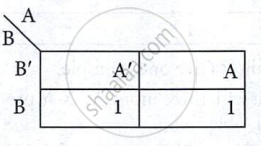
Evaluate the simplified Boolean equation for the following K-map:
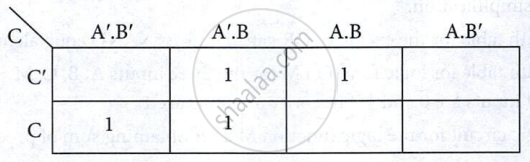
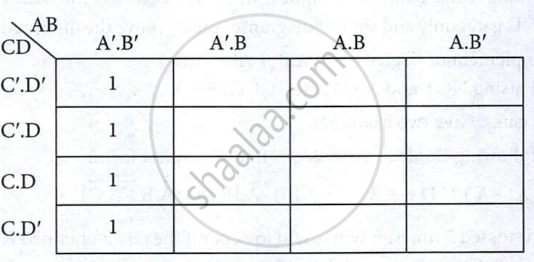
Evaluate the simplified Boolean equation for the following K-map:
What is the Boolean expression for the shaded area in the following diagram:
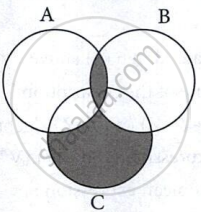
Draw a logic diagram corresponding to the following truth table:
|
A |
B |
C |
F(A,B,C) |
|---|---|---|---|
|
0 |
0 |
0 |
0 |
|
0 |
0 |
1 |
0 |
|
0 |
1 |
0 |
1 |
|
0 |
1 |
1 |
1 |
|
1 |
0 |
0 |
0 |
|
1 |
0 |
1 |
1 |
|
1 |
1 |
0 |
1 |
|
1 |
1 |
1 |
1 |
What is the principle of duality? Give one example.
A combinational logic circuit with three inputs W, X, Y produces output 1 if and only if an odd number of inputs is 1. Show its truth table.
Show that y' = A.B.C + A.B.C' + A.B'.C can be simplified to A.(B+C). Also mention the law used at each step of simplification.
Draw the truth table for the exclusive OR gate. Draw its NAND equivalent circuit.
Draw the truth table for logic function M for the three inputs A, B, C. M = f(A,B,C). The output is 0 if majority of inputs are 0 and 1 if majority of inputs are 1.
Draw the logic circuit for the logic function M after obtaining sum of products expression for M.
Given two inputs A and B and the output F, where F = A.B' + A'.B + A.B + A'.B'. Implement F using 2-input NAND gates only and show it diagrammatically. Give the intermediate results in the diagram.
Find the complement of E, given E = `bar(A.B) + A' + A.B`
Implement F using NOT and AND gates. Given F = X'.Y + X-Y.
Define a logic gate.
Give two examples of logic gates.
Reduce the following Boolean expression to its simplest form:
`[bar((C.D)+A)]+A+C.D+A.B`
Reduce the following Boolean expression to its simplest form:
`A.[B + C.(bar(A.B + A.C))]`
A coin is tossed 3 times. A win is said to occur if the result obtained is Heads for at least 2 tosses. Taking A, B, C as inputs and W as output, Write a truth table, given that A, B, C are 1 if the result is Heads or 0 if the result is Tails; and W is 1 if a win occurs otherwise it is 0.
- Write an expression for W.
- Reduce the expression obtained.
State the absorption laws. Verify one of the Absorption laws using a truth table.
Prove X + Y'.Z = (X + Y' + Z') (X + Y' + Z) (X + Y + Z) algebraically.
Write the dual of the Boolean expression (U.V + W).(V' + U).0 = 0
Obtain a simplified form for a Boolean expression:
F(X,Y,Z,W) = Σ(0,1,3,4,5,6,7,9,10,11,13,15) using a Karnaugh map.
Write the sum of product form of the function G(U, V, W) truth table representation of G is as follows:
|
U |
V |
W |
G |
|---|---|---|---|
|
0 |
0 |
0 |
1 |
|
0 |
0 |
1 |
1 |
|
0 |
1 |
0 |
0 |
|
0 |
1 |
1 |
0 |
|
1 |
0 |
0 |
1 |
|
1 |
0 |
1 |
1 |
|
1 |
1 |
0 |
0 |
|
1 |
1 |
1 |
0 |
Prove A.B + A'.C = (A + C). (A' + B) using Boolean postulates.
Why are NOR and NAND gates called universal gates?
Draw the logic circuit of the following Boolean function using NAND gates only.
F(A,B,C,D) = A.C + C.D + B.C
Represent the following Boolean function using NOR gates only.
F(A,B,C) = (A + C).(A + B).(B + C)
Represent the following using NOR gates only.
F(A,B,C) = A.(B' + C)
Represent the Boolean expression X + Y.Z' using NAND gates only.
Draw the logic circuit for the expression:
(X.Y)'. (X+Z') . (X.Z)'
Write the sum of Product form of the function G (u, v, w), truth table representation of G is as follows:
|
U |
V |
W |
G |
|---|---|---|---|
|
0 |
0 |
0 |
1 |
|
0 |
0 |
1 |
1 |
|
0 |
1 |
0 |
0 |
|
0 |
1 |
1 |
1 |
|
1 |
0 |
0 |
1 |
|
1 |
0 |
1 |
1 |
|
1 |
1 |
0 |
0 |
|
1 |
1 |
1 |
1 |
Simplify the following Boolean expression using laws of Boolean Algebra. At each step state clearly the law used for simplification.
X.Y. (X.Y + Y.Z)
State De Morgan's Laws. Verify any one of them using a truth table.
Convert the following sum-of-products expression into its corresponding product-of-sums form:
F(O, V, W) = O'.V'.W' + O'.V'.W + O'.V.W + O.V'.W
Find the complement of F(a,b,c,d) = [a + {(b + c).(b' + d')}].
Draw the logic gate diagram of the XOR gate.
Draw the truth table of the XOR gate.
Given the Boolean function F(A, B, C, D) = Σ(0,2,3,4,6,7,9,13)
- Use Karnaugh's map to reduce this function F, using the given SOP form. Draw logic gate diagram for the reduced SOP form. You may use gates with more than two inputs. Assume that variables and their complements are available as inputs.
- Given X(A, B, C, D) = П(2,3,4,5,12,14)
Explain the following:
Disjunctive Operator
Explain the following:
Conjunctive Operator
Explain the following:
Conditional Operator
Explain the following:
Equivalence
Explain the following:
Negative
Explain the usage of the following operator:
∼
Explain the usage of the following operator:
∧
Explain the usage of the following operator:
↔
Explain the usage of the following operator:
∨
Explain the following:
Conjunction
Explain the following:
Disjunction
Explain the following:
Negation
Explain the following:
Implication
Explain the following:
Decisional
Explain the following:
Antecedent
Explain the following:
Consequent
Give an example of the following type:
Converse
Give an example of the following type:
Inverse
Give an example of the following type:
Contra-positive
Define the term Tautology.
Give a valid example of Tautology.
Define the term Contradiction.
Give a valid example of Contradiction.
Complete the following law:
p v p = ______
Complete the following law:
p ∧ p = ______
Complete the following law:
p → q = ______
Complete the following law:
p ∧ (q ∨ r) = ______
Complete the following law:
~ (p ∧ q) = ______
Complete the following law:
∼ (p ∨ q) = ______
Complete the following law:
(p ∨ p') = ______
Complete the following law:
p ∧ p' = ______
Complete the following law:
p ∨ q = ______
Complete the following law:
p ∧ p = ______
Complete the following law:
(p ∨ q) ∨ r = ______
Complete the following law:
(p ∧ q) ∨ r = ______
Complete the following law:
p ∨ (q ∨ r) = ______
If p and q are propositions, construct a truth table for the following:
p ∧ q'
If p and q are propositions, construct a truth table for the following:
p ∨ q
If p and q are propositions, construct a truth table for the following:
p ⇒ q
If p and q are propositions, construct a truth table for the following:
(p ⇒ q) ∧ (q ⇒ p)
If p and q are propositions, construct a truth table for the following:
p ∧ q ∧ r
Determine whether the following is valid/satisfiable or unsatisfiable.
(p → q) ∧ r
Determine whether the following is valid/satisfiable or unsatisfiable.
(p → q) ∧ r
Determine whether the following is valid/satisfiable or unsatisfiable.
(a ∧ b) ↔ (~ a ∧ ~ b)
Determine whether the following is valid/satisfiable or unsatisfiable.
(a ∨ b) ∧ (~ a ∧ ~ b)
Draw the truth table of the proportional logic expression:
p ⇒ q
Draw the truth table of the proportional logic expression:
p ⇔ q
If (x ⇒ y), then write its converse:
If (x ⇒ y), then write its contrapositive.
Define the term Contradiction.
Define the term Tautology.
Define the term contingency.
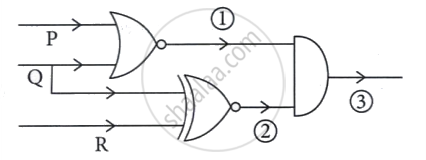
Derive the expression for the given logic circuits and simplify it.
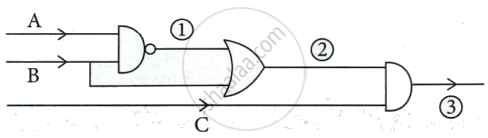
Derive the expression for the given logic circuits and simplify it.
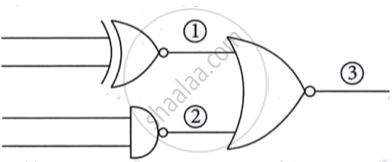
XNOR will give AB + A'B' NAND will give (AB)'
Derive the expression for the given logic circuits and simplify it.
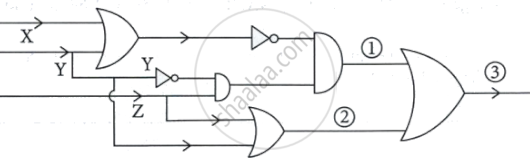
Derive the expression for the given logic circuits and simplify it.
Solutions for 1: Boolean Algebra
Dheeraj Mehrotra solutions for कम्प्यूटर साइंस [अंग्रेजी] कक्षा १२ chapter 1 - Boolean Algebra
Shaalaa.com has the CISCE Mathematics कम्प्यूटर साइंस [अंग्रेजी] कक्षा १२ CISCE solutions in a manner that help students grasp basic concepts better and faster. The detailed, step-by-step solutions will help you understand the concepts better and clarify any confusion. Dheeraj Mehrotra solutions for Mathematics कम्प्यूटर साइंस [अंग्रेजी] कक्षा १२ CISCE 1 (Boolean Algebra) include all questions with answers and detailed explanations. This will clear students' doubts about questions and improve their application skills while preparing for board exams.
Further, we at Shaalaa.com provide such solutions so students can prepare for written exams. Dheeraj Mehrotra textbook solutions can be a core help for self-study and provide excellent self-help guidance for students.
Concepts covered in कम्प्यूटर साइंस [अंग्रेजी] कक्षा १२ chapter 1 Boolean Algebra are Propositional Logic, Well Formed Formulae, Truth Values and Interpretation of Well Formed Formulae, Truth Tables, Satisfiable, Unsatisfiable, Valid Formulae, Equivalence Laws and Their Use in Simplifying Well Formed Formulaes, Binary-valued Quantities, Basic Postulates of Boolean Algebra Operations AND, OR and NOT, Basic Theorems of Boolean Algebra (Eg. Duality, Idempotence, Commutativity, Associativity, Distributivity, Operations with 0 and 1, Complements, Absorption, Involution), DeMorgan’S Law/Theorem and Their Applications, Reducing Boolean Expression (SOP and POS) to Its Minimal Form, Use of Karnaugh Map for Minimization of Boolean Expressions (Up to 4 Variables).
Using Dheeraj Mehrotra कम्प्यूटर साइंस [अंग्रेजी] कक्षा १२ solutions Boolean Algebra exercise by students is an easy way to prepare for the exams, as they involve solutions arranged chapter-wise and also page-wise. The questions involved in Dheeraj Mehrotra Solutions are essential questions that can be asked in the final exam. Maximum CISCE कम्प्यूटर साइंस [अंग्रेजी] कक्षा १२ students prefer Dheeraj Mehrotra Textbook Solutions to score more in exams.
Get the free view of Chapter 1, Boolean Algebra कम्प्यूटर साइंस [अंग्रेजी] कक्षा १२ additional questions for Mathematics कम्प्यूटर साइंस [अंग्रेजी] कक्षा १२ CISCE, and you can use Shaalaa.com to keep it handy for your exam preparation.
