Please select a subject first
Advertisements
Advertisements
Explain why photoelectric effect cannot be explained on the basis of wave nature of light.
Concept: undefined >> undefined
Derive an expression for de Broglie wavelength of electrons.
Concept: undefined >> undefined
Advertisements
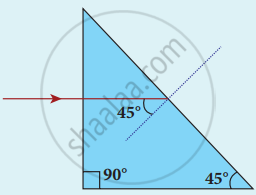
A beam of light consisting of red, green and blue is incident on a right-angled prism as shown in figure. The refractive index of the material of the prism for the above red, green and blue colours are 1.39, 1.44 and 1.47 respectively. What are the colours suffer total internal reflection?
Concept: undefined >> undefined
Briefly explain the principle and working of electron microscope.
Concept: undefined >> undefined
Describe briefly Davisson – Germer experiment which demonstrated the wave nature of electrons.
Concept: undefined >> undefined
How do we obtain characteristic x-ray spectra?
Concept: undefined >> undefined
What should be the velocity of the electron so that its momentum equals that of 4000 Å wavelength photon.
Concept: undefined >> undefined
Calculate the de Broglie wavelength of a proton whose kinetic energy is equal to 81.9 × 10⁻¹⁵ J.
(Given: mass of proton is 1836 times that of electron).
Concept: undefined >> undefined
A deuteron and an alpha particle are accelerated with the same potential. Which one of the two has
- greater value of de Broglie wavelength associated with it and
- less kinetic energy?
Explain.
Concept: undefined >> undefined
An electron is accelerated through a potential difference of 81 V. What is the de Broglie wavelength associated with it? To which part of the electromagnetic spectrum does this wavelength correspond?
Concept: undefined >> undefined
The ratio between the de Broglie wavelength associated with proton accelerated through a potential of 512 V and that of alpha particle accelerated through a potential of X volts is found to be one. Find the value of X.
Concept: undefined >> undefined
The barrier potential of a silicon diode is approximately, ____________.
Concept: undefined >> undefined
In an unbiased p-n junction, the majority of charge carriers (that is, holes) in the p-region diffuse into the n-region because of
Concept: undefined >> undefined
If a positive half-wave rectified voltage is fed to a load resistor, for which part of a cycle there will be current flow through the load?
Concept: undefined >> undefined
The zener diode is primarily used as ____________.
Concept: undefined >> undefined
The barrier potential of a p-n junction depends on
(i) type of semiconductor material
(ii) amount of doping
(iii) temperature
Which one of the following is correct?
Concept: undefined >> undefined
Which one of the following represents forward bias diode?
Concept: undefined >> undefined
A diode is called a unidirectional device. Explain.
Concept: undefined >> undefined
What do you mean by leakage current in a diode?
Concept: undefined >> undefined
Draw the input and output waveforms of a full wave rectifier.
Concept: undefined >> undefined
