Please select a subject first
Advertisements
Advertisements
Answer briefly.
Why does amplitude modulation give noisy reception?
Concept: undefined >> undefined
Answer briefly.
Explain why is modulation needed.
Concept: undefined >> undefined
Advertisements
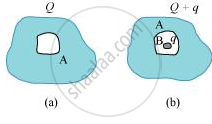
(a) A conductor A with a cavity as shown in Fig (a) is given a charge Q. Show that the entire charge must appear on the outer surface of the conductor.
(b) Another conductor B with charge q is inserted into the cavity keeping B insulated from A. Show that the total charge on the outside surface of A is Q + q [Fig. (b)].
(c) A sensitive instrument is to be shielded from the strong electrostatic fields in its environment. Suggest a possible way.
Concept: undefined >> undefined
Answer the following question.
State the units of linear charge density.
Concept: undefined >> undefined
Two charges 5 μC and -4μC are kept 5.0 m apart at points A and B respectively. How much work will have to be done to move the charge at A through a distance of 5.0 m further away from point B along the line BA?
Concept: undefined >> undefined
Answer the following question.
While rotating an object or while opening a door or a water tap we apply a force or forces. Under which conditions is this process easy for us? Why? Define the vector quantity concerned. How does it differ for a single force and for two opposite forces with different lines of action?
Concept: undefined >> undefined
Answer the following question.
Why is the moment of a couple independent of the axis of rotation even if the axis is fixed?
Concept: undefined >> undefined
Answer the following question.
Explain the term 'steady state'.
Concept: undefined >> undefined
Answer the following question.
Define coefficient of thermal conductivity.
Concept: undefined >> undefined
Answer the following question.
Derive its expression for the coefficient of thermal conductivity.
Concept: undefined >> undefined
Answer the following question.
Give any four applications of thermal conductivity in everyday life.
Concept: undefined >> undefined
Answer the following question.
Explain the term thermal resistance. State its SI unit and dimensions.
Concept: undefined >> undefined
Answer the following question.
How heat transfer occurs through radiation in absence of a medium?
Concept: undefined >> undefined
Answer the following question.
Which materials can be used as thermal insulators and why?
Concept: undefined >> undefined
Solve the following problem.
Which will require more energy, heating a 2.0 kg block of lead by 30 K or heating a 4.0 kg block of copper by 5 K?
(slead = 128 J kg–1 K–1, `"s"_"copper"` = 387 J kg–1 K–1)
Concept: undefined >> undefined
Solve the following problem.
The rate of flow of heat through a copper rod with temperature difference 30 °C is 1500 cal/s. Find the thermal resistance of copper rod.
Concept: undefined >> undefined
Solve the following problem.
An electric kettle takes 20 minutes to heat a certain quantity of water from 0 °C to boiling point. It requires 90 minutes to turn all the water at 100 °C into steam. Find the latent heat of vaporization. (Specific heat of water = 1 cal/g °C)
Concept: undefined >> undefined
Solve the following problem.
Find the temperature difference between two sides of a steel plate 4 cm thick, when the heat is transmitted through the plate at the rate of 400 k cal per minute per square meter at a steady state. Thermal conductivity of steel is 0.026 kcal/m s K.
Concept: undefined >> undefined
Explain balancing or mechanical equilibrium. The linear velocity of a rotating fan as a whole is generally zero. Is it in mechanical equilibrium? Justify your answer.
Concept: undefined >> undefined
Solve the following problem.
A 2 m long wooden plank of mass 20 kg is pivoted (supported from below) at 0.5 m from either end. A person of mass 40 kg starts walking from one of these pivots to the farther end. How far can the person walk before the plank topples?
Concept: undefined >> undefined
