Please select a subject first
Advertisements
Advertisements
A person A can clearly see objects between 25 cm and 200 cm. Which of the following may represent the range of clear vision for a person B having muscles stronger than A, but all other parameters of eye identical to that of A?
Concept: undefined >> undefined
The focal length of a normal eye-lens is about
Concept: undefined >> undefined
Advertisements
The distance of the eye-lens from the retina is x. For a normal eye, the maximum focal length of the eye-lens
Concept: undefined >> undefined
A man wearing glasses of focal length +1 m cannot clearly see beyond 1 m
Concept: undefined >> undefined
When we see an object, the image formed on the retina is
(a) real
(b) virtual
(c) erect
(d) inverted
Concept: undefined >> undefined
Mark the correct options.
(a) If the far point goes ahead, the power of the divergent lens should be reduced.
(b) If the near point goes ahead, the power of the convergent lens should be reduced.
(c) If the far point is 1 m away from the eye, divergent lens should be used.
(d) If the near point is 1 m away from the eye, divergent lens should be used.
Concept: undefined >> undefined
A person looks at different trees in an open space with the following details. Arrange the trees in decreasing order of their apparent sizes.
| Tree | Height(m) | Distance from the eye(m) |
| A | 2.0 | 50 |
| B | 2.5 | 80 |
| C | 1.8 | 70 |
| D | 2.8 | 100 |
Concept: undefined >> undefined
Can virtual image be formed on the retina in a seeing process?
Concept: undefined >> undefined
A normal eye has retina 2 cm behind the eye-lens. What is the power of the eye-lens when the eye is (a) fully relaxed, (b) most strained?
Concept: undefined >> undefined
A nearsighted person cannot see beyond 25 cm. Assuming that the separation of the glass from the eye is 1 cm, find the power of lens needed to see distant objects.
Concept: undefined >> undefined
As `C = (1/V) Q` , can you say that the capacitance C is proportional to the charge Q?
Concept: undefined >> undefined
A capacitor has capacitance C. Is this information sufficient to know what maximum charge the capacitor can contain? If yes, what is this charges? If no, what other information is needed?
Concept: undefined >> undefined
A capacitor of capacitance C is charged to a potential V. The flux of the electric field through a closed surface enclosing the capacitor is
Concept: undefined >> undefined
Two capacitors each having capacitance C and breakdown voltage V are joined in series. The capacitance and the breakdown voltage of the combination will be
Concept: undefined >> undefined
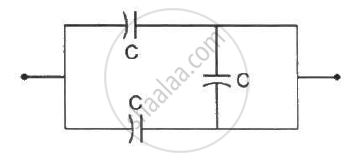
The equivalent capacitance of the combination shown in the figure is _________ .
Concept: undefined >> undefined
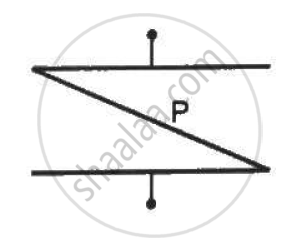
A thin metal plate P is inserted between the plates of a parallel-plate capacitor of capacitance C in such a way that its edges touch the two plates . The capacitance now becomes _________ .
Concept: undefined >> undefined
Two metal spheres of capacitance C1 and C2 carry some charges. They are put in contact and then separated. The final charges Q1 and Q2 on them will satisfy
Concept: undefined >> undefined
Three capacitors of capacitances 6 µF each are available. The minimum and maximum capacitances, which may be obtained are
Concept: undefined >> undefined
The capacitance of a capacitor does not depend on
Concept: undefined >> undefined
Following operations can be performed on a capacitor:
X − connect the capacitor to a battery of emf ε.
Y − disconnect the battery.
Z − reconnect the battery with polarity reversed.
W − insert a dielectric slab in the capacitor.
(a) In XYZ (perform X, then Y, then Z) the stored electric energy remains unchanged and no thermal energy is developed.
(b) The charge appearing on the capacitor is greater after the action XWY than after the action XYZ.
(c) The electric energy stored in the capacitor is greater after the action WXY than after the action XYW.
(d) The electric field in the capacitor after the action XW is the same as that after WX.
Concept: undefined >> undefined
