Please select a subject first
Advertisements
Advertisements
Fill in the blank in the following table:
| Class interval | Frequency | Cumulative Frequency |
| 25 - 34 | ...... | 15 |
| 35 - 44 | ...... | 28 |
| 45 - 54 | 21 | ...... |
| 55 - 64 | 16 | ...... |
| 65 - 74 | ...... | 73 |
| 75 - 84 | 12 | ...... |
Concept: undefined >> undefined
Given below are the marks obtained by 30 students in an examination:
| 08 | 17 | 33 | 41 | 47 | 23 | 20 | 34 |
| 09 | 18 | 42 | 14 | 30 | 19 | 29 | 11 |
| 36 | 48 | 40 | 24 | 22 | 02 | 16 | 21 |
| 15 | 32 | 47 | 44 | 33 | 01 |
Taking class intervals 1-10, 11-20, ....., 41-50; make a frequency table for the above distribution.
Concept: undefined >> undefined
Advertisements
Construct the frequency distribution table from the following cumulative frequency table:
| Ages | No. of students |
| Below 4 | 0 |
| Below 7 | 85 |
| Below 10 | 140 |
| Below 13 | 243 |
| Below 16 | 300 |
(i) State the number of students in the age group 10 - 13.
(ii) State the age-group which has the least number of students.
Concept: undefined >> undefined
Construct a frequency table from the following data:
| Marks | No. of students |
| less than 10 | 6 |
| less than 20 | 15 |
| less than 30 | 30 |
| less than 40 | 39 |
| less than 50 | 53 |
| less than 60 | 70 |
Concept: undefined >> undefined
Construct a frequency distribution table from the following cumulative frequency distribution:
| Class Interval | Cumulative Frequency |
| 10 - 19 | 8 |
| 20 - 29 | 19 |
| 30- 39 | 23 |
| 40- 49 | 30 |
Concept: undefined >> undefined
Construct a cumulative frequency distribution table from the frequency table given below:
( i )
| Class Interval | Frequency |
| 0 - 8 | 9 |
| 8 - 16 | 13 |
| 16 - 24 | 12 |
| 24 - 32 | 7 |
| 32 - 40 | 15 |
( ii )
| Class Interval | Frequency |
| 1 - 10 | 12 |
| 11 - 20 | 18 |
| 21 - 30 | 23 |
| 31 - 40 | 15 |
| 41 - 50 | 10 |
Concept: undefined >> undefined
Construct a cumulative frequency distribution table from the frequency table given below:
| Class Interval | Frequency |
| 0 -8 | 9 |
| 8 - 16 | 13 |
| 16 - 24 | 12 |
| 24 - 32 | 7 |
| 32 - 40 | 15 |
Concept: undefined >> undefined
The marks of 24 candidates in the subject mathematics are given below:
| 45 | 48 | 15 | 23 | 30 | 35 | 40 | 11 |
| 29 | 0 | 3 | 12 | 48 | 50 | 18 | 30 |
| 15 | 30 | 11 | 42 | 23 | 2 | 3 | 44 |
The maximum marks are 50. Make a frequency distribution taking class intervals 0 - 10, 10-20, .......
Concept: undefined >> undefined
Given below are the marks obtained by 30 students in an examination:
|
08 |
17 |
33 |
41 |
47 |
23 |
20 |
34 |
|
09 |
18 |
42 |
14 |
30 |
19 |
29 |
11 |
|
36 |
48 |
40 |
24 |
22 |
02 |
16 |
21 |
|
15 |
32 |
47 |
44 |
33 |
01 |
Taking class intervals 1 - 10, 11 - 20, ....., 41 - 50; make a frequency table for the above distribution.
Concept: undefined >> undefined
Construct a cumulative frequency distribution table from the frequency table given below:
| Class Interval | Frequency |
| 1 - 10 | 12 |
| 11 - 20 | 18 |
| 21 - 30 | 23 |
| 31 - 40 | 15 |
| 41 - 50 | 10 |
Concept: undefined >> undefined
Construct a frequency distribution table from the following cumulative frequency distribution:
| C.I | C.F |
| 5 - 10 | 18 |
| 10 - 15 | 30 |
| 15 - 20 | 46 |
| 20 - 25 | 73 |
| 25 - 30 | 90 |
Concept: undefined >> undefined
The diameter of a circle is 28 cm.
Find its :
(i) Circumference
(ii) Area.
Concept: undefined >> undefined
A metal wire, when bent in the form of an equilateral triangle of largest area, encloses an area of 484 `sqrt3` cm2. If the same wire is bent into the form of a circle of largest area, find the area of this circle.
Concept: undefined >> undefined
The circumference of a circular field is 308 m. Find is:
(i) Radius
(ii) Area.
Concept: undefined >> undefined
The sum of the circumference and diameter of a circle is 116 cm. Find its radius.
Concept: undefined >> undefined
The radii of two circles are 25 cm and 18 cm. Find the radius of the circle which has a circumference equal to the sum of circumferences of these two circles.
Concept: undefined >> undefined
The cost of fencing a circular field at the rate of ₹ 240 per meter is ₹ 52,800. The field is to be ploughed at the rate of ₹ 12.50 per m2. Find the cost of pouching the field.
Concept: undefined >> undefined
The radii of two circles are 48 cm and 13 cm. Find the area of the circle which has its circumference equal to the difference of the circumferences of the given two circles.
Concept: undefined >> undefined
In the given figure, the area of the shaded portion is 770 cm2. If the circumference of the outer circle is 132 cm, find the width of the shaded portion.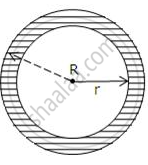
Concept: undefined >> undefined
The radius of a circle is 5 m. Find the circumference of the circle whose area is 49 times the area of the given circle.
Concept: undefined >> undefined
