Advertisements
Advertisements
Distinguish by a chemical test sodium chloride and sodium sulphide.
Concept: undefined >> undefined
Distinguish by a chemical test sodium hydroxide solution and ammonium hydroxide solution.
Concept: undefined >> undefined
Advertisements
Salts A, B, C, D and E undergo reactions (i) to (v) respectively. Identify the anion present in these salts on the basis of these reactions.
- When silver nitrate solution is added to a solution of A, a white precipitate, insoluble in dilute nitric acid, is formed.
- The addition of dilute hydrochloric acid to B produces a gas which turns lead acetate black on paper.
- When a freshly prepared solution of ferrous sulphate is added to a solution of C and concentrated sulphuric acid is gently poured from the side of the test tube, a brown ring is formed.
- When dilute sulphuric acid is added to D, a gas is produced which turns acidified potassium dichromate solution from orange to green.
- The addition of dilute hydrochloric acid to E produces effervescence. The gas produced turns lime water milky but does not affect acidified potassium dichromate solution.
Concept: undefined >> undefined
Identify the following substance:
Gas C has an offensive smell like rotten eggs.
Concept: undefined >> undefined
State the observation for the following, when:
Concentrated sulphuric acid is added to carbon.
Concept: undefined >> undefined
Name the alloys for the given composition:
Magnesium and aluminium
Concept: undefined >> undefined
Name the alloys for the given composition:
Magnesium + Manganese + Aluminium + Copper
Concept: undefined >> undefined
Complete and balance the following reaction, state whether dilute or conc. acid is used.
\[\ce{NH4OH + HCl->}\]
Concept: undefined >> undefined
Complete and balance the following reaction, state whether dilute or conc. acid is used.
\[\ce{NH4OH + HCl->}\]
Concept: undefined >> undefined
Convert Hydrochloric acid to nascent chlorine.
Concept: undefined >> undefined
Write an equation for the reaction of hydrochloric acid on:
Manganese (IV) oxide
Concept: undefined >> undefined
Convert Hydrochloric acid to nascent chlorine.
Concept: undefined >> undefined
Complete and balance the following reaction, state whether dilute or cone. acid is used.
\[\ce{NA4OH + HCl -> }\]
Concept: undefined >> undefined
Study the flow chart and give balanced equations with conditions for the conversions A, B, C, D and E.

Concept: undefined >> undefined
Complete and balance the following reaction, state whether dilutes or conc. acid is used.
\[\ce{NH4OH + HCl -> }\]
Concept: undefined >> undefined
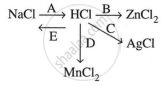
Study the flow chart and give balanced equations with conditions for the conversions A, B, C, D, and E.
Concept: undefined >> undefined
Complete and balance the following reaction, state whether dilute or cone. acid is used.
\[\ce{NH4OH + HCl ->}\]
Concept: undefined >> undefined
Complete and balance the following reaction, state whether dilute or conc. acid is used.
\[\ce{NH4OH +HCI ->}\]
Concept: undefined >> undefined
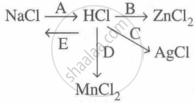
Study the flow chart and give balanced equations with conditions for the conversions A, B, C, D and E.
Concept: undefined >> undefined
