Advertisements
Advertisements
A force of 7 N acts on an object. The displacement is, say 8 m, in the direction of the force (see the given figure). Let us take it that the force acts on the object through the displacement. What is the work done in this case?

Concept: undefined >> undefined
When do we say that work is done?
Concept: undefined >> undefined
Advertisements
Write an expression for the work done when a force is acting on an object in the direction of its displacement.
Concept: undefined >> undefined
A pair of bullocks exerts a force of 140 N on a plough. The field being ploughed is 15 m long. How much work is done in ploughing the length of the field?
Concept: undefined >> undefined
Look at the activity below. Reason out whether or not work is done in the light of your understanding of the term ‘work’.
A sailboat is moving due to wind energy.
Concept: undefined >> undefined
An object thrown at a certain angle to the ground moves in a curved path and falls back to the ground. The initial and the final points of the path of the object lie on the same horizontal line. What is the work done by the force of gravity on the object?
Concept: undefined >> undefined
Can there be displacement of an object in the absence of any force acting on it? Think. Discuss this question with your friends and teacher.
Concept: undefined >> undefined
In each of the following a force, F is acting on an object of mass, m. The direction of displacement is from west to east, as shown by the longer arrow. Observe the diagrams carefully and state whether the work done by the force is negative, positive or zero.
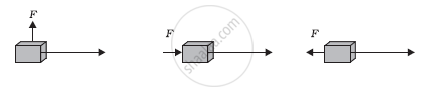
Concept: undefined >> undefined
Soni says that the acceleration in an object could be zero even when several forces are acting on it. Do you agree with her? Why?
Concept: undefined >> undefined
How does the sound produced by a vibrating object in a medium reach your ear?
Concept: undefined >> undefined
Explain how sound is produced by your school bell.
Concept: undefined >> undefined
What is sound and how is it produced?
Concept: undefined >> undefined
What do we get from cereals, pulses, fruits and vegetables?
Concept: undefined >> undefined
How do biotic and abiotic factors affect crop production?
Concept: undefined >> undefined
What are the desirable agronomic characteristics for crop improvements?
Concept: undefined >> undefined
What is genetic manipulation?
Concept: undefined >> undefined
State Kepler’s law which is represented by the relation r3 ∝ T2.
Concept: undefined >> undefined
Which of the Kepler’s laws of planetary motion led Newton to establish the inverse-square rule for gravitational force between two bodies ?
Concept: undefined >> undefined
Can we apply Newton’s third law to the gravitational force ? Explain your answer.
Concept: undefined >> undefined
