Advertisements
Advertisements
The ratio between the volume of a sphere and volume of a circumscribing right circular cylinder is
Concept: undefined >> undefined
A cone and a hemisphere have equal bases and equal volumes the ratio of their heights is
Concept: undefined >> undefined
Advertisements
A cone, a hemisphere and a cylinder stand on equal bases and have the same height. The ratio of their volumes is
Concept: undefined >> undefined
Opposite angles of a quadrilateral ABCD are equal. If AB = 4 cm, determine CD.
Concept: undefined >> undefined
The radius of a hemispherical balloon increases from 6 cm to 12 cm as air is being pumped into it. The ratios of the surface areas of the balloon in the two cases is ______.
Concept: undefined >> undefined
The diagonals AC and BD of a parallelogram ABCD intersect each other at the point O. If ∠DAC = 32º and ∠AOB = 70º, then ∠DBC is equal to ______.
Concept: undefined >> undefined
Diagonals AC and BD of a parallelogram ABCD intersect each other at O. If OA = 3 cm and OD = 2 cm, determine the lengths of AC and BD.
Concept: undefined >> undefined
Diagonals of a parallelogram are perpendicular to each other. Is this statement true? Give reason for your answer.
Concept: undefined >> undefined
Diagonals of a quadrilateral ABCD bisect each other. If ∠A = 35º, determine ∠B.
Concept: undefined >> undefined
E and F are points on diagonal AC of a parallelogram ABCD such that AE = CF. Show that BFDE is a parallelogram.
Concept: undefined >> undefined
Points P and Q have been taken on opposite sides AB and CD, respectively of a parallelogram ABCD such that AP = CQ (Figure). Show that AC and PQ bisect each other.
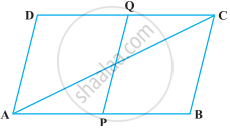
Concept: undefined >> undefined
In a parallelogram ABCD, AB = 10 cm and AD = 6 cm. The bisector of ∠A meets DC in E. AE and BC produced meet at F. Find the length of CF.
Concept: undefined >> undefined
A diagonal of a parallelogram bisects one of its angles. Show that it is a rhombus.
Concept: undefined >> undefined
In the following figure, AB || DE, AB = DE, AC || DF and AC = DF. Prove that BC || EF and BC = EF.

Concept: undefined >> undefined
P and Q are points on opposite sides AD and BC of a parallelogram ABCD such that PQ passes through the point of intersection O of its diagonals AC and BD. Show that PQ is bisected at O.
Concept: undefined >> undefined
ABCD is a rectangle in which diagonal BD bisects ∠B. Show that ABCD is a square.
Concept: undefined >> undefined
P is the mid-point of the side CD of a parallelogram ABCD. A line through C parallel to PA intersects AB at Q and DA produced at R. Prove that DA = AR and CQ = QR.
Concept: undefined >> undefined
ABCD is a rhombus in which altitude from D to side AB bisects AB. Find the angles of the rhombus.
Concept: undefined >> undefined
Through A, B and C, lines RQ, PR and QP have been drawn, respectively parallel to sides BC, CA and AB of a ∆ABC as shown in the following figure. Show that BC = `1/2` QR.

Concept: undefined >> undefined
A square is inscribed in an isosceles right triangle so that the square and the triangle have one angle common. Show that the vertex of the square opposite the vertex of the common angle bisects the hypotenuse.
Concept: undefined >> undefined
