Advertisements
Advertisements
The feasible region for an LPP is shown in the figure. Let F = 3x – 4y be the objective function. Maximum value of F is ______.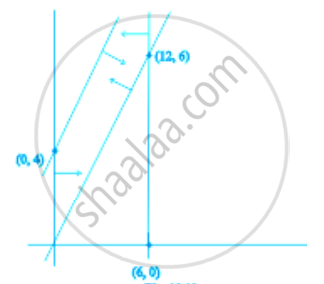
Concept: undefined >> undefined
Refer to Question 30. Minimum value of F is ______.
Concept: undefined >> undefined
Advertisements
Corner points of the feasible region for an LPP are (0, 2), (3, 0), (6, 0), (6, 8) and (0, 5). Let F = 4x + 6y be the objective function. The Minimum value of F occurs at ______.
Concept: undefined >> undefined
Refer to Question 32, Maximum of F – Minimum of F = ______.
Concept: undefined >> undefined
In a LPP, the linear inequalities or restrictions on the variables are called ____________.
Concept: undefined >> undefined
In a LPP, the objective function is always ______.
Concept: undefined >> undefined
If the feasible region for a LPP is ______ then the optimal value of the objective function Z = ax + by may or may not exist.
Concept: undefined >> undefined
In a LPP if the objective function Z = ax + by has the same maximum value on two corner points of the feasible region, then every point on the line segment joining these two points give the same ______ value.
Concept: undefined >> undefined
A feasible region of a system of linear inequalities is said to be ______ if it can be enclosed within a circle.
Concept: undefined >> undefined
A corner point of a feasible region is a point in the region which is the ______ of two boundary lines.
Concept: undefined >> undefined
The feasible region for an LPP is always a ______ polygon.
Concept: undefined >> undefined
If the feasible region for a LPP is unbounded, maximum or minimum of the objective function Z = ax + by may or may not exist.
Concept: undefined >> undefined
Maximum value of the objective function Z = ax + by in a LPP always occurs at only one corner point of the feasible region.
Concept: undefined >> undefined
In a LPP, the minimum value of the objective function Z = ax + by is always 0 if the origin is one of the corner point of the feasible region.
Concept: undefined >> undefined
In a LPP, the maximum value of the objective function Z = ax + by is always finite.
Concept: undefined >> undefined
Let A and B be two events such that P(A) = 0.6, P(B) = 0.2, and P(A|B) = 0.5. Then P(A′|B′) equals ______.
Concept: undefined >> undefined
Two cards are drawn from a well-shuffled deck of 52 playing cards with replacement. The probability, that both cards are queens, is ______.
Concept: undefined >> undefined
A relation R in set A = {1, 2, 3} is defined as R = {(1, 1), (1, 2), (2, 2), (3, 3)}. Which of the following ordered pair in R shall be removed to make it an equivalence relation in A?
Concept: undefined >> undefined
Let the relation R in the set A = {x ∈ Z : 0 ≤ x ≤ 12}, given by R = {(a, b) : |a – b| is a multiple of 4}. Then [1], the equivalence class containing 1, is:
Concept: undefined >> undefined
Based on the given shaded region as the feasible region in the graph, at which point(s) is the objective function Z = 3x + 9y maximum?

Concept: undefined >> undefined
