Advertisements
Advertisements
How long can an electric lamp of 100 W be kept glowing by fusion of 2 kg of deuterium? Take the fusion reaction as
\[\ce{^2_1H + ^2_1H -> ^3_2He + n + 3.27 MeV}\]
Concept: undefined >> undefined
The primary origin(s) of magnetism lies in ______.
- atomic currents.
- pauli exclusion principle.
- polar nature of molecules.
- intrinsic spin of electron.
Concept: undefined >> undefined
Advertisements
Three identical bar magnets are rivetted together at centre in the same plane as shown in figure. This system is placed at rest in a slowly varying magnetic field. It is found that the system of magnets does not show any motion. The north-south poles of one magnet is shown in the figure. Determine the poles of the remaining two.

Concept: undefined >> undefined
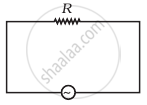
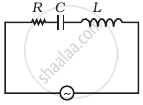
Study the circuits (a) and (b) shown in figure and answer the following questions.
 (a) |
 (b) |
- Under which conditions would the rms currents in the two circuits be the same?
- Can the rms current in circuit (b) be larger than that in (a)?
Concept: undefined >> undefined
Can the instantaneous power output of an ac source ever be negative? Can the average power output be negative?
Concept: undefined >> undefined
The alternating current in a circuit is described by the graph shown in figure. Show rms current in this graph.

Concept: undefined >> undefined
Are the nucleons fundamental particles, or do they consist of still smaller parts? One way to find out is to probe a nucleon just as Rutherford probed an atom. What should be the kinetic energy of an electron for it to be able to probe a nucleon? Assume the diameter of a nucleon to be approximately 10–15 m.
Concept: undefined >> undefined
A nuclide 1 is said to be the mirror isobar of nuclide 2 if Z1 = N2 and Z2 = N1. (a) What nuclide is a mirror isobar of 1123 Na? (b) Which nuclide out of the two mirror isobars have greater binding energy and why?
Concept: undefined >> undefined
Deuteron is a bound state of a neutron and a proton with a binding energy B = 2.2 MeV. A γ-ray of energy E is aimed at a deuteron nucleus to try to break it into a (neutron + proton) such that the n and p move in the direction of the incident γ-ray. If E = B, show that this cannot happen. Hence calculate how much bigger than B must E be for such a process to happen.
Concept: undefined >> undefined
Before the neutrino hypothesis, the beta decay process was throught to be the transition, `n -> p + vece`. If this was true, show that if the neutron was at rest, the proton and electron would emerge with fixed energies and calculate them. Experimentally, the electron energy was found to have a large range.
Concept: undefined >> undefined
A rectangular, a square, a circular and an elliptical loop, all in the (x - y) plane, are moving out of a uniform magnetic field with a constant velocity `vecv = vhati`. The magnetic field is directed along the negative z-axis direction. The induced emf, during the passage of these loops, out of the field region, will not remain constant for ______.
Concept: undefined >> undefined
If the reading of the voltmeter V1 is 40 V, then the reading of voltmeter V2 is ______.

Concept: undefined >> undefined
Distinguish between isotopes and isobars.
Concept: undefined >> undefined
Two nuclei have different mass numbers A1 and A2. Are these nuclei necessarily the isotopes of the same element? Explain.
Concept: undefined >> undefined
James Chadwick, in 1932 studied the emission of neutral radiations when Beryllium nuclei were bombarded with alpha particles. He concluded that emitted radiations were neutrons and not photons. Explain.
Concept: undefined >> undefined
Two nuclei may have the same radius, even though they contain different numbers of protons and neutrons. Explain.
Concept: undefined >> undefined
Using Huygens's construction of secondary wavelets explain how a diffraction pattern is obtained on a screen due to a narrow slit on which a monochromatic beam of light is incident normally.
Concept: undefined >> undefined
Using Rutherford's model of the atom, derive the expression for the total energy of the electron in hydrogen atom. What is the significance of total negative energy possessed by the electron?
Concept: undefined >> undefined
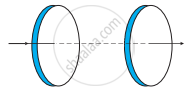
Figure shows a capacitor made of two circular plates each of radius 12 cm, and separated by 5.0 cm. The capacitor is being charged by an external source (not shown in the figure). The charging current is constant and equal to 0.15 A.
- Calculate the capacitance and the rate of charge of the potential difference between the plates.
- Obtain the displacement current across the plates.
- Is Kirchhoff’s first rule (junction rule) valid at each plate of the capacitor? Explain.
Concept: undefined >> undefined
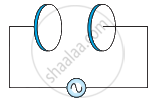
A parallel plate capacitor (Figure) made of circular plates each of radius R = 6.0 cm has a capacitance C = 100 pF. The capacitor is connected to a 230 V ac supply with a (angular) frequency of 300 rad s−1.
- What is the rms value of the conduction current?
- Is the conduction current equal to the displacement current?
- Determine the amplitude of B at a point 3.0 cm from the axis between the plates.
Concept: undefined >> undefined
