Advertisements
Advertisements
A series LCR circuit is connected to a source having voltage v = vm sin ωt. Derive the expression for the instantaneous current I and its phase relationship to the applied voltage.
Obtain the condition for resonance to occur. Define ‘power factor’. State the conditions under which it is (i) maximum and (ii) minimum.
Concept: undefined >> undefined
Derive an expression for the average power consumed in a series LCR circuit connected to a.c. source in which the phase difference between the voltage and the current in the circuit is Φ.
Concept: undefined >> undefined
Advertisements
A short magnet is moved along the axis of a conducting loop. Show that the loop repels the magnet if the magnet is approaching the loop and attracts the magnet if it is going away from the loop.
Concept: undefined >> undefined
The battery discussed in the previous question is suddenly disconnected. Is a current induced in the other loop? If yes, when does it start and when does it end? Do the loops attract each other or repel?
Concept: undefined >> undefined
A pivoted aluminium bar falls much more slowly through a small region containing a magnetic field than a similar bar of an insulating material. Explain.
Concept: undefined >> undefined
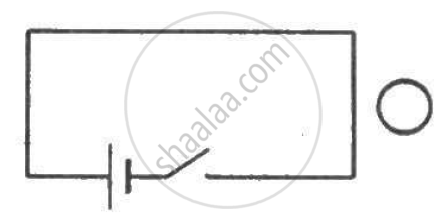
Consider the situation shown in figure. If the switch is closed and after some time it is opened again, the closed loop will show ____________ .
Concept: undefined >> undefined
A bar magnet is released from rest along the axis of a very long, vertical copper tube. After some time the magnet ____________ .
Concept: undefined >> undefined
Two circular loops of equal radii are placed coaxially at some separation. The first is cut and a battery is inserted in between to drive a current in it. The current changes slightly because of the variation in resistance with temperature. During this period, the two loops _______________ .
Concept: undefined >> undefined
A bar magnet is moved along the axis of a copper ring placed far away from the magnet. Looking from the side of the magnet, an anticlockwise current is found to be induced in the ring. Which of the following may be true?
(a) The south pole faces the ring and the magnet moves towards it.
(b) The north pole faces the ring and the magnet moves towards it.
(c) The south pole faces the ring and the magnet moves away from it.
(d) The north pole faces the ring and the magnet moves away from it.
Concept: undefined >> undefined
Can we find the mass of a photon by the definition p = mv?
Concept: undefined >> undefined
Is it always true that for two sources of equal intensity, the number of photons emitted in a given time are equal?
Concept: undefined >> undefined
What is the speed of a photon with respect to another photon if (a) the two photons are going in the same direction and (b) they are going in opposite directions?
Concept: undefined >> undefined
Can a photon be deflected by an electric field? Or by a magnetic field?
Concept: undefined >> undefined
A hot body is placed in a closed room maintained at a lower temperature. Is the number of photons in the room increasing?
Concept: undefined >> undefined
Should the energy of a photon be called its kinetic energy or its internal energy?
Concept: undefined >> undefined
In an experiment on photoelectric effect, a photon is incident on an electron from one direction and the photoelectron is emitted almost in the opposite direction. Does this violate the principle of conservation of momentum?
Concept: undefined >> undefined
It is found that yellow light does not eject photoelectrons from a metal. Is it advisable to try with orange light or with green light?
Concept: undefined >> undefined
It is found that photosynthesis starts in certain plants when exposed to sunlight, but it does not start if the plants are exposed only to infrared light. Explain.
Concept: undefined >> undefined
The threshold wavelength of a metal is λ0. Light of wavelength slightly less than λ0 is incident on an insulated plate made of this metal. It is found that photoelectrons are emitted for some time and after that the emission stops. Explain.
Concept: undefined >> undefined
If an electron has a wavelength, does it also have a colour?
Concept: undefined >> undefined
