Advertisements
Advertisements
Earth can be thought of as a sphere of radius 6400 km. Any object (or a person) is performing circular motion around the axis of earth due to earth’s rotation (period 1 day). What is acceleration of object on the surface of the earth (at equator) towards its centre? what is it at latitude θ? How does these accelerations compare with g = 9.8 m/s2?
Concept: undefined >> undefined
Earth also moves in circular orbit around sun once every year with on orbital radius of 1.5 × 10¹¹ m. What is the acceleration of earth (or any object on the surface of the earth) towards the centre of the sun? How does this acceleration compare with g = 9.8 m/s2?
Concept: undefined >> undefined
Advertisements
A person driving a car suddenly applies the brakes on seeing a child on the road ahead. If he is not wearing seat belt, he falls forward and hits his head against the steering wheel. Why?
Concept: undefined >> undefined
When a body slides down from rest along a smooth inclined plane making an angle of 45° with the horizontal, it takes time T. When the same body slides down from rest along a rough inclined plane making the same angle and through the same distance, it is seen to take time pT, where p is some number greater than 1. Calculate the co-efficient of friction between the body and the rough plane.
Concept: undefined >> undefined
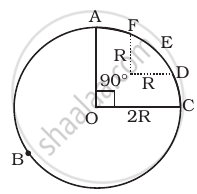
A racing car travels on a track (without banking) ABCDEFA (Figure). ABC is a circular arc of radius 2 R. CD and FA are straight paths of length R and DEF is a circular arc of radius R = 100 m. The co-efficient of friction on the road is µ = 0.1. The maximum speed of the car is 50 ms–1. Find the minimum time for completing one round.
Concept: undefined >> undefined
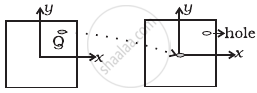
A uniform square plate has a small piece Q of an irregular shape removed and glued to the centre of the plate leaving a hole behind (Figure). The moment of inertia about the z-axis is then ______.
Concept: undefined >> undefined
With reference to figure of a cube of edge a and mass m, state whether the following are true or false. (O is the centre of the cube.)
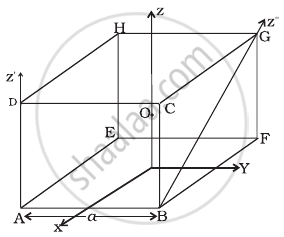
- The moment of inertia of cube about z-axis is Iz = Ix + Iy
- The moment of inertia of cube about z ′ is I'z = `I_z + (ma^2)/2`
- The moment of inertia of cube about z″ is = `I_z + (ma^2)/2`
- Ix = Iy
Concept: undefined >> undefined
Why does a solid sphere have smaller moment of inertia than a hollow cylinder of same mass and radius, about an axis passing through their axes of symmetry?
Concept: undefined >> undefined
Satellites orbiting the earth have finite life and sometimes debris of satellites fall to the earth. This is because ______.
Concept: undefined >> undefined
Is it possibe for a body to have inertia but no weight?
Concept: undefined >> undefined
Show the nature of the following graph for a satellite orbiting the earth.
- KE vs orbital radius R
- PE vs orbital radius R
- TE vs orbital radius R.
Concept: undefined >> undefined
Why does a metal bar appear hotter than a wooden bar at the same temperature? Equivalently it also appears cooler than wooden bar if they are both colder than room temperature.
Concept: undefined >> undefined
Consider a heat engine as shown in figure Q1 and Q2 are heat added to heat bath T1 and heat taken from T2 in one cycle of engine. W is the mechanical work done on the engine. If W > 0, then possibilities are ______.
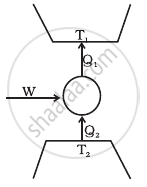
- Q1 > Q2 > 0
- Q2 > Q1 > 0
- Q2 < Q1 < 0
- Q1 < 0, Q2 > 0
Concept: undefined >> undefined
If a refrigerator’s door is kept open, will the room become cool or hot? Explain.
Concept: undefined >> undefined
If the co-efficient of performance of a refrigerator is 5 and operates at the room temperature (27°C), find the temperature inside the refrigerator.
Concept: undefined >> undefined
Calculate the ratio of the mean free paths of the molecules of two gases having molecular diameters 1 A and 2 A. The gases may be considered under identical conditions of temperature, pressure and volume.
Concept: undefined >> undefined
Ten small planes are flying at a speed of 150 km/h in total darkness in an air space that is 20 × 20 × 1.5 km3 in volume. You are in one of the planes, flying at random within this space with no way of knowing where the other planes are. On the average about how long a time will elapse between near collision with your plane. Assume for this rough computation that a saftey region around the plane can be approximated by a sphere of radius 10 m.
Concept: undefined >> undefined
Four pendulums A, B, C and D are suspended from the same elastic support as shown in figure. A and C are of the same length, while B is smaller than A and D is larger than A. If A is given a transverse displacement ______.

Concept: undefined >> undefined
With propagation of longitudinal waves through a medium, the quantity transmitted is ______.
Concept: undefined >> undefined
Which of the following statements are true for wave motion?
Concept: undefined >> undefined
