Please select a subject first
Advertisements
Advertisements
Particles of masses 1 g, 2 g, 3 g, .........., 100 g are kept at the marks 1 cm, 2 cm, 3 cm, ..........., 100 cm respectively on a metre scale. Find the moment of inertia of the system of particles about a perpendicular bisector of the metre scale.
Concept: undefined >> undefined
Find the moment of inertia of a pair of spheres, each having a mass mass m and radius r, kept in contact about the tangent passing through the point of contact.
Concept: undefined >> undefined
Advertisements
The moment of inertia of a uniform rod of mass 0⋅50 kg and length 1 m is 0⋅10 kg-m2about a line perpendicular to the rod. Find the distance of this line from the middle point of the rod.
Concept: undefined >> undefined
The radius of gyration of a uniform disc about a line perpendicular to the disc equals its radius. Find the distance of the line from the centre.
Concept: undefined >> undefined
Find the moment of inertia of a uniform square plate of mass m and edge a about one of its diagonals.
Concept: undefined >> undefined
The surface density (mass/area) of a circular disc of radius a depends on the distance from the centre as [rholeft( r right) = A + Br.] Find its moment of inertia about the line perpendicular to the plane of the disc thorough its centre.
Concept: undefined >> undefined
Because of the friction between the water in oceans with the earth's surface the rotational kinetic energy of the earth is continuously decreasing. If the earth's angular speed decreases by 0⋅0016 rad/day in 100 years find the average torque of the friction on the earth. Radius of the earth is 6400 km and its mass is 6⋅0 × 1024 kg.
Concept: undefined >> undefined
Suppose the rod in the previous problem has a mass of 1 kg distributed uniformly over its length.
(a) Find the initial angular acceleration of the rod.
(b) Find the tension in the supports to the blocks of mass 2 kg and 5 kg.
Concept: undefined >> undefined
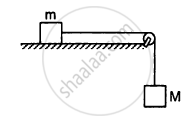
The following figure shows two blocks of mass m and M connected by a string passing over a pulley. The horizontal table over which the mass m slides is smooth. The pulley has a radius r and moment of inertia I about its axis and it can freely rotate about this axis. Find the acceleration of the mass M assuming that the string does not slip on the pulley.
Concept: undefined >> undefined
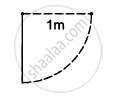
A metre stick weighing 240 g is pivoted at its upper end in such a way that it can freely rotate in a vertical place through this end (see the following figure). A particle of mass 100 g is attached to the upper end of the stick through a light string of length 1 m. Initially, the rod is kept vertical and the string horizontal when the system is released from rest. The particle collides with the lower end of the stick and sticks there. Find the maximum angle through which the stick will rise.
Concept: undefined >> undefined
A sphere of mass m rolls on a plane surface. Find its kinetic energy at an instant when its centre moves with speed \[\nu.\]
Concept: undefined >> undefined
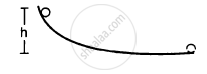
A small spherical ball is released from a point at a height h on a rough track shown in the following figure. Assuming that it does not slip anywhere, find its linear speed when it rolls on the horizontal part of the track.
Concept: undefined >> undefined
Which of the following do you feel are compatible with the idea of secularism? Give reasons.
(a) Absence of domination of one religious group by another.
(b) Recognition of a state religion.
(c) Equal state support to all religions.
(d) Mandatory prayers in schools.
(e) Allowing separate educational institutions for any minority community.
(f) Appointment of temple management bodies by the government.
(g) Intervention of state to ensure entry of Dalits in temples.
Concept: undefined >> undefined
Why is it necessary for a country to have a clear demarcation of powers and responsibilities in the constitution? What would happen in the absence of such a demarcation?
Concept: undefined >> undefined
What do you understand by secularism? Can it be equated with religious tolerance?
Concept: undefined >> undefined
Do you agree with the following statement? Give reasons for supporting or opposing it.
Secularism does not allow us to have a religious identity.
Concept: undefined >> undefined
Do you agree with the following statement? Give reasons for supporting or opposing it.
Secularism is against inequality within a religious group or between different religious groups.
Concept: undefined >> undefined
Do you agree with the following statement? Give reasons for supporting or opposing it.
Secularism has a western-Christian origin. It is not suitable for India.
Concept: undefined >> undefined
Write true or false against the following statement:
The Constitution guarantees remedy against violation of Rights.
Concept: undefined >> undefined
Which of the following is a correct interpretation of the Cultural and Educational Rights?
Concept: undefined >> undefined
