Please select a subject first
Advertisements
Advertisements
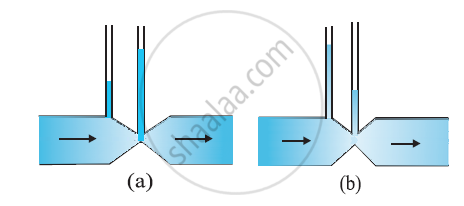
Figures (a) and (b) refer to the steady flow of a (non-viscous) liquid. Which of the two figures is incorrect? Why?
Concept: undefined >> undefined
The cylindrical tube of a spray pump has a cross-section of 8.0 cm2 one end of which has 40 fine holes each of diameter 1.0 mm. If the liquid flow inside the tube is 1.5 m min–1, what is the speed of ejection of the liquid through the holes?
Concept: undefined >> undefined
Advertisements
In deriving Bernoulli’s equation, we equated the work done on the fluid in the tube to its change in the potential and kinetic energy. (a) What is the largest average velocity of blood flow in an artery of diameter 2 × 10⁻³ m if the flow must remain laminar? (b) Do the dissipative forces become more important as the fluid velocity increases? Discuss qualitatively.
Concept: undefined >> undefined
A copper block of mass 2.5 kg is heated in a furnace to a temperature of 500 °C and then placed on a large ice block. What is the maximum amount of ice that can melt? (Specific heat of copper = 0.39 J g–1 K–1; heat of fusion of water = 335 J g–1).
Concept: undefined >> undefined
Answer the following question based on the P-T phase diagram of carbon dioxide:
Is CO2 solid, liquid or gas at
- –70 °C under 1 atm,
- –60 °C under 10 atm,
- 15 °C under 56 atm?
Concept: undefined >> undefined
Answer the following questions based on the P–T phase diagram of CO2:
CO2 at 1 atm pressure and temperature – 60 °C is compressed isothermally. Does it go through a liquid phase?
Concept: undefined >> undefined
Answer the following questions based on the P–T phase diagram of CO2:
What happens when CO2 at 4 atm pressure is cooled from room temperature at constant pressure?
Concept: undefined >> undefined
Answer the following questions based on the P–T phase diagram of CO2:
Describe qualitatively the changes in a given mass of solid CO2 at 10 atm pressure and temperature –65 °C as it is heated up to room temperature at constant pressure.
Concept: undefined >> undefined
Answer the following questions based on the P–T phase diagram of CO2:
Describe qualitatively the changes in a given mass of solid CO2 at 10 atm pressure and temperature –65 °C as it is heated up to room temperature at constant pressure.
Concept: undefined >> undefined
Answer the following questions based on the P–T phase diagram of CO2:
CO2 is heated to a temperature 70 °C and compressed isothermally. What changes in its properties do you expect to observe?
Concept: undefined >> undefined
A ‘thermacole’ icebox is a cheap and efficient method for storing small quantities of cooked food in summer in particular. A cubical icebox of side 30 cm has a thickness of 5.0 cm. If 4.0 kg of ice is put in the box, estimate the amount of ice remaining after 6 h. The outside temperature is 45 °C, and coefficient of thermal conductivity of thermacole is 0.01 J s–1 m–1 K–1. [Heat of fusion of water = 335 × 103 J kg–1]
Concept: undefined >> undefined
A brass boiler has a base area of 0.15 m2 and thickness 1.0 cm. It boils water at the rate of 6.0 kg/min when placed on a gas stove. Estimate the temperature of the part of the flame in contact with the boiler. The thermal conductivity of brass = 109 J s –1 m–1 K–1; Heat of vaporisation of water = 2256 × 103 J kg–1.
Concept: undefined >> undefined
Explain why a body with large reflectivity is a poor emitter
Concept: undefined >> undefined
Explain why The climate of a harbour town is more temperate than that of a town in a desert at the same latitude.
Concept: undefined >> undefined
A thermodynamic system is taken from an original state to an intermediate state by the linear process shown in Figure
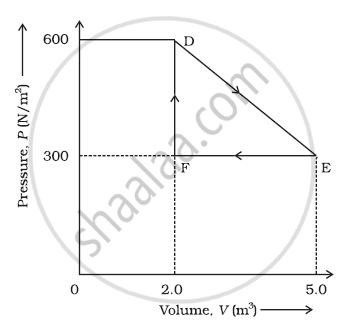
Its volume is then reduced to the original value from E to F by an isobaric process. Calculate the total work done by the gas from D to E to F
Concept: undefined >> undefined
A spring having with a spring constant 1200 N m–1 is mounted on a horizontal table as shown in Fig. A mass of 3 kg is attached to the free end of the spring. The mass is then pulled sideways to a distance of 2.0 cm and released.

Determine (i) the frequency of oscillations, (ii) maximum acceleration of the mass, and (iii) the maximum speed of the mass.
Concept: undefined >> undefined
let us take the position of mass when the spring is unstretched as x = 0, and the direction from left to right as the positive direction of the x-axis. Give x as a function of time t for the oscillating mass if at the moment we start the stopwatch (t = 0), the mass is
(a) at the mean position,
(b) at the maximum stretched position, and
(c) at the maximum compressed position.
In what way do these functions for SHM differ from each other, in frequency, in amplitude or the initial phase?
Concept: undefined >> undefined
The acceleration due to gravity on the surface of moon is 1.7 ms–2. What is the time period of a simple pendulum on the surface of moon if its time period on the surface of earth is 3.5 s? (g on the surface of earth is 9.8 ms–2)
Concept: undefined >> undefined
Answer the following questions:
A time period of a particle in SHM depends on the force constant k and mass m of the particle: `T = 2pi sqrt(m/k)` A simple pendulum executes SHM approximately. Why then is the time
Concept: undefined >> undefined
Answer the following questions:
The motion of a simple pendulum is approximately simple harmonic for small angle oscillations. For larger angles of oscillation, a more involved analysis shows that T is greater than `2pisqrt(1/g)` Think of a qualitative argument to appreciate this result.
Concept: undefined >> undefined
