Advertisements
Advertisements
H3PO3 can be represented by structures 1 and 2 shown below. Can these two structures be taken as the canonical forms of the resonance hybrid representing H3PO3? If not, give reasons for the same.
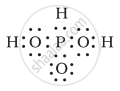 |
 |
| (1) | (2) |
Concept: undefined >> undefined
Write the resonance structure for SO3.
Concept: undefined >> undefined
Advertisements
Write the resonance structures for NO2.
Concept: undefined >> undefined
Write the resonance structures for `"NO"_3^(-)`.
Concept: undefined >> undefined
At 0°C, the density of a certain oxide of a gas at 2 bar is same as that of dinitrogen at 5 bar. What is the molecular mass of the oxide?
Concept: undefined >> undefined
The pressure of 1 g of an ideal gas A at 27 °C is found to be 2 bar. When 2 g of another ideal gas B is introduced in the same flask at the same temperature the pressure becomes 3 bar. Find a relationship between their molecular masses.
Concept: undefined >> undefined
The drain cleaner, Drainex contains small bits of aluminum which react with caustic soda to produce dihydrogen. What volume of dihydrogen at 20 °C and one bar will be released when 0.15g of aluminum reacts?
Concept: undefined >> undefined
The density of a gas is found to be 5.46 g/dm3 at 27 °C at 2 bar pressure. What will be its density at STP?
Concept: undefined >> undefined
How much time would it take to distribute one Avogadro number of wheat grains, if 1010 grains are distributed each second?
Concept: undefined >> undefined
Why is Wurtz reaction not preferred for the preparation of alkanes containing odd number of carbon atoms? Illustrate your answer by taking one example
Concept: undefined >> undefined
Ethyl acetate is formed by the reaction between ethanol and acetic acid and the equilibrium is represented as:
\[\ce{CH3COOH (l) + C2H5OH (l) ⇌ CH3COOC2H5 (l) + H2O (l)}\]
Write the concentration ratio (reaction quotient), Qc, for this reaction (note: water is not in excess and is not a solvent in this reaction).
Concept: undefined >> undefined
Ethyl acetate is formed by the reaction between ethanol and acetic acid and the equilibrium is represented as:
\[\ce{CH3COOH (l) + C2H5OH (l) ⇌ CH3COOC2H5 (l) + H2O (l)}\]
At 293 K, if one starts with 1.00 mol of acetic acid and 0.18 mol of ethanol, there is 0.171 mol of ethyl acetate in the final equilibrium mixture. Calculate the equilibrium constant.
Concept: undefined >> undefined
Ethyl acetate is formed by the reaction between ethanol and acetic acid and the equilibrium is represented as:
\[\ce{CH3COOH (l) + C2H5OH (l) ⇌ CH3COOC2H5 (l) + H2O (l)}\]
Starting with 0.5 mol of ethanol and 1.0 mol of acetic acid and maintaining it at 293 K, 0.214 mol of ethyl acetate is found after sometime. Has equilibrium been reached?
Concept: undefined >> undefined
Suggest a reason as to why CO is poisonous.
Concept: undefined >> undefined
Explain the following reaction.
CO is heated with ZnO.
Concept: undefined >> undefined
Equilibrium constant, Kc for the reaction
\[\ce{N2 (g) + 3H2 (g) ⇌ 2NH3 (g)}\] at 500 K is 0.061.
At a particular time, the analysis shows that composition of the reaction mixture is 3.0 mol L–1 N2, 2.0 mol L–1 H2 and 0.5 mol L–1 NH3. Is the reaction at equilibrium? If not in which direction does the reaction tend to proceed to reach equilibrium?
Concept: undefined >> undefined
What causes the temporary and permanent hardness of water?
Concept: undefined >> undefined
Discuss the principle and method of softening of hard water by synthetic ion-exchange resins.
Concept: undefined >> undefined
The number of atoms present in one mole of an element is equal to Avogadro number. Which of the following element contains the greatest number of atoms?
Concept: undefined >> undefined
45.4 L of dinitrogen reacted with 22.7 L of dioxygen and 45.4 L of nitrous oxide was formed. The reaction is given below:
\[\ce{2N2(g) + O2(g) -> 2N2O(g)}\]
Which law is being obeyed in this experiment? Write the statement of the law?
Concept: undefined >> undefined
