Advertisements
Advertisements
When air is pumped into a cycle tyre the volume and pressure of the air in the tyre both are increased. What about Boyle’s law in this case?
Concept: undefined >> undefined
A particle is acted simultaneously by mutually perpendicular simple harmonic motions x = a cos ωt and y = a sin ωt. The trajectory of motion of the particle will be ______.
Concept: undefined >> undefined
Advertisements
Figure shows the circular motion of a particle. The radius of the circle, the period, sense of revolution and the initial position are indicated on the figure. The simple harmonic motion of the x-projection of the radius vector of the rotating particle P is ______.

Concept: undefined >> undefined
The rotation of earth about its axis is ______.
- periodic motion.
- simple harmonic motion.
- periodic but not simple harmonic motion.
- non-periodic motion.
Concept: undefined >> undefined
A particle is in linear simple harmonic motion between two points A and B, 10 cm apart (Figure). Take the direction from A to B as the + ve direction and choose the correct statements.
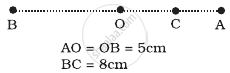
- The sign of velocity, acceleration and force on the particle when it is 3 cm away from A going towards B are positive.
- The sign of velocity of the particle at C going towards O is negative.
- The sign of velocity, acceleration and force on the particle when it is 4 cm away from B going towards A are negative.
- The sign of acceleration and force on the particle when it is at point B is negative.
Concept: undefined >> undefined
In figure, what will be the sign of the velocity of the point P′, which is the projection of the velocity of the reference particle P . P is moving in a circle of radius R in anticlockwise direction.

Concept: undefined >> undefined
Sound waves of wavelength λ travelling in a medium with a speed of v m/s enter into another medium where its speed is 2v m/s. Wavelength of sound waves in the second medium is ______.
Concept: undefined >> undefined
A sound wave is passing through air column in the form of compression and rarefaction. In consecutive compressions and rarefactions ______.
Concept: undefined >> undefined
A string of mass 2.5 kg is under a tension of 200 N. The length of the stretched string is 20.0 m. If the transverse jerk is struck at one end of the string, the disturbance will reach the other end in ______.
Concept: undefined >> undefined
A transverse harmonic wave on a string is described by y(x, t) = 3.0 sin (36t + 0.018x + π/4) where x and y are in cm and t is in s. The positive direction of x is from left to right.
- The wave is travelling from right to left.
- The speed of the wave is 20 m/s.
- Frequency of the wave is 5.7 Hz.
- The least distance between two successive crests in the wave is 2.5 cm.
Concept: undefined >> undefined
Speed of sound waves in a fluid depends upon ______.
- directty on density of the medium.
- square of Bulk modulus of the medium.
- inversly on the square root of density.
- directly on the square root of bulk modulus of the medium.
Concept: undefined >> undefined
At what temperatures (in °C) will the speed of sound in air be 3 times its value at O°C?
Concept: undefined >> undefined
A steel wire has a length of 12 m and a mass of 2.10 kg. What will be the speed of a transverse wave on this wire when a tension of 2.06 × 10⁴N is applied?
Concept: undefined >> undefined
If c is r.m.s. speed of molecules in a gas and v is the speed of sound waves in the gas, show that c/v is constant and independent of temperature for all diatomic gases.
Concept: undefined >> undefined
Given below are some functions of x and t to represent the displacement of an elastic wave.
- y = 5 cos (4x) sin (20t)
- y = 4 sin (5x – t/2) + 3 cos (5x – t/2)
- y = 10 cos [(252 – 250) πt] cos [(252 + 250)πt]
- y = 100 cos (100πt + 0.5x)
State which of these represent
- a travelling wave along –x direction
- a stationary wave
- beats
- a travelling wave along +x direction.
Given reasons for your answers.
Concept: undefined >> undefined
Light waves each of amplitude "a" and frequency "ω", emanating from two coherent light sources superpose at a point. If the displacements due to these waves are given by y1 = a cos ωt and y2 = a cos(ωt + ϕ) where ϕ is the phase difference between the two, obtain the expression for the resultant intensity at the point.
Concept: undefined >> undefined
No physicist has ever "“seen"” an electron. Yet, all physicists believe in the existence of electrons. An intelligent but superstitious man advances this analogy to argue that ‘ghosts’ exist even though no one has '‘seen'’ one. How will you refute his argument?
Concept: undefined >> undefined
The shells of crabs found around a particular coastal location in Japan seem mostly to resemble the legendary face of a Samurai. Given below are two explanations of this observed fact. Which of these strikes you as a scientific explanation ?
(a) A tragic sea accident several centuries ago drowned a young Samurai. As a tribute to his bravery, nature through its inscrutable ways immortalized his face by imprinting it on the crab shells in that area.
(b) After the sea tragedy, fishermen in that area, in a gesture of honor to their dead hero, let free any crab shell caught by them which accidentally had a shape resembling the face of a Samurai. Consequently, the particular shape of the crab shell survived longer and therefore in course of time the shape was genetically propagated. This is an example of evolution by artificial selection.
[Note : This interesting illustration taken from Carl Sagan’s ‘The Cosmos’ highlights the fact that often strange and inexplicable facts which on the first sight appear ‘supernatural’ actually turn out to have simple scientific explanations. Try to think out other examples of this kind].
Concept: undefined >> undefined
A physical quantity P is related to four observables a, b, c and d as follows:
`P = (a^3b^2)/((sqrtcd))`
The percentage errors of measurement in a, b, c and d are 1%, 3%, 4% and 2%, respectively. What is the percentage error in the quantity P? If the value of P calculated using the above relation turns out to be 3.763, to what value should you round off the result?
Concept: undefined >> undefined
