Advertisements
Advertisements
It is said that a liquid rises or is depressed in capillary due to the surface tension. If a liquid neither rises nor depresses in a capillary, can we conclude that the surface tension of the liquid is zero?
Concept: undefined >> undefined
The contact angle between water and glass is 0°. When water is poured in a glass to the maximum of its capacity, the water surface is convex upward. The angle of contact in such a situation is more than 90°. Explain.
Concept: undefined >> undefined
Advertisements
A uniform vertical tube of circular cross section contains a liquid. The contact angle is 90°. Consider a diameter of the tube lying in the surface of the liquid. The surface to the right of this diameter pulls the surface on the left of it. What keeps the surface on the left in equilibrium?
Concept: undefined >> undefined
When a glass capillary tube is dipped at one end in water, water rises in the tube. The gravitational potential energy is thus increased. Is it a violation of conservation of energy?
Concept: undefined >> undefined
If a mosquito is dipped into water and released, it is not able to fly till it is dry again. Explain
Concept: undefined >> undefined
The force of surface tension acts tangentially to the surface whereas the force due to air pressure acts perpendicularly on the surface. How is then the force due to excess pressure inside a bubble balanced by the force due to the surface tension?
Concept: undefined >> undefined
When the size of a soap bubble is increased by pushing more air in it, the surface area increases. Does it mean that the average separation between the surface molecules is increased?
Concept: undefined >> undefined
Frictional force between solids operates even when they do not move with respect to each other. Do we have viscous force acting between two layers even if there is no relative motion?
Concept: undefined >> undefined
Water near the bed of a deep river is quiet while that near the surface flows. Give reasons.
Concept: undefined >> undefined
If water in one flask and castor oil in other are violently shaken and kept on a table, which will come to rest earlier?
Concept: undefined >> undefined
A heavy mass is attached to a thin wire and is whirled in a vertical circle. The wire is most likely to break
Concept: undefined >> undefined
When a metal wire elongates by hanging a load on it, the gravitational potential energy is decreased.
Concept: undefined >> undefined
Which of the following is a mechanical wave?
Concept: undefined >> undefined
By a surface of a liquid we mean
Concept: undefined >> undefined
A cork floating in a calm pond executes simple harmonic motion of frequency
\[\nu\] when a wave generated by a boat passes by it. The frequency of the wave is
Concept: undefined >> undefined
An ice cube is suspended in vacuum in a gravity free hall. As the ice melts it
Concept: undefined >> undefined
When water droplets merge to form a bigger drop
Concept: undefined >> undefined
Air is pushed into a soap bubble of radius r to double its radius. If the surface tension of the soap solution in S, the work done in the process is
Concept: undefined >> undefined
Both the strings, shown in figure, are made of same material and have same cross section. The pulleys are light. The wave speed of a transverse wave in the string AB is
\[\nu_1\] and in CD it is \[\nu_2\]. Then \[\nu_1 / \nu_2\]
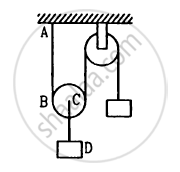
Concept: undefined >> undefined
If more air is pushed in a soap bubble, the pressure in it
Concept: undefined >> undefined
