Advertisements
Advertisements
If the opposite vertices of a square are (1, – 1) and (3, 4), find the coordinates of the remaining angular points.
Concept: undefined >> undefined
Prove that the points (–3, 0), (1, –3) and (4, 1) are the vertices of an isosceles right angled triangle. Find the area of this triangle
Concept: undefined >> undefined
Advertisements
If P (2, – 1), Q(3, 4), R(–2, 3) and S(–3, –2) be four points in a plane, show that PQRS is a rhombus but not a square. Find the area of the rhombus
Concept: undefined >> undefined
Find the coordinates of the centre of the circle passing through the points (0, 0), (–2, 1) and (–3, 2). Also, find its radius.
Concept: undefined >> undefined
The graphs of y = p(x) are given in following figure, for some polynomials p(x). Find the number of zeroes of p(x), in the following.

Concept: undefined >> undefined
The graphs of y = p(x) are given in following figure, for some polynomials p(x). Find the number of zeroes of p(x).

Concept: undefined >> undefined
The graphs of y = p(x) are given in following figure, for some polynomials p(x). Find the number of zeroes of p(x).

Concept: undefined >> undefined
The graphs of y = p(x) are given in following figure, for some polynomials p(x). Find the number of zeroes of p(x).

Concept: undefined >> undefined
The graphs of y = p(x) are given in following figure, for some polynomials p(x). Find the number of zeroes of p(x).

Concept: undefined >> undefined
The graphs of y = p(x) are given in following figure, for some polynomials p(x). Find the number of zeroes of p(x).

Concept: undefined >> undefined
Find the distance between the following pairs of points:
(2, 3), (4, 1)
Concept: undefined >> undefined
Find the distance between the following pairs of points:
(−5, 7), (−1, 3)
Concept: undefined >> undefined
Find the distance between the following pairs of points:
(a, b), (−a, −b)
Concept: undefined >> undefined
Find the distance between the points (0, 0) and (36, 15). Can you now find the distance between the two towns A and B discussed in Section 7.2.
Concept: undefined >> undefined
Check whether (5, -2), (6, 4) and (7, -2) are the vertices of an isosceles triangle.
Concept: undefined >> undefined
Determine if the points (1, 5), (2, 3) and (−2, −11) are collinear.
Concept: undefined >> undefined
In a classroom, 4 friends are seated at the points A, B, C and D as shown in the following figure. Champa and Chameli walk into the class and after observing for a few minutes, Champa asks Chameli, “Don’t you think ABCD is a square?” Chameli disagrees.
Using distance formula, find which of them is correct.
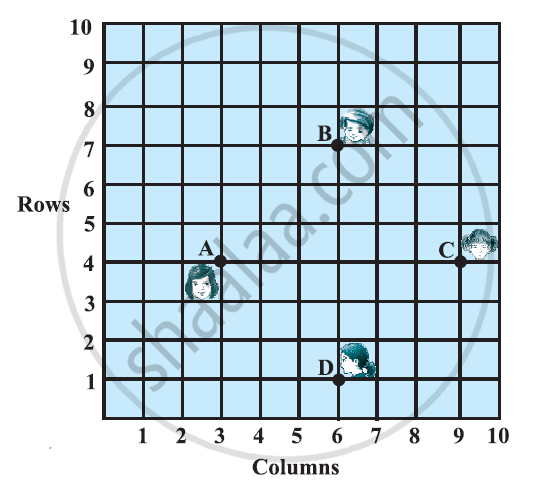
Concept: undefined >> undefined
Name the type of quadrilateral formed, if any, by the following points, and give reasons for your answer:
(- 1, - 2), (1, 0), (- 1, 2), (- 3, 0)
Concept: undefined >> undefined
Name the type of quadrilateral formed, if any, by the following point, and give reasons for your answer:
(−3, 5), (3, 1), (0, 3), (−1, −4)
Concept: undefined >> undefined
Name the type of quadrilateral formed, if any, by the following point, and give reasons for your answer:
(4, 5), (7, 6), (4, 3), (1, 2)
Concept: undefined >> undefined
