Please select a subject first
Advertisements
Advertisements
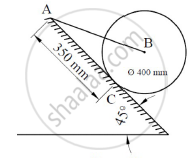
The cylinder B, diameter 400mm and weight 5kN, is held in position as shown in Figure 12 with the help of cable AB. Find the tension in the cable and the reaction developed at contact C.
Concept: Determination of reactions at supports for various types of loads on beams
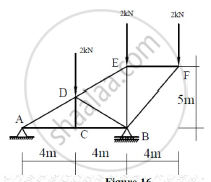
For the truss shown in Figure 16, find the forces in members DE, BD and CB.
Concept: Load Support
Referring to the truss shown in the figure. Find :
(a) Reaction at D and C
(b)Zero force members.
(c)Forces in member FE and DC by method of section.
(d)Forces in other members by method of joints.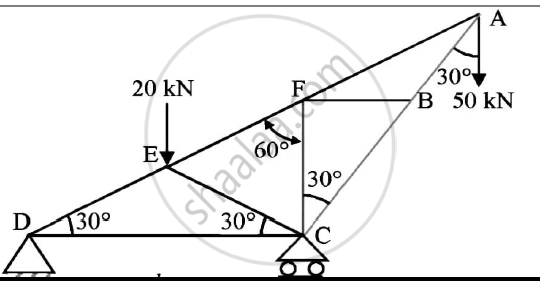
Concept: Analysis of Plane Trusses by Using Method of Joints
What is a zero force member in a truss? With examples state the conditions for a zero force member.
Concept: Analysis of Plane Trusses by Using Method of Joints
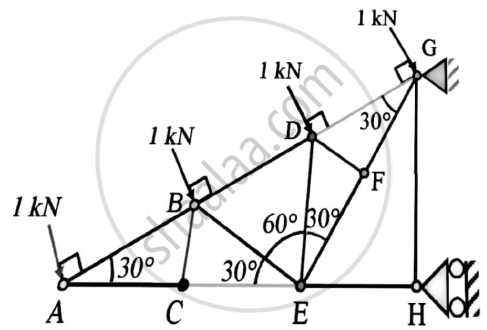
In the truss shown in figure,compute the forces in each member.
Concept: Analysis of Plane Trusses by Using Method of Joints
A truss is loaded and supported as shown.Determine the following:
(1)Identify the zero force members,if any
(2)Find the forces in members EF,ED and FC by method of joints.
(3)Find the forces in members GF,GC and BC by method of sections
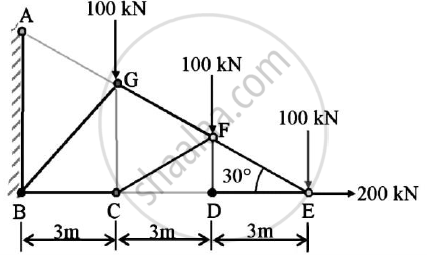
Concept: Analysis of Plane Trusses by Using Method of Joints
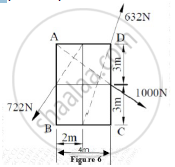
Concept: Resultant of Concurrent Force System
Three forces F1, F2 and F3 act at the origin of Cartesian coordinate axes system. The force F1 (= 70N) acts along OA whereas F2 (= 80N) acts along OB and F3 (= 100N) acts along OC. The coordinates of the points A, B and C are (2,1,3), (-1,2,0) and (4,-1,5) respectively. Find the resultant of this force system.
Concept: Resultant of Concurrent Force System
Cylinder A (diameter 1m, weight 20 kN) and cylinder B (diameter 1.5m, weight 40 kN) are arranged as shown in Figure 8. Find the reactions at all contact points. All contacts are smooth.

Concept: Equilibrium of parallel force system
A force of 500 N is acting on a block of 50 kg mass resting on a horizontal surface as shown in the figure. Determine the velocity after the block has travelled a distance of 10m. Co efficient of kinetic friction is 0.5.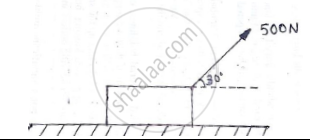
Concept: Cone of Friction
A 30 kg block is released from rest.If it slides down from a rough incline which is having co-efficient of friction 0.25.Determine the maximum compression of the spring.Take k=1000 N/m.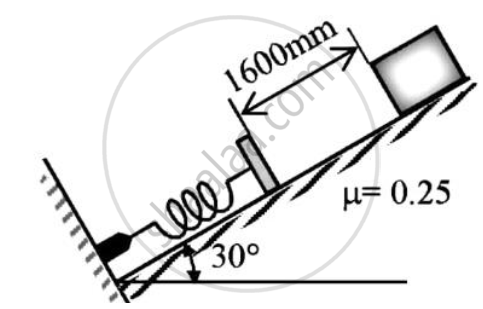
Concept: Equilibrium of Bodies on Inclined Plane
A homogeneous cylinder 3 m diameter and weighing 400 N is resting on two rough inclined surface’s shown.If the angle of friction is 15o.Find couple C applied to the cylinder that will start it rotating clockwise.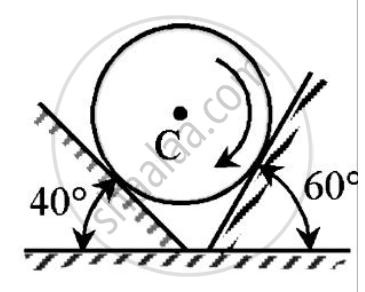
Concept: Cone of Friction
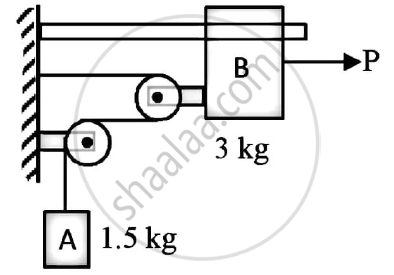
The system in figure is initially at rest.
Neglecting friction determine the force P required if the velocity of the collar is 5 m/s after 2 sec and corresponding tension in the cable.
Concept: Introduction to Laws of Friction
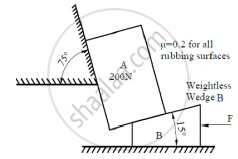
Find the force ‘F’ to have motion of block A impeding up the plane. Take coefficient of friction for all the surfaces in contact as 0.2. Consider the wedge B as weightless. Refer Figure 11.
Concept: Application to Problems Involving Wedges
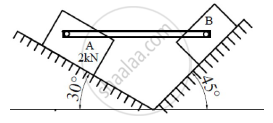
Find the weight WB so as to have its impending motion down the plane. Take weight of block A as 2kN. The pin connected rod AB is initially is in horizontal position. Refer Figure 13. Coefficient of friction = 0.25 for all surfaces.
Concept: Cone of Friction
Determine the tension in a cable BC shown in fig by virtual work method.
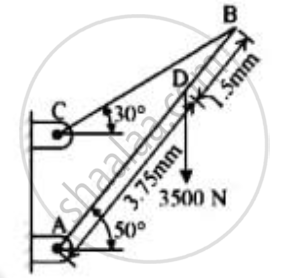
Given: F=3500 N
ϴ = 50o
Length of rod = 3.75 mm + 1.5 mm = 5.25 mm
To find : Tension in cable BC
Concept: Applications on Equilibrium Mechanisms
Two cylinders 1 and 2 are connected by a rigid bar of negligible weight hinged to each cylinder and left to rest in equilibrium in the position shown under the application of force P applied at the center of cylinder 2.
Determine the magnitude of force P.If the weights of the cylinders 1 and 2 are 100N and 50 N respectively.
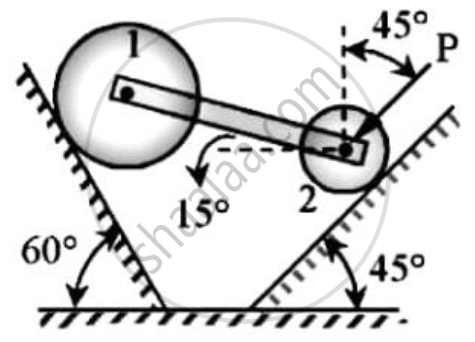
Concept: Applications on Equilibrium Mechanisms
Determine the required stiffness k so that the uniform 7 kg bar AC is in equilibrium when θ=30o.
Due to the collar guide at B the spring remains vertical and is unstretched when θ = 0o.Use principle of virtual work.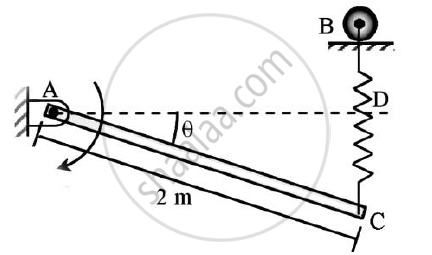
Concept: Applications on Equilibrium Mechanisms
Using Principle of Virtual Work, determine the force P which will keep the weightless bar AB in equilibrium. Take length AB as 2m and length AC as 8m. The bar makes an angle of 30° with horizontal. All the surfaces in contact are smooth. Refer Figure 9.
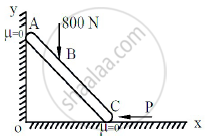
Concept: Applications on Equilibrium Mechanisms
Find the co-ordinate of the centroid of the area as shown in the given figure.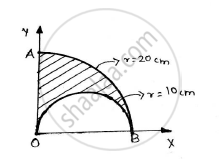
Concept: Velocity and Acceleration in Terms of Rectangular Co-ordinate System
