Please select a subject first
Advertisements
Advertisements
Write a short note.
Obstacles to national unity
Concept: Challenges to National Unity
Explain the following concept with example.
Racial diversity
Concept: Diversity in Indian Society
Explain the following concept with example.
Religious diversity
Concept: Diversity in Indian Society
Explain the following concept with examples.
Economic inequality
Concept: Challenges to National Unity
State whether the following statement are true or false with reason.
Society is gradually opening up to understanding and accepting gender fluidity.
Concept: Diversity in Indian Society
Correct the incorrect pair and rewrite it.
Concept: Diversity in Indian Society
Correct the incorrect pair and rewrite it.
Concept: Introduction of Diversity and Unity in Indian Society
Match the following:
| Column 'A' | Column 'B' |
| (i) Transgender | (a) Physical relationship between women and women |
| (ii) Lesbian | (b) A person who is attracted to both sexes |
| (iii) Bisexual | (c) Homosexuality |
| (iv) Gay | (d) Lack of compatibility with a person's physical sexuality and mental sexuality |
Concept: Diversity in Indian Society
India has adopted ______ language formula.
Concept: Unity in Diversity
Correct the underlined words, complete and rewrite the statement:
Golden temple is built at Jalandar.
Concept: Unity in Diversity
Identify the appropriate term from the given options and rewrite it against the given statement:
Conflict based on language.
Concept: Challenges to National Unity
Complete the concept map:
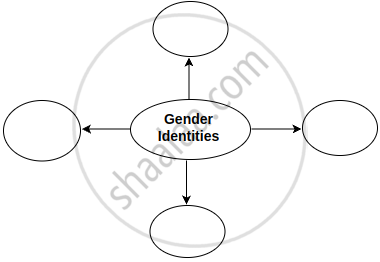
Concept: Diversity in Indian Society
Match the following:
| Column 'A' | Column 'B' |
| (i) Not to interfere | (a) Lewis Worth |
| (ii) Facilitate exchanges | (b) Making changes in the structure of the business |
| (iii) Digitisation | (c) Globalisation |
| (iv) Urbanization is a way of life | (d) Computer system |
Concept: Digitalisation
Write a short note.
Characteristics of social movement
Concept: Environmental Movement in India
The years 1975-1985 was announced as the international decade for ______.
Concept: Womens’ Movement in India
The All India Women’s Conference was established in the year ______.
Concept: Womens’ Movement in India
Correct the underlined word and complete the statement.
Swami Dayanand Saraswati founded the Brahmo Samaj in 1875.
Concept: Types of Social Movements
Correct the underlined word and complete the statement.
April 22nd is celebrated as Environment Day.
Concept: Environmental Movement in India
Correct the underlined word and complete the statement.
The Narmada Bachao Andolan was started by Vandana Shiva.
Concept: Environmental Movement in India
Correct the underlined word and complete the statement.
The Hindu Widow Remarriage Act was passed in the year 1956.
Concept: Environmental Movement in India
