Please select a subject first
Advertisements
Advertisements
`1/sin^2θ - 1/cos^2θ - 1/tan^2θ - 1/cot^2θ - 1/sec^2θ - 1/("cosec"^2θ) = -3`, then find the value of θ.
Concept: Trigonometric Identities (Square Relations)
Find the value of sin2θ + cos2θ

Solution:
In Δ ABC, ∠ABC = 90°, ∠C = θ°
AB2 + BC2 = `square` .....(Pythagoras theorem)
Divide both sides by AC2
`"AB"^2/"AC"^2 + "BC"^2/"AC"^2 = "AC"^2/"AC"^2`
∴ `("AB"^2/"AC"^2) + ("BC"^2/"AC"^2) = 1`
But `"AB"/"AC" = square and "BC"/"AC" = square`
∴ `sin^2 theta + cos^2 theta = square`
Concept: Trigonometric Identities (Square Relations)
The radii of ends of a frustum are 14 cm and 6 cm respectively and its height is 6 cm. Find its volume \[\pi\] = 3.14)
Concept: Frustum of a Cone
The circumferences of circular faces of a frustum are 132 cm and 88 cm and its height is 24 cm. To find the curved surface area of the frustum complete the following activity.( \[\pi = \frac{22}{7}\])
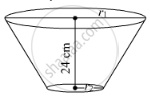
Concept: Frustum of a Cone
The area of a sector of a circle of 6 cm radius is 15 π sq. cm. Find the measure of the arc and the length of the arc corresponding to the sector.
Concept: Length of an Arc
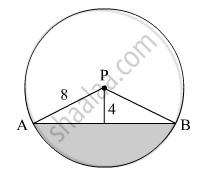
In the given figure, seg AB is a chord of a circle with centre P. If PA = 8 cm and distance of chord AB from the centre P is 4 cm, find the area of the shaded portion. ( \[\pi\] = 3.14, \[\sqrt{3}\]= 1.73 )
Concept: Length of an Arc
In Δ ABC, if ∠ A = 65° ; ∠ B = 40° then find the measure of ∠ C.
Concept: Length of an Arc
Length of a rectangular tank is twice its breadth. If the
depth of the tank is 3 m and area of its four walls is 108 m2, find the
length of the tank.
Concept: Length of an Arc
Find the length of an arc if measure of the arc is 90° and its radius
is 14 cm.
Concept: Length of an Arc
Measure of an arc of a sector of a circle is 900 and its radius is 7cm. Find the perimeter of the sector.
(A) 44 cm (B) 25 cm (C) 36 cm (D) 56 cm
Concept: Length of an Arc
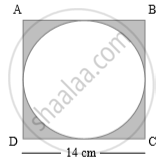
A circle is inscribed in square ABCD of side 14 cm. Complete the following activity to find the area of the shaded portion.
Activity:
Area of square ABCD = ______
= 142
= 196 cm2
Area of circle = πr2 = `22/7xx 7^2`
= ____ cm2
Area of shaded portion = Area of square ABCD – Area of circle
= 196 – _______
= _____ cm2
Concept: Length of an Arc
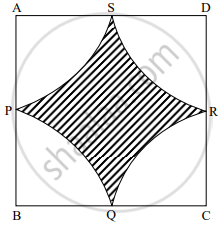
In the given figure `square`ABCD is a square of side 50 m. Points P, Q, R, S are midpoints of side AB, side BC, side CD, side AD respectively. Find area of shaded region
Concept: Length of an Arc
If x = `θ/360` × 2πr then what is x in the formula?
Concept: Length of an Arc
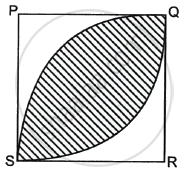
In the figure, PQRS is a square with side 10 cm. The sectors drawn with P and R as centres form the shaded figure. Find the area of the shaded figure. (Use π = 3.14)
Concept: Area of a Segment
In the given figure, a rectangle ABCD is inscribed inside a semi-circle of radius 10 cm. Using the dimensions given in the figure, determine the area of the shaded region.

Concept: Length of an Arc
A milk container of height 16 cm is made of metal sheet in the form of frustum of a cone with radii of its lower and upper ends as 8 cm and 20 cm respectively. Find the cost of milk at the rate of ₹ 22 per litre which the container can hold.
Concept: Frustum of a Cone
The perimeter of an arc of radius 4.2 cm is 12.8 cm. Determine the angle subtended by the arc at the centre of circle.
Concept: Length of an Arc
Find the total surface area of frustum, if its radii are 15 cm and 7 cm. Also, the slant height of the frustum is 14 cm.
Radii of the frustum = `square` cm and `square` cm
Slant height of the frustum = `square` cm
Total surface area = `π[(r_1^2 + r_2^2 + (r_1 + r_2)l]`
= `22/7 [square + square + (square + square) square]`
= `22/7 (square)`
= `square` cm2
Hence, the total surface area of the frustum is `square`.
Concept: Frustum of a Cone
If radius of the base of cone is 7 cm and height is 24 cm, then find its slant height.
Concept: Frustum of a Cone
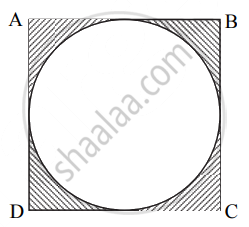
In the figure given above, `square`ABCD is a square and a circle is inscribed in it. All sides of a square touch the circle. If AB = 14 cm, find the area of shaded region.
Solution:
Area of square = `(square)^2` ......(Formula)
= 142
= `square "cm"^2`
Area of circle = `square` ......(Formula)
= `22/7 xx 7 xx 7`
= 154 cm2
(Area of shaded portion) = (Area of square) - (Area of circle)
= 196 − 154
= `square "cm"^2`
Concept: Segment of a Circle
