Advertisements
Advertisements
Why is the Supreme Court described as a ‘Court of Record’?
Concept: Jurisdiction and Powers of the Supreme Court
The Supreme Court is the head of the entire system of judiciary. In this context, answer the following question:
Mention any two qualifications required by a person to be the judge of the Supreme Court.
Concept: The Supreme Court
The Supreme Court is the head of the entire system of judiciary. In this context, answer the following question:
Mention any three cases which come under the Original Jurisdiction of the Supreme Court.
Concept: Jurisdiction and Powers of the Supreme Court
The Supreme Court of India is the supreme judicial authority and the highest court of the Republic of India. It is the final court of appeal for all civil and criminal cases. With reference to the Supreme Court, answer the following question:
Under Article 129, the Supreme Court of India is called a Court of Record. Justify this statement with any three points.
Concept: Jurisdiction and Powers of the Supreme Court
The Supreme Court of India is the supreme judicial authority and the highest court of the Republic of India. It is the final court of appeal for all civil and criminal cases. With reference to the Supreme Court, answer the following question:
Explain the following term:
Revisory Jurisdiction
Concept: Jurisdiction and Powers of the Supreme Court
Name the highest criminal court in a district.
Concept: Subordinate Court >> Criminal Courts
Mention one reason to state that the Lok Adalat has its own advantage.
Concept: Lok Adalats
With reference to the powers and functions of the High Court, explain briefly the meaning and scope of the following:
Its Appellate Jurisdiction
Concept: Powers and Jurisdiction of High Court
With reference to the powers and functions of the High Court, explain briefly the meaning and scope of the following:
Judicial Review
Concept: Powers and Jurisdiction of High Court
The partition of Bengal and the formation of the Muslim League were two important events that had an impact on the national struggle for independence. In this context, explain the following:
Any three factors relating to the formation of the Muslim League.
Concept: Factors Leading to the Formation of the Muslim League
State one point of distinction between the District Judge and the Sessions Judge.
Concept: Subordinate Court >> Criminal Courts
| Residents of Jodhpur, X and Y got married in the year 2014 and after 4 months of wedlock, petty family issues and arguments resulted in their separation for 6 years. The matter was placed before the Bench of Lok Adalat Family Court, Jodhpur wherein all efforts were made to reunite the family again. With constant efforts of counselling parties agreed to live together and withdraw their Divorce Petition. |
Which advantage of the Lok Adalat is highlighted in the above case?
Concept: Lok Adalats
Through various national movements, Gandhiji mobilised public support to win freedom for India. In this context, state the following:
Any three causes for Gandhiji to launch the Non-Cooperation Movement.
Concept: Causes that Led to the Non-Cooperation Movement
Through various national movements, Gandhiji mobilised public support to win freedom for India. In this context, state the following:
The impact of the Non-Cooperation Movement in India’s freedom struggle.
Concept: Impact of the Civil Disobedience Movement
Why was the Simon Commission rejected by the Congress?
Concept: Impact of the Civil Disobedience Movement
The area in which Anand stays has had no water supply for three days in spite of repeated complaints. The residents have a meeting and discuss a few methods to resolve this problem. Being a follower of the beliefs and methods of the Early Nationalists, which of the following methods is Anand NOT LIKELY to approve?
Concept: Programmes of Non-Cooperation Movement
Read the excerpt given below and answer the questions that follow:
|
The March, which took place in India, was led by Mohandas Gandhi to protest British rule in India. During the march, thousands of Indians followed Gandhi from his religious retreat near Ahmedabad to the Arabian Sea coast, a distance of some 240 miles. The march resulted in the arrest of nearly 60,000 people, including Gandhi himself. - The Marion (Ohio) Star [Edited] |
- Name the march being discussed above.
- Which movement did this march lead to?
- In which year was that movement launched?
Concept: Civil Disobedience Movement (1930-1934)
Read the excerpt given below and answer the question that follow:
|
The March, which took place in India, was led by Mohandas Gandhi to protest British rule in India. During the march, thousands of Indians followed Gandhi from his religious retreat near Ahmedabad to the Arabian Sea coast, a distance of some 240 miles. The march resulted in the arrest of nearly 60,000 people, including Gandhi himself. - The Marion (Ohio) Star [Edited] |
The movement which began with this march made a considerable impact on the social and political surroundings of the country. Analyse this statement by mentioning any three impacts.
Concept: Impact of the Civil Disobedience Movement
Which of the following countries will NOT be part of this cartoon?
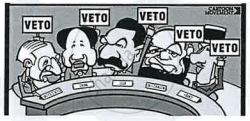
Concept: Events Leading to Quit India Movement
With reference to the Two Major World wars in the 20th century, answer the following question:
State any four causes that led to the Second World War.
Concept: Causes of Second World War
