Please select a subject first
Advertisements
Advertisements
Name the radiation of the electromagnetic spectrum which is used for the following:
To photograph internal parts of the human body and Give the frequency range
Concept: Electromagnetic Spectrum
Name the radiation of the electromagnetic spectrum which is used for the following:
For taking photographs of the sky during the night and foggy conditions . Give the frequency range
Concept: Electromagnetic Spectrum
Name the e.m. waves which are suitable for radar systems used in aircraft navigation. Write the range of frequency of these waves.
Concept: Electromagnetic Spectrum
If the Earth did not have atmosphere, would its average surface temperature be higher or lower than what it is now? Explain.
Concept: Electromagnetic Spectrum
An e.m. wave exerts pressure on the surface on which it is incident. Justify.
Concept: Electromagnetic Spectrum
Electromagnetic waves with wavelength
- λ1 is suitable for radar systems used in aircraft navigation.
- λ2 is used to kill germs in water purifiers.
- λ3 is used to improve visibility in runways during fog and mist conditions.
Identify and name the part of the electromagnetic spectrum to which these radiations belong. Also arrange these wavelengths in ascending order of their magnitude.
Concept: Electromagnetic Spectrum
Identify the electromagnetic wave whose wavelength range is from about 10-12 m to about 10-8 m. Write one use of this.
Concept: Electromagnetic Spectrum
Identify the electromagnetic wave whose wavelength range is from about 10-3 m to about 10-1 m. Write one use of this.
Concept: Electromagnetic Spectrum
Choose the correct option related to wavelengths (λ) of different parts of the electromagnetic spectrum.
Concept: Electromagnetic Spectrum
Identify the electromagnetic radiation and write its wavelength range, which is used to kill germs in water purified. Name the two sources of these radiations.
Concept: Electromagnetic Spectrum
Identify the part of the electromagnetic spectrum which:
- produces the heating effect.
- is absorbed by the ozone layer in the atmosphere.
- is used for studying crystal structure.
Write any one method of the production of each of the above radiations.
Concept: Electromagnetic Spectrum
A ray PQ incident normally on the refracting face BA is refracted in the prism BAC made of material of refractive index 1.5. Complete the path of ray through the prism. From which face will the ray emerge? Justify your answer.
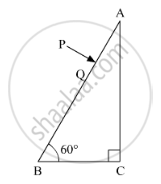
Concept: Dispersion by a Prism
Draw a labeled ray diagram to obtain the real image formed by an astronomical telescope in normal adjustment position. Define its magnifying power.
Concept: Optical Instruments >> Telescope
Why can’t we see clearly through fog?
Concept: Some Natural Phenomena Due to Sunlight
Name the phenomenon responsible for it.
Concept: Some Natural Phenomena Due to Sunlight
A ray PQ incident on the refracting face BA is refracted in the prism BAC as shown in the figure and emerges from the other refracting face AC as RS such that AQ = AR. If the angle of prism A = 60° and refractive index of material of prism is `sqrt3 `. Calculate angle θ.
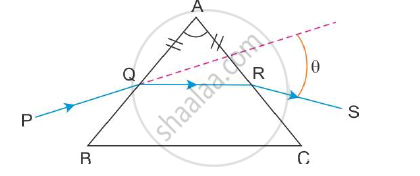
Concept: Dispersion by a Prism
Why does unpolarised light from a source show a variation in intensity when viewed through a polaroid which is rotated?
Concept: Some Natural Phenomena Due to Sunlight
Explain the basic differences between the construction and working of a telescope and a microscope
Concept: Optical Instruments >> Simple Microscope or a Reading Glass
A ray PQ incident on the face AB of a prism ABC, as shown in the figure, emerges from the face AC such that AQ = AR.
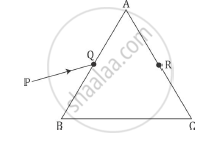
Draw the ray diagram showing the passage of the ray through the prism. If the angle of the prism is 60° and refractive index of the material of prism is `sqrt3` , determine the values of angle of incidence and angle of deviation
Concept: Dispersion by a Prism
Two monochromatic rays of light are incident normally on the face AB of an isosceles right-angled prism ABC. The refractive indices of the glass prism for the two rays '1' and '2' are respectively 1.38 and 1.52. Trace the path of these rays after entering through the prism.
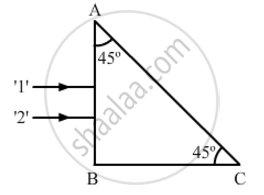
Concept: Dispersion by a Prism
