Definitions [31]
A magnet is a material that produces a magnetic field and can attract magnetic substances such as iron, nickel, cobalt, and some of their alloys.
The region around a magnet in which it can exert a magnetic force is called its magnetic field.
Define Curie temperature.
The temperature above which a ferromagnetic substance becomes paramagnetic is called curie temperature.
Magnetic Flux (ϕ): Total number of magnetic field lines passing through a given area, measured in weber (Wb).
A magnetic line of force is an imaginary curve in a magnetic field such that the tangent drawn at any point on it gives the direction of the magnetic field at that point.
The magnetic potential energy of a magnetic dipole is the energy it possesses due to its orientation in an external magnetic field.
For a magnetic dipole of moment \[\vec m\] placed in a uniform magnetic field \[\vec B\]: U = −\[\vec m\] . \[\vec B\]
or U = −mB cos θ
where θ is the angle between \[\vec m\] and \[\vec B\].
A magnetic needle, when freely suspended through its centre of gravity, comes to rest under the influence of Earth’s magnetic field.
Definition: The vertical plane passing through the axis of a freely suspended magnetic needle, at rest under Earth’s magnetic field, is called the magnetic meridian.
The vertical plane passing through the line joining the geographical North Pole and the geographical South Pole is called the geographic meridian.
At any place, the acute angle between the magnetic meridian and the geographic meridian is called the angle of declination.
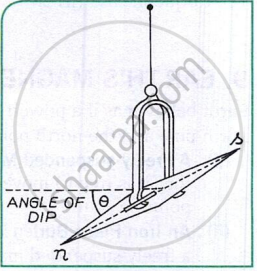
If a magnetic needle is pivoted on a horizontal axis through its centre of gravity so that it is free to rotate in a vertical plane, it dips with respect to the horizontal when kept in the magnetic meridian. Such a needle is called a dip needle.
The angle of dip at a place is the angle between the direction of Earth’s magnetic field and the horizontal, in the magnetic meridian at that place.
- Angle of dip = angle between Earth’s magnetic field and the horizontal in the magnetic meridian.
Some substances, when placed in a magnetic field, are strongly magnetised in the direction of the magnetising field. When brought close to either pole of a magnet, they are attracted rapidly towards the magnet.
Such substances are called ferromagnetic substances, and their magnetism is called ferromagnetism.
Some substances, when placed in a magnetic field, are feebly magnetised in a direction opposite to the direction of the magnetising field. When brought close to a pole of a powerful magnet, they are somewhat repelled away from the magnet.
Such substances are called diamagnetic substances, and their magnetism is called diamagnetism.
Some substances, when placed in a magnetic field, are feebly magnetised in the direction of the magnetising field. When brought close to a pole of a powerful magnet, they are attracted towards the magnet.
Such substances are called paramagnetic substances, and their magnetism is called paramagnetism.
Magnetic susceptibility measures how easily a substance becomes magnetised in an applied magnetic field.
Relative permeability is the ratio of the permeability of a substance to the permeability of free space.
\[\vec H\] represents the magnetising influence of the applied external field. In practice, it can be controlled by changing the current in a coil or solenoid.
Intensity of magnetisation is the magnetic moment per unit volume of a magnetised substance.
Magnetic induction \[\vec B\] is the number of magnetic lines of induction crossing a unit area normally inside a magnetised substance.
Magnetic permeability is the ratio of magnetic induction inside a substance to the magnetic intensity of the magnetising field.
Ferromagnetic substances are strongly magnetised in the direction of the applied field and are strongly attracted by magnets, even retaining magnetism after the field is removed.
Diamagnetic substances are materials that are weakly magnetised in a direction opposite to the applied magnetic field and are weakly repelled by it.
Paramagnetic substances are weakly magnetised in the same direction as the applied field and are weakly attracted toward regions of stronger field.
Property of substances strongly attracted by a magnetic field and capable of retaining magnetism due to alignment of magnetic domains.
OR
Substances in which the magnetic moments of atoms align spontaneously within regions called domains, producing strong magnetism.
Property of substances that are weakly repelled by a magnetic field due to zero net magnetic moment per atom (paired electrons).
OR
Substances with all paired electrons, resulting in zero permanent magnetic moment per atom.
Property of substances weakly attracted by a magnetic field due to a net atomic magnetic moment caused by unpaired electrons.
OR
Substances whose atoms possess unpaired electrons, giving each atom a net magnetic moment; moments are randomly oriented in the absence of a field.
Demagnetisation is the loss of a magnet's net magnetic moment, caused by disturbance of the ordered alignment of its atomic magnetic domains.
The reverse magnetising field required to reduce residual magnetisation to zero.
SI Unit: A/m
The point beyond which M does not increase further with increasing H, as all domains are aligned.
The phenomenon in which magnetisation M (or flux density B) lags behind the magnetising field H during a cycle of magnetisation.
Residual magnetisation retained by the material when H is reduced to zero after saturation.
SI Unit: A/m
Formulae [8]
Magnetic Field Strength (B): B = \[\frac {ϕ}{A}\]
where A is the area normal to the field, valid for a uniform field.
SI Unit of B: tesla (T)
Conversion: 1 T = 104 gauss
M = mp(2l)
- SI unit: A m2
- Direction: from the South pole to the North pole.
The torque on a dipole in a uniform magnetic field is: τ = mB sin θ
μ = \[\frac {B}{H}\]
SI Units: T m A−1 = N A−2 = Wb A−1m−1
\[{\mu_r=\frac{\mu}{\mu_0}}\]
Alternatively, \[{\mu_r=\frac{B}{B_0}}\]
where B0 is the magnetic flux density in vacuum for the same magnetising field.
\[\vec M\] = χm\[\vec H\]
\[\therefore\] χm = \[\frac {M}{H}\]
\[\vec{M}=\frac{\vec{m}}{V}\]
where:
- \[\vec m\] = magnetic moment of the substance
- V = volume of the substance
SI Unit: A m−1
\[{\vec{H}=\frac{\vec{B}}{\mu_0}-\vec{M}}\]
Equivalently, \[{\vec{B}=\mu_0(\vec{H}+\vec{M})}\]
Key Points
- Every ordinary magnet has two poles: north and south.
- Like poles repel; unlike poles attract.
- A freely suspended magnet aligns approximately along the north–south direction.
- Magnetic field lines are closed loops.
- A broken magnet always produces smaller magnets, each with both poles.
- Earth behaves approximately like a giant magnet.
- Near geographic north lies Earth’s magnetic-south region in the simple bar-magnet model.
- A compass works because its needle aligns with Earth’s magnetic field.
- Field lines show field direction (tangent) and strength (density)
- They form closed loops, never intersect, and are denser near poles
- Uniform field = parallel, equidistant lines
- B = ϕ/A; SI units: flux in weber, field strength in tesla
- Attraction/repulsion explained via the "contracting and laterally repelling" elastic analogy
- A current-carrying solenoid behaves like a magnetic dipole.
- Like poles repel and unlike poles attract.
- Anticlockwise current at an observed end means that end is north.
- Clockwise current at an observed end means that end is south.
- Magnetic dipole moment of a solenoid is: m = NIA
- Far axial field of a solenoid is: B = \[\frac {μ_0}{4π}\frac {2m}{r^3}\]
- This is the same far-axial field as that of a bar magnet.
- The magnetic axis of a dip needle represents the direction of Earth’s magnetic field.
- The angle of dip is measured with reference to the horizontal direction.
- The dip needle is vertical at Earth’s magnetic poles.
- The dip needle is horizontal at Earth’s equator.
- At the poles, the angle of dip is 90°.
- At the equator, the angle of dip is 0°.
- Demagnetisation = disturbance of domain alignment → net magnetic moment ≈ 0.
- Method 1: Hammering or heating above the Curie temperature → thermal/mechanical agitation → domains disturbed → demagnetised.
- Method 2: Rod placed in AC-carrying solenoid → current reduced gradually to zero → rod demagnetised.
Important Questions [3]
- Define Curie temperature.
- If Magnetic Susceptibility of a Certain Magnetic Material is 0 0001, Find Its Relative Permeability.
- A Rectangular Loop of Area 5m2, Has 50 Turns and Carries a Current of 1a. It is Hold in a Uniform Magnetic Field of 0.1t, at an Angle of 30°. Calculate the Torque Experienced by the Coil.
Concepts [21]
- Concept of Magnetism
- Current Loop as a Magnetic Dipole : Magnetic Dipole Moment of Current Loop
- Magnetic Dipole Moment of a Revolving Electron
- The Bar Magnet
- Magnetic Lines of Force
- Current-carrying Solenoid: An Electromagnetic Equivalent of a Bar-magnet
- Magnetic Field of a Magnetic Dipole (Small Bar Magnet)
- Torque on a Magnetic Dipole (Bar Magnet) in a Uniform Magnetic Field
- Potential Energy of a Magnet in a Magnetic Field
- Earth’s Magnetic Field
- Elements of the Earth's Magnetic Field > Angle of Declination
- Elements of the Earth's Magnetic Field > Angle of Dip or Magnetic Inclination
- Elements of the Earth's Magnetic Field > Horizontal Component of Earth's Magnetic Field
- Classification of Substances According to their Magnetic Behaviour
- Some Important Terms Used in Magnetism
- Properties of Dia, Para, and Ferromagnetic Substances
- Explanation of Dia, Para and Ferromagnetism on the Basis of Atomic Model of Magnetism
- Explanation of Demagnetisation by Atomic Model
- Hysteresis: Retentivity and Coercivity
- Differences in Magnetic Properties of Soft Iron and Steel
- Selection of Magnetic Materials
