Definitions [4]
- Cost Price (C.P.): The amount for which an article is bought is called its Cost Price (C.P.).
- Selling Price (S.P.): The price at which a product is sold is known as its selling price (S.P.).
- Profit or Gain: When the S.P. is more than the C.P., then there is a profit or gain.
- Loss: When the S.P. is less than the C.P., then there is a loss.
- Discount: A Discount is the reduction given on the marked price of an article by the seller, usually to attract customers.
- Marked Price (M.P.): Marked Price (also called Tag Price) is the price printed or written on an article by the shopkeeper, which is usually higher than the cost price
- Compound interest: Compound interest is interest calculated on the initial principal, which also includes all of the accumulated interest from previous periods on a deposit or loan.
Direct Proportion: Two quantities x and y are said to be in direct proportion if they increase or decrease together in such a manner that the ratio of their corresponding values remains constant.
Inverse Proportion:
-
Two quantities x and y are said to be in inverse proportion if Two quantities may change in such a manner that if one quantity increases, the other quantity decreases, and vice versa.
-
For example,
1) As the number of workers increases, the time taken to finish the job decreases.
2) If we increase the speed, the time taken to cover a given distance decreases.
- To understand this, let us look into the following situation.
Zaheeda can go to her school in four different ways. She can walk, run, cycle, or go by car. As Zaheeda doubles her speed by running, time reduces to half. As she increases her speed to three times by cycling, time decreases to one third. Similarly, as she increases her speed to 15 times, time decreases to one-fifteenth. (Or, in other words, the ratio by which time decreases is inverse of the ratio by which the corresponding speed increases).
Two quantities x and y are said to be in inverse proportion if Two quantities may change in such a manner that if one quantity increases, the other quantity decreases, and vice versa.
For example,
1) As the number of workers increases, the time taken to finish the job decreases.
2) If we increase the speed, the time taken to cover a given distance decreases.
Zaheeda can go to her school in four different ways. She can walk, run, cycle, or go by car. As Zaheeda doubles her speed by running, time reduces to half. As she increases her speed to three times by cycling, time decreases to one third. Similarly, as she increases her speed to 15 times, time decreases to one-fifteenth. (Or, in other words, the ratio by which time decreases is inverse of the ratio by which the corresponding speed increases).
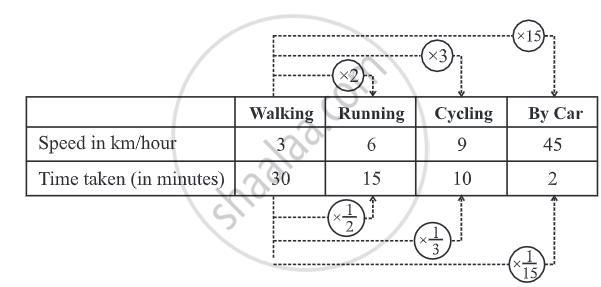
Relation for Inverse Proportion:
Two quantities x and y are said to be in inverse proportion if an increase in x causes a proportional decrease in y (and vice-versa) in such a manner that the product of their corresponding values remains constant. That is, if xy = k, then x and y are said to vary inversely. In this case if y1, y2 are the values of y corresponding to the values x1, x2 of x respectively then x1y1 = x2y2 or `x_1/x_2 = y_2/y_1`.
Formulae [2]
- Profit = Selling Price - Cost Price, which means CP < SP.
- Loss = Cost Price - Selling Price, which means CP > SP.
- Selling Price = Marked Price – Discount
- Discount% = `"Discount"/"Marked Price"` × 100%
- Compound Interest= Amount – Principal.
