Definitions [5]
Two figures are similar if they have the same shape but may differ in size.
- Same shape means: Corresponding angles are equal
-
May differ in size means: Corresponding sides are proportional
Two figures are congruent if they have the same shape and size.
Important relation:
- Congruent figures are always similar
- Similar figures are not necessarily congruent
In similar triangles, the angles opposite to proportional sides are the corresponding angles, and so, they are equal.
-
∠A = ∠P
-
∠B = ∠Q
-
∠C = ∠R
In similar triangles, the sides opposite to equal angles are said to be the
corresponding sides.
ΔABC ∼ ΔPQR
\[\frac{AB}{PQ}=\frac{BC}{QR}=\frac{AC}{PR}\]
Two triangles are similar if
- Their corresponding angles are equal, and
- Their corresponding sides are proportional.
- Symbolically:
ΔABC ∼ ΔPQR (read as “ABC is similar to PQR”).
Theorems and Laws [2]
Statement:
If a line divides any two sides of a triangle in the same ratio, then the line is parallel to the third side.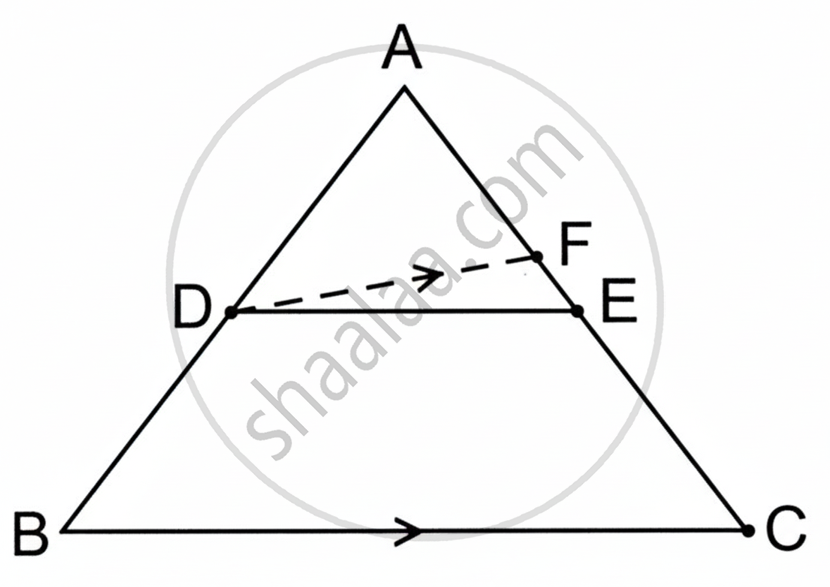
To Prove:
-
Assume a line through point D parallel to BC meets AC at F.
-
By BPT, \[\frac{\mathrm{AD}}{\mathrm{DB}}=\frac{\mathrm{AF}}{\mathrm{FC}}\]
- Given, \[\frac{\mathrm{AD}}{\mathrm{DB}}=\frac{\mathrm{AE}}{\mathrm{EC}}\]
-
Hence,\[\frac{AF}{FC}=\frac{AE}{EC}\]
-
⇒ Points E and F coincide.
Therefore,
Statement:
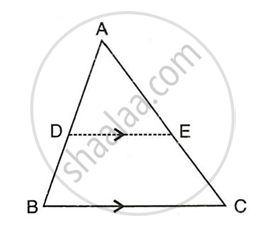
If a line is drawn parallel to one side of a triangle, it divides the other two sides in the same ratio.
To Prove:
\[\frac{\mathrm{AD}}{\mathrm{DB}}=\frac{\mathrm{AE}}{\mathrm{EC}}\]
Proof:
-
A line parallel to a side of a triangle forms equal corresponding angles.
-
Hence, the two triangles formed are similar (AAA similarity).
-
In similar triangles, corresponding sides are proportional.
Therefore, the line divides the two sides in the same ratio.
\[\frac{\mathrm{AD}}{\mathrm{DB}}=\frac{\mathrm{AE}}{\mathrm{EC}}\]
Key Points
-
AA / AAA → two angles equal
-
SAS → included angle equal + sides proportional
-
SSS → all sides proportional
