Definitions [2]
The equation of the locus of a point is the algebraic relation which is satisfied by the coordinates of every point on the locus of the point.
Locus is the path traced by a moving point, which moves so as to satisfy a certain given condition/conditions.
Theorems and Laws [4]
Statement:
The locus of a point which is equidistant from two fixed points is the perpendicular bisector of the line segment joining the two fixed points.
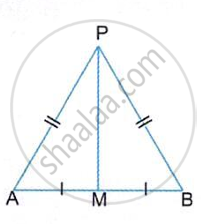
Given:
- A and B are two fixed points
- P is a point such that PA = PB
To Prove:
-
P lies on the perpendicular bisector of AB
Construction:
- Join AB
- Let M be the midpoint of AB
- Join PM
Proof:
-
In ΔPMA and ΔPMB,
PA = PB (given), MA = MB (M is the midpoint of AB), PM = PM (common). -
∴ ΔPMA ≅ ΔPMB (SSS).
-
∴ ∠PMA = ∠PMB (c.p.c.t.).
-
∠PMA + ∠PMB = 180° (straight line AB).
-
∴ ∠PMA = ∠PMB = 90°.
-
Hence, PM ⟂ AB passes through midpoint M.
Thus, P lies on the perpendicular bisector of AB.
Statement:
Every point on the perpendicular bisector of a line segment is equidistant from the two fixed points.
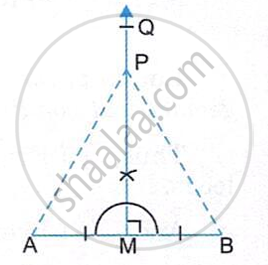
Given:
- A and B are two fixed points
- MQ is the perpendicular bisector of AB
- P is any point on MQ
To Prove:
PA = PB
Construction:
-
Join PA and PB
Proof:
-
In ΔPMA and ΔPMB,
MA = MB (M is the midpoint of AB), PM = PM (common),
∠PMA = ∠PMB = 90° (MQ ⟂ AB). -
∴ ΔPMA ≅ ΔPMB (SAS).
-
∴ PA = PB (c.p.c.t.).
Conclusion:
Hence, every point on the perpendicular bisector of AB is equidistant from A and B.
Statement:
The locus of a point equidistant from two intersecting lines is the pair of angle bisectors of the angles formed by the given lines.
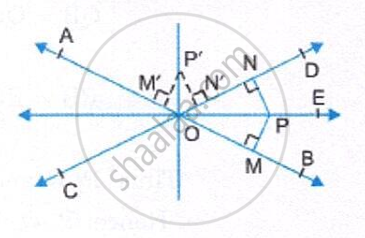
Given:
- Lines AB and CD intersect at O
- P is a point inside ∠BOD
- PM ⟂ OB, PN ⟂ OD
- PM = PN
To Prove:
-
P lies on the bisector of ∠BOD
Construction:
-
Join OP
Proof:
- In ΔOMP and ΔONP, we have
(i) PM = PN (given)
(ii) ∠OMP = ∠ONP = 90° (PM ⟂ OB, PN ⟂ OD)
(iii) OP = OP (common) -
∴ ΔOMP ≅ ΔONP (RHS congruence)
-
∴ ∠MOP = ∠PON (c.p.c.t.)
- Hence, OP bisects ∠BOD.
Conclusion:
Therefore, P lies on the bisector of ∠BOD.
Statement:
Every point on the angle bisector of two intersecting lines is equidistant from the lines.
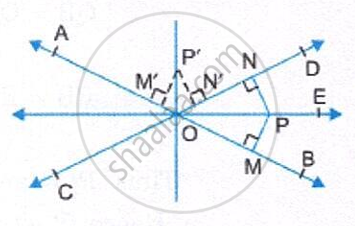
Given:
- Lines AB and CD intersect at O
- OE is the bisector of ∠BOD
- P is a point on OE
- PM ⟂ OB and PN ⟂ OD
To Prove:
PM = PN
Proof:
-
In ΔOMP and ΔONP, we have
(i) ∠MOP = ∠PON (OE bisects ∠BOD)
(ii) ∠OMP = ∠ONP = 90° (PM ⟂ OB, PN ⟂ OD)
(iii) OP = OP (common) -
∴ ΔOMP ≅ ΔONP (ASA congruence)
-
∴ PM = PN (c.p.c.t.)
Conclusion:
Hence, P is equidistant from OB and OD, and therefore from the intersecting lines AB and CD.
Key Points
- Step I: Take any point P(x, y) on the locus.
- Step II: Write down the geometrical condition of the locus.
- Step III: Convert the geometrical condition into an algebraic equation involving x and y.
- Step IV: Simplify the equation to get the required “equation of the locus”.
-
Equidistant from two fixed points → lies on the perpendicular bisector.
-
Equidistant from two intersecting lines → lies on the angle bisectors.
-
Fixed distance from a point → forms a circle.
-
Equidistant from two parallel lines → lies on a line midway and parallel to them.
-
Fixed distance from a line → forms two parallel lines.
-
Midpoints of equal chords → lie on a concentric circle.
-
Midpoints of parallel chords → lie on a diameter perpendicular to the chords.
-
Equidistant from two concentric circles → forms a circle midway between them.
Important Questions [6]
- Use Ruler and Compasses Only for the Following Questions. All Constructions Lines and Arcs Must Be Clearly Shown. Construct the Locus of Points at a Distance of 3.5 Cm from A.
- Use Ruler and Compasses Only for the Following Questions. All Constructions Lines and Arcs Must Be Clearly Shown Construct the Locus of Points Equidistant from Ac and Bc.
- Use Ruler and Compasses Only for the Following Questions. All Constructions Lines and Arcs Must Be Clearly Shown Mark 2 Points X and Y Which Are a Distance of 3.5 Cm from a and Also Equidistant from Ac and Bc. Measure Xy.
- Construct a Triangle Abc with Ab = 5.5 Cm, Ac = 6 Cm and ∠Bac = 105° Construct the Locus of Points Equidistant from Ba and Bc Construct the Locus of Points Equidistant from B and C. Mark the Point Which Satisfies the Above Two Loci as P. Measure and Write the Length of Pc.
- I. Construct Abc, Where Ab = 3.5 Cm, Bc = 6 Cm and Abc = 60o. Ii. Construct the Locus of Points Inside the Triangle Which Are Equidistant from Ba and Bc. Iii. Construct the Locus of Points Inside the Triangle Which Are Equidistant from B and C. Iv. Mark the Point P Which is Equidistant from Ab, Bc and Also Equidistant from B and C. Measure and Records the Length of Pb.
- Use ruler and compass to answer this question. Construct ∠ABC = 90°, where AB = 6 cm, BC = 8 cm. Construct the locus of points equidistant from B and C
