Definitions [4]
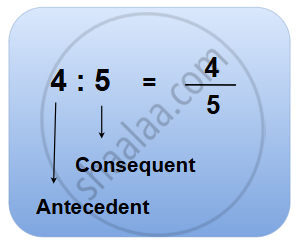
A ratio is the relationship between two quantities of the same kind with the same unit, obtained by dividing the first by the second.
Example:
The ratio between 15 kg and 20 kg
15 kg : 20 kg = `15/20` = `3/4` = 3:4.
- Cost Price (C.P.): The amount for which an article is bought is called its Cost Price (C.P.).
- Selling Price (S.P.): The price at which a product is sold is known as its selling price (S.P.).
- Profit or Gain: When the S.P. is more than the C.P., then there is a profit or gain.
- Loss: When the S.P. is less than the C.P., then there is a loss.
- Discount: A Discount is the reduction given on the marked price of an article by the seller, usually to attract customers.
- Marked Price (M.P.): Marked Price (also called Tag Price) is the price printed or written on an article by the shopkeeper, which is usually higher than the cost price
- Compound interest: Compound interest is interest calculated on the initial principal, which also includes all of the accumulated interest from previous periods on a deposit or loan.
- Conversion Period: Time period and rate when interest not compounded annually The time period after which the interest is added each time to form a new principal is called the conversion period.
Formulae [2]
- Profit = Selling Price - Cost Price, which means CP < SP.
- Loss = Cost Price - Selling Price, which means CP > SP.
- Selling Price = Marked Price – Discount
- Discount% = `"Discount"/"Marked Price"` × 100%
- Compound Interest= Amount – Principal.
Theorems and Laws [2]
If x : a = y : b, prove that `(x^4 + a^4)/(x^3 + a^3) + (y^4 + b^4)/(y^3 + b^3) = ((x + y)^4 + (a + b)^4)/((x+ y)^3 + (a + b)^3`
`x/a = y/b` = k (say)
x = ak, y = bk
L.H.S. = `(x^4 + a^4)/(x^3 + a^3) + (y^4 + b^4)/(y^3 + b^3)`
= `(a^4k^4 + a^4)/(a^3k^3 + a^3) + (b^4k^4 + b^4)/(b^3k^3 + b^3)`
= `(a^4(k^4 + 1))/(a^3(k^3 + 1)) + (b^4(k^4 + 1))/(b^3(k^3 + 1)`
= `(a(k^4 + 1))/(k^3 + 1) + (b(k^4 + 1))/(k^3 + 1)`
= `(a(k^4 + 1) + b(k^4 + 1))/(k^3 + 1)`
= `((k^4 + 1)(a + b))/(k^3 + 1)`
R.H.S. = `((x + y)^4 + (a + b)^4)/((x+ y)^3 + (a + b)^3`
= `((ak + bk)^4 + (a + b)^4)/((ak + bk)^3 + (a + b)^3`
= `(k^4(a + b)^4 + (a - b)^4)/(k^3(a + b)^3(a + b)^3`
= `((a + b)^4(k^4 + 1))/((a + b)^3(k^3 + 1)`
= `((a + b)(k^4 + 1))/(k^3 + 1)`
= `((k^4 + 1)(a + b))/(k^3 + 1)`
∴ L.H.S. = R.H.S.
Hence proved
If `x/a = y/b = z/c`, prove that `(3x^3 - 5y^3 + 4z^3)/(3a^3 - 5b^3 + 4c^3) = ((3x - 5y + 4z)/(3a - 5b + 4c))^3`.
`x/a = y/b = z/c` = k(say)
x = ak, y = bk, z = ck
L.H.S. = `(3x^3 5y^3 + 4z^3)/(3a^3 5b^3 + 4c^3)`
= `(3a^3k^3 - 5b^3k^3 + 4c^3k^3)/(3a^3 - 5b^3 + 4ac^3)`
= `(k^3(3a^3 - 5b^3 + 4c^3))/(3a^3 - 5b^3 + 4c^3`
= k3
R.H.S. = `((3x - 5y + 4z)/(3a - 5b + 4c))^3`
= `((3ak - 5bk + 4ck)/(3a - 5b + ac))^3`
= `((k(3a - 5b + 4c))/(3a - 5b + 4c))^3`
= (k)3
= k3
∴ L.H.S. = R.H.S.
Concepts [10]
- Ratio
- Increase Or Decrease as Percent
- Concept of Discount
- Estimation in Percentages
- Basic Concepts of Profit and Loss
- Calculation of Interest
- Concept of Compound Interest
- Deducing a Formula for Compound Interest
- Rate Compounded Annually Or Half Yearly (Semi Annually)
- Applications of Compound Interest Formula
