Definitions [44]
The commercial unit of electrical energy, also known as the Board of Trade (B.O.T.) unit, which is the electrical energy consumed by an appliance of 1000 watt in 1 hour, equal to 3.6 ×10⁶ joules, is called Kilowatt Hour.
The physical quantity said to be done whenever a force acts on a body and the body moves through some distance in the direction of the force, which is the product of magnitude of displacement and the component of force along the displacement, with SI unit joule (J) and dimensional formula [M¹L²T⁻²], is called Work.
The work done when a force acting on a body has a component in the direction of displacement, so that W=FscosθW=Fscosθ is a positive value, is called Positive Work.
The work done when a force acting on a body has a component in the opposite direction of displacement, so that W = F s cos θ is a negative value, is called Negative Work.
The work done when either F = 0, or s = 0, or θ = 90°, so that the work done equals zero, is called Zero Work.
The limiting value of the average power as the time interval approaches zero, expressed as P = limΔt→0\[\frac {ΔW}{Δt}\] = \[\frac {dW}{dt}\], is called Instantaneous Power.
The rate of doing work, where if an agent does work W in time t its average power is Pav = \[\frac {W}{t}\], which is a scalar quantity with SI unit watt (W) and dimension [ML²T⁻³], is called Power.
The potential energy stored in stretched or compressed materials like springs or rubber bands, expressed as P Eelastic = \[\frac {1}{2}\]kx2, is called Elastic Potential Energy.
The energy stored in a body or a system by virtue of its position in a field of force or by its configuration is called Potential Energy.
The energy possessed by a body by virtue of its motion, expressed as K E = \[\frac {1}{2}\]mv2, is called Kinetic Energy.
The capacity or ability of a body to do work, measured by the amount of work the body can perform, which is a scalar quantity with SI unit joule (J) and dimensional formula [ML²T⁻²], is called Energy.
The potential energy associated with an object's height above the ground, expressed as P Egravitational = mgh, is called Gravitational Potential Energy.
The energy possessed by a body due to its state of motion is called its kinetic energy.
Define 'joule'.
The SI unit of work is joule.
1 joule of work is said to be done when a force of 1 newton displaces a body through 1 metre in its own direction.
Define Translational motion.
When a force acts on a rigid body which is free to move, the body starts moving in a straight line in the direction of the force. This is called translational motion.
Define the term energy.
“Capacity of doing work” is called Energy.
Energy, in physics, is the capacity for doing work. It may exist in potential, kinetic, thermal, electrical, chemical, nuclear, or other various forms. There are, moreover, heat and work-i.e., energy in the process of transfer from one body to another.
Explain the types of mechanical energy.
The energy possessed by an object due to its position is called mechanical energy.
Mechanical energy can be classified into two:
- Kinetic energy: The energy possessed by a moving object is known as kinetic energy. It is also known as the energy of motion.
Examples: Moving car, a cricket ball bowled by a player, and a bullet coming out of a gun. - Potential energy: The energy possessed by an object that is at rest is known as potential energy. It is also known as the stored energy of position.
Examples: Objects lifted above, stone in the stretched rubber, and water in the dam.
Work is said to be done only when the force applied on a body makes the body move (i.e., there is a displacement of the body).
Define work.
The work done by a force on a body is equal to the product of the force applied and the distance moved by the body in the direction of force i.e.,
Work done = Force × distance moved in the direction of force
The motion of a body in a straight line path is called translational motion.
The kinetic energy of the body due to motion in a straight line is called translational kinetic energy.
If a body rotates about an axis, the motion is called rotational motion.
The kinetic energy of the body due to rotational motion is called rotational kinetic energy or simply rotational energy.
If a body moves to and fro about its mean position, the motion is called vibrational motion.
The kinetic energy of the body due to its vibrational motion is called vibrational kinetic energy or simply vibrational energy.
The energy possessed by a body due to its state of rest or of motion, is called mechanical energy.
The energy possessed by a body at rest due to its position or size and shape is called potential energy.
Define the term potential energy of a body.
The energy possessed by a body by virtue of its specific position (or changed configuration) is called the potential energy.
Define power.
Power is defined as the rate of doing work or work done per second.
i.e., Power = `("Work done in joule")/("Times in second")`
or, p = `("W (in joule)")/("t (in second)")`
The rate of doing work is called power.
A collision in which both linear momentum and kinetic energy are conserved is called an elastic collision.
A collision as a process where "several objects come together, interact (exert forces on each other) and scatter in different directions."
OR
An event where two or more bodies exert forces on each other in a relatively short time is called a collision.
OR
The interaction between two bodies during a very small duration in which they exert relatively large forces on each other, and during which momentum or kinetic energy is transferred from one object to another, is called Collision.
Define coefficient of restitution.
For two colliding bodies, the negative of the ratio of the relative velocity of separation to the relative velocity of approach is called the coefficient of restitution.
A collision in which linear momentum is conserved but kinetic energy is not conserved is called an inelastic collision.
The ratio of the relative velocity of separation to the relative velocity of approach between two colliding objects is called the Coefficient of Restitution.
A collision where there is a loss in kinetic energy during the collision, but linear momentum is conserved.
OR
A collision in which the total kinetic energy does not remain constant after the collision is called an inelastic collision.
A collision where the kinetic energy of the entire system is conserved during the collision (along with the linear momentum).
OR
The collision in which the total kinetic energy before and after the collision remains the same, and both momentum and kinetic energy are conserved, is called Elastic Collision.
A collision in two dimensions (oblique collision) is defined as: a collision where the direction of at least one initial velocity is NOT along the line of impact, requiring analysis using two mutually perpendicular directions—the line of impact and the common tangent at the point of contact.
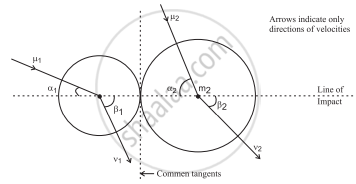
Oblique or non-head-on collision.
A force that does not follow the conservative force rule, where the work done by or against it depends on the actual path taken.
OR
If work done by or against a force is dependent of the actual path, the force is said to be a non- conservative force.
Energy possessed by an object on account of its position in a force field. It changes as the work is done by or against a conservative force.
A force is said to be a conservative force if the work done by or against it is independent of the actual path chosen and depends only on the initial and final positions of the object.
OR
If work done by or against a force is independent of the actual path, the force is said to be a conservative force.
The state of equilibrium in which the potential energy of the system is at its local minimum is called stable equilibrium.
OR
The equilibrium in which the potential energy at the equilibrium position is minimum as compared to its neighbouring points, where \[\frac {d^2U}{dr^2}\] is positive, is called Stable Equilibrium.
The state of equilibrium in which the potential energy of the system is constant over a plane and remains same at any position is called neutral equilibrium.
OR
The equilibrium in which the potential energy remains constant even if the body moves to neighbouring points, where \[\frac {d^2U}{dr^2}\] = 0, is called Neutral Equilibrium.
The state of equilibrium in which the potential energy of the system is at its local maximum is called unstable equilibrium.
OR
The equilibrium in which the potential energy at the equilibrium position is maximum as compared to other positions, where \[\frac {d^2U}{dr^2}\] is negative, is called Unstable Equilibrium.
Formulae [9]
How many watts equal one horse power?
The relation between two units of power is as follows -
1 hours power = 746 W
1 h.p. = 746 W
Write the formula for the work done on a body when a force acts on the body in the direction of its displacement. Give the meaning of each symbol which occurs in the formula.
W = FS cos θ
Where,
(F) - Force
(W) - Work
(S) - Displacement
θ - Angle between F and S
When F and S are parallel, θ = 0.
Then, work done is, W = FS
K = \[\frac {1}{2}\] mv2
Kinetic Energy = \[\frac {1}{2}\] mass × (velocity)2
W = \[\int_{\mathrm{b}}^{\mathrm{a}}\vec{\mathrm{F}}.\overline{\mathrm{ds}}=\int_{\mathrm{b}}^{\mathrm{a}}\mathrm{F}\mathrm{ds}\cos\theta\]
Gravitational Potential Energy Uh = mgh
Power P = \[\frac{\text{Work done }W}{\text{Time taken }t}\]
or
P = \[\frac {W}{t}\]
Where:
- ∑KEinitial = total initial kinetic energy
- ∑KEfinal = total final kinetic energy
Where:
- The lost kinetic energy is due to internal friction or vibrational motion of atoms, causing a heating effect
- Linear momentum is still conserved: \[\sum\vec{p}_{initial}\] = \[\sum\vec{p}_{final}\]
Where:
- \[\sum\vec{p}_{initial}\] = total initial momentum of all objects
- \[\sum\vec{p}_{final}\] = total final momentum of all objects
Theorems and Laws [3]
Statement:
According to the work-energy theorem, the increase in kinetic energy of a moving body is equal to the work done by a force acting in the direction of the moving body.
Proof:
Let a body of mass m be moving with an initial velocity u. When a constant force F is applied to the body along its direction of motion, it produces an acceleration a, and the body's velocity increases from u to v over a distance S.
Force,
F = ma
Work done by the force,
W = F × S
From the equation of motion,
\[v^2=u^2+2aS\Rightarrow S=\frac{v^2-u^2}{2a}\]
Substituting equations (i) and (iii) into (ii):
W = \[ma\times\frac{v^2-u^2}{2a}=\frac{1}{2}m(v^2-u^2)\]
Now,
Initial kinetic energy, Ki = \[\frac {1}{2}\]mu2
Final kinetic energy, Kf = \[\frac {1}{2}\]mv2
Therefore,
W = Kf − Ki
Conclusion:
Work done on the body = Increase in its kinetic energy.
Hence, the work-energy theorem is proved.
Change in kinetic energy of the body = Work done on the body by the net force
Kf - Ki = W
Following points are very useful while calculating the work done by resistive force.
- If a particle of mass m is moving with velocity v. This particle is stopped by some resistive force, then the work done by the resistive force, W = -1/2 mv²
- Decrease in the gravitational potential energy = Increase in the kinetic energy + Work done against non-conservative forces
Statement: Energy can neither be created nor be destroyed. It can only be converted from one form to another.
Conservation of Mechanical Energy:
When only conservative forces act on a system, the total mechanical energy remains constant:
- This implies that the sum of kinetic and potential energies at any given point of time is equal to the initial total mechanical energy of the system.
- When a body falls freely in air, mechanical energy is conserved as potential energy is lost and an equal amount of kinetic energy is gained.
- If motion involves friction/collision, conservation of mechanical energy is not applicable, as energy is converted to heat and sound.
Key Points
- The S.I. unit of work is joule (J).
1 joule = 1 newton × 1 metre, i.e., work done when a force of 1 N moves a body 1 m in its direction. - The C.G.S. unit of work is erg.
1 erg = 1 dyne × 1 cm, i.e., work done when a force of 1 dyne moves a body 1 cm in its direction. - The relation between joule and erg is:
1 joule = 10⁷ erg
- Work done by a constant force is given by W = \[\vec F\] . \[\vec s\] = F s cos θ; for infinitesimal displacement, dW = \[\vec F\] . d\[\vec x\].
- For a variable force, the standard formula is not applicable; work done is calculated using W = \[\int_{s_{1}}^{s_{2}}\vec{F}\cdot d\vec{s}.\]
- The area under the force-displacement graph represents the work done; for linearly variable force, W = Area APQB.
- Conservative force (e.g., gravity) — work done is path independent; non-conservative force (e.g., friction) — work done is path dependent.
- Mechanical energy is conserved under conservative forces only; Wconservative = −ΔU and Wnon-conservative = ΔKE + ΔPE.
- There are two main types of potential energy: gravitational and elastic.
- Gravitational potential energy is due to height and is given by U = mgh.
- It is zero at infinity and becomes less negative as the distance from Earth increases.
- Elastic potential energy is stored when an object is stretched or compressed.
- Lifting a body stores energy as gravitational potential energy by doing work against gravity.
- S.I. unit: If 1 joule of work is done in 1 second, the power spent is said to be 1 watt.
- C.G.S. unit: The C.G.S. unit of power is erg per second (erg s-1).
- Relationship between S.I. and C.G.S. units:
1 W = 1 J s-1 = 107 erg s-1 - 1 horse power (H.P.) = 746 W = 0.746 kW
Concepts [17]
- Introduction of Work, Energy and Power
- Notions of Work and Kinetic Energy: the Work-energy Theorem
- Mechanical Energy > Kinetic Energy (K)
- Concept of Work
- Types of Forces>Work Done by a Variable Force
- Work Energy Theorem
- Mechanical Energy > Potential Energy (U)
- Conservation of Mechanical Energy
- Potential Energy of a Spring
- Concept of Power
- Collisions
- Elastic and Inelastic Collisions
- Collisions in One Dimension
- Collision in Two Dimensions
- Types of Forces>Conservative and Non-Conservative Forces
- Motion in a Vertical Circle
- States of Equilibrium
