Definitions [6]
Let \[ y = f(x) \]
Then the first derivative of y with respect to x is \[ \frac{dy}{dx} = f'(x) \]
If f'(x) is differentiable, we differentiate it again with respect to x. Thus,
\[ \boxed{\frac{d^2y}{dx^2} = \frac{d}{dx}\left(\frac{dy}{dx}\right)} \]
This is called the second order derivative of y with respect to x.
The second derivative of f(x) may also be written as
\[ \boxed{f''(x), \quad y'', \quad y_2, \quad D^2y} \]
Higher order derivatives are obtained by differentiating successively.
When x and y are expressed separately as functions of the same third variable t, i.e. \[ x = f(t), \qquad y = g(t), \] the equations are called parametric equations, and t is called the parameter.
The parameter may also be denoted by \[\theta, u,\] etc.
Important Condition
The formula \[ \frac{dy}{dx} = \frac{dy/dt}{dx/dt} \] is directly applicable when
\[ \boxed{\frac{dx}{dt} \neq 0.} \]
If \[ \frac{dx}{dt} = 0, \] the point must be examined separately. It may correspond to a point where the tangent is vertical.
Implicit Function
Implicit differentiation means differentiating both sides of an equation with respect to x, while remembering that y depends on x. Therefore, whenever a term containing y is differentiated, the factor \[\frac{dy}{dx}\] appears by the chain rule.
Explicit Function
If a relation between x and y can be easily solved for y and written as \[ y = f(x), \] then y is given as an explicit function of x.
A point in the domain of a function is called a critical point if either the derivative is zero there or the derivative does not exist there. Critical points are checked while locating possible maxima or minima.
The points where a function changes from decreasing to increasing or from increasing to decreasing are called turning points.
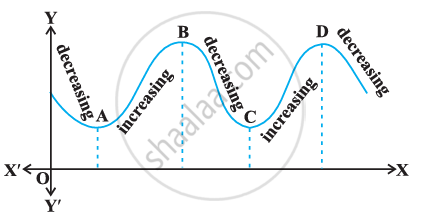
Let f be a function defined on an interval I.
Maximum value: f has a maximum value at c ∈ I if \[ \boxed{f(c) \geq f(x) \quad \text{for all } x \in I} \]
The value f(c) is called the maximum value and c is called a point of maximum.
Minimum value: f has a minimum value at c ∈ I if \[ \boxed{f(c) \leq f(x) \quad \text{for all } x \in I} \]
The value f(c) is called the minimum value and c is called a point of minimum.
Extreme value: A maximum or minimum value of f is called an extreme value.
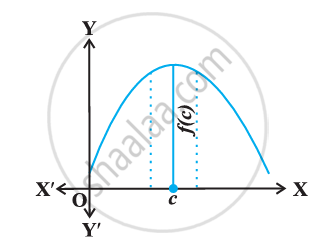
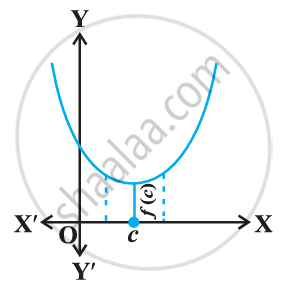
Maximum value Minimum value
Theorems and Laws [3]
If y = 5 cos x – 3 sin x, prove that `(d^2y)/(dx^2) + y = 0`.
Given, y = 5 cos x – 3 sin x
Differentiating both sides with respect to x,
`dy/dx = 5 d/dx cos x - 3 d/dx sin x`
= 5 (−sin x) − 3 cos x
= −5 sin x − 3 cos x
Differentiating both sides again with respect to x,
`(d^2 y)/dx = - 5 d/dx sin x - 3 d/dx cos x`
= −5 cos x − 3 (−sin x)
= 3 sin x − 5 cos x
Hence, `(d^2 y)/dx^2 + y` = 0
(3 sin x − 5 cos x) + (5 cos x − 3 sin x) = 0 ...(On substituting the value of y)
Assume f'(c) = 0 and the second derivative exists at c:
-
Local Maximum: f''(c) < 0
-
Local Minimum: f''(c) > 0
-
Test Fails: f''(c) = 0. If this happens, you must go back and use the First Derivative Test to check if it is a maxima, minima, or point of inflection.
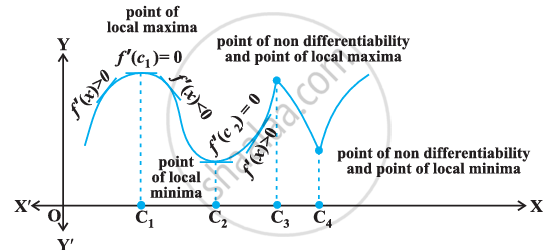
Let c be a critical point of a continuous function f:
-
Local Maximum: If f'(x) changes sign from positive to negative as x passes through c, then cc is a point of local maximum.
-
Local Minimum: If f'(x) changes sign from negative to positive then c is a point of local minimum.
-
Point of Inflection: f'(x) does not change sign as x passes through c (it is neither a maxima nor a minima).
Key Points
-
Second derivative means differentiating the function twice with respect to the same variable.
-
It is defined only when the first derivative is differentiable.
-
Common notations are \[\frac{d^2y}{dx^2}\], f''(x), y'', \[D^2y\], and \[y_2\].
-
Higher order derivatives can be defined similarly.
- If y = f(x), then \[\frac{dy}{dx}\] = f′(x) is called the first-order derivative.
- The derivative of the first derivative is called the second-order derivative:
\[\frac{d^2y}{dx^2}\] = f″(x) - Higher order derivatives are written as:
fⁿ(x) or \[\frac{d^ny}{dx^n}\]
-
Parametric form means both x and y are written in terms of a third variable.
-
The third variable is called the parameter.
-
The main formula is:
\[\frac{dy}{dx} = \frac{\frac{dy}{dt}}{\frac{dx}{dt}}\] -
This formula is based on the chain rule.
-
Always check that \[\frac{dx}{dt} \neq 0\].
-
The final answer may remain in terms of the parameter unless the question asks for conversion.
- If an equation contains both x and y and cannot be solved directly for y, it is called an implicit function.
- Implicit functions are generally written in the form:
f(x, y) = 0 - To differentiate an implicit function, differentiate both sides with respect to x, treating y as a function of x.
-
Maxima and minima are extreme values of a function.
-
Critical points occur where \(f'(x)=0\) or \(f'(x)\) is not defined.
-
If \(f'(x)\) changes from positive to negative, the function has a local maximum.
-
If \(f'(x)\) changes from negative to positive, the function has a local minimum.
-
If \(f''(c) < 0\), there is a local maximum at \(x=c\).
-
If \(f''(c) > 0\), there is a local minimum at \(x=c\).
-
For absolute extrema on \([a,b]\), compare values at critical points and endpoints.
-
Not every critical point gives a maximum or minimum.
-
The second derivative test is quick, but the first derivative test is often more reliable in detailed reasoning.
Concepts [7]
- Second Order Derivative
- Higher Order Derivatives
- Derivatives of Functions in Parametric Forms
- Differentiation of Implicit Functions
- Dependent and Independent Variables
- Marginal Cost and Marginal Revenue Using Derivatives
- Maxima and Minima
