Definitions [5]
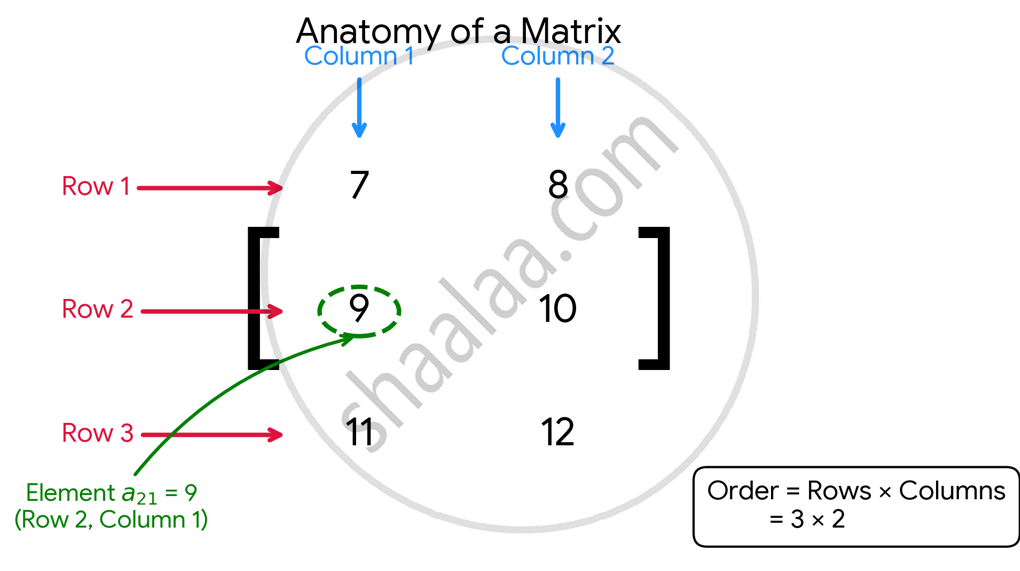
A matrix is a rectangular arrangement of numbers arranged in rows and columns, enclosed in brackets [ ] or parentheses ( ).
Elements (Entries) of a Matrix
- Each number in a matrix is called an element (or entry).
Rows and Columns
- Horizontal lines → rows
- Vertical lines → columns
Order of a Matrix
- Order = number of rows × number of columns
- Written as m × n and read as “m by n”
Two matrices are equal if and only if:
- They have the same order (same number of rows and columns), and
- Their corresponding elements are equal.
i.e
If \[ A = [a_{ij}]_{m \times n} \quad \text{and} \quad B = [b_{ij}]_{m \times n}, \]
then \[ A = B \iff a_{ij} = b_{ij} \text{ for all } i, j, \]
Example:
\[A=
\begin{bmatrix}
2 & & 3 \\
1 & & 5
\end{bmatrix}\mathrm{and} B=
\begin{bmatrix}
2 & & 3 \\
1 & & 5
\end{bmatrix}\]
The transpose of a matrix is obtained by interchanging its rows and columns.
-
If a matrix is A, its transpose is denoted by AT
-
If A is of order m × n, then
AT is of order n × m - First row of A becomes first column of AT, and so on.
A square matrix \[A = [a_{ij}]_{n \times n}\] is called skew-symmetric if \[A^T = -A\]
i.e.,\[a_{ij} = -a_{ji}\] for all i and j.
A square matrix \[A = [a_{ij}]_{n \times n}\] is called symmetric if
i.e., \[a_{ij} = a_{ji}\] for all i and j.
Theorems and Laws [3]
If A and B are symmetric matrices, prove that AB – BA is a skew symmetric matrix.
If A and B are symmetric matrices.
∴ A’ = A and B’ = B
(AB – BA) = (AB)’ – (BA)’ ...[∵ (X – Y) = X’ – Y’]
= B’A’ – A’B’ ...[∵ (XY) = Y’X’]
= BA – AB ...[∵ B’ = B, A’ = A]
= –(AB – BA)
∴ AB – BA is a skew symmetric matrix.
Theorem 2: Any square matrix can be expressed as the sum of a symmetric and a skew-symmetric matrix.
Proof: Let A be a square matrix, then we can write
\[\mathrm{A=\frac{1}{2}(A+A^{\prime})+\frac{1}{2}(A-A^{\prime})}\]
From Theorem 1, we know that (A + A′) is a symmetric matrix and (A − A′) is a skew-symmetric matrix.
Multiplying by \[\frac{1}{2}\] does not change these properties.
Since for any matrix A, (kA)′ = kA′, it follows that \[\frac{1}{2}(\mathrm{A}+\mathrm{A}^{\prime})\] is symmetric matrix and \[\frac{1}{2}(\mathrm{A}-\mathrm{A}^{\prime})\] is skew symmetric matrix.
Thus, any square matrix can be expressed as the sum of a symmetric and a skew-symmetric matrix.
Theorem 1: For any square matrix A with real number entries, A + A′ is a symmetric matrix and A − A′ is a skew-symmetric matrix.
Proof:
Part 1: Symmetric Matrix
Let B = A + A′, then
Take transpose on both sides:
B′ = (A + A′)′
= A′ + (A′)′ (as (A + B)′ = A′ + B′)
= A′ + A (as (A′)′ = A)
= A + A′ (as A + B = B + A)
= B
Therefore, B = A + A′ is a symmetric matrix
Part 2: Skew-Symmetric Matrix
Now let
C = A − A′
C′ = (A − A′)′ = A′ − (A′)′ (Why?)
= A′ − A (Why?)
= −(A − A′) = −C
Therefore
C = A − A′ is a skew-symmetric matrix.
Key Points
-
Matrix: A rectangular array of elements.
-
Element: An entry inside a matrix.
-
Order: Size of a matrix written as rows × columns.
-
Row: Horizontal set of elements.
-
Column: Vertical set of elements.
-
aij: Element in the i-th row and j-th column.
| Matrix Type | Order | Key Property |
|---|---|---|
| Row Matrix | 1 × n | Only one row |
| Column Matrix | m × 1 | Only one column |
| Square Matrix | n × n | Rows = Column |
| Diagonal Matrix | n × n | Square; non-diagonal elements = 0 |
| Scalar Matrix | n × n | Diagonal; all diagonal elements equal |
| Identity Matrix | n × n | Scalar matrix with diagonal = 1 |
| Zero Matrix | Any order | All elements = 0 |
-
Equality of matrices is possible only when the order is the same.
-
Corresponding elements must be compared position by position.
-
If even one corresponding entry differs, the matrices are not equal.
-
Transpose = interchange rows and columns.
-
If A is \[m \times n\], then A' is \[n \times m\].
-
Standard notation: A' or \[A^T\].
-
Key properties: (A')' = A, (kA)' = kA', (A + B)' = A' + B', (AB)' = B'A'.
-
A square matrix is symmetric if \[A^T = A\].
-
A square matrix is skew-symmetric if \[A^T = -A\].
-
In a skew-symmetric matrix, all diagonal elements are zero.
-
For any square matrix A:
-
\[A + A^T\] is symmetric.
-
\[A - A^T\] is skew-symmetric.
-
-
Any square matrix A can be written as
-
The decomposition into symmetric and skew-symmetric parts is unique.
