Definitions [12]
Define adsorption.
Adsorption is the phenomenon of accumulation of a higher concentration of one substance on the surface of another (in bulk) due to unbalanced/unsatisfied attractive forces on the surface.
The phenomenon of accumulation of substance at the surface of another molecular species rather than in its bulk is called adsorption. e.g. Adsorption of gases like nitrogen, carbon dioxide by activated charcoal.
When both adsorption and absorption occur simultaneously, it is known as sorption.
The process of removal of an adsorbed substance from the surface of adsorbent is known as desorption.
The substance adsorbed on the surface of another substance is called as adsorbate or absorbed phase.
A substance which adsorbs another substance on its surface is called as adsorbent.
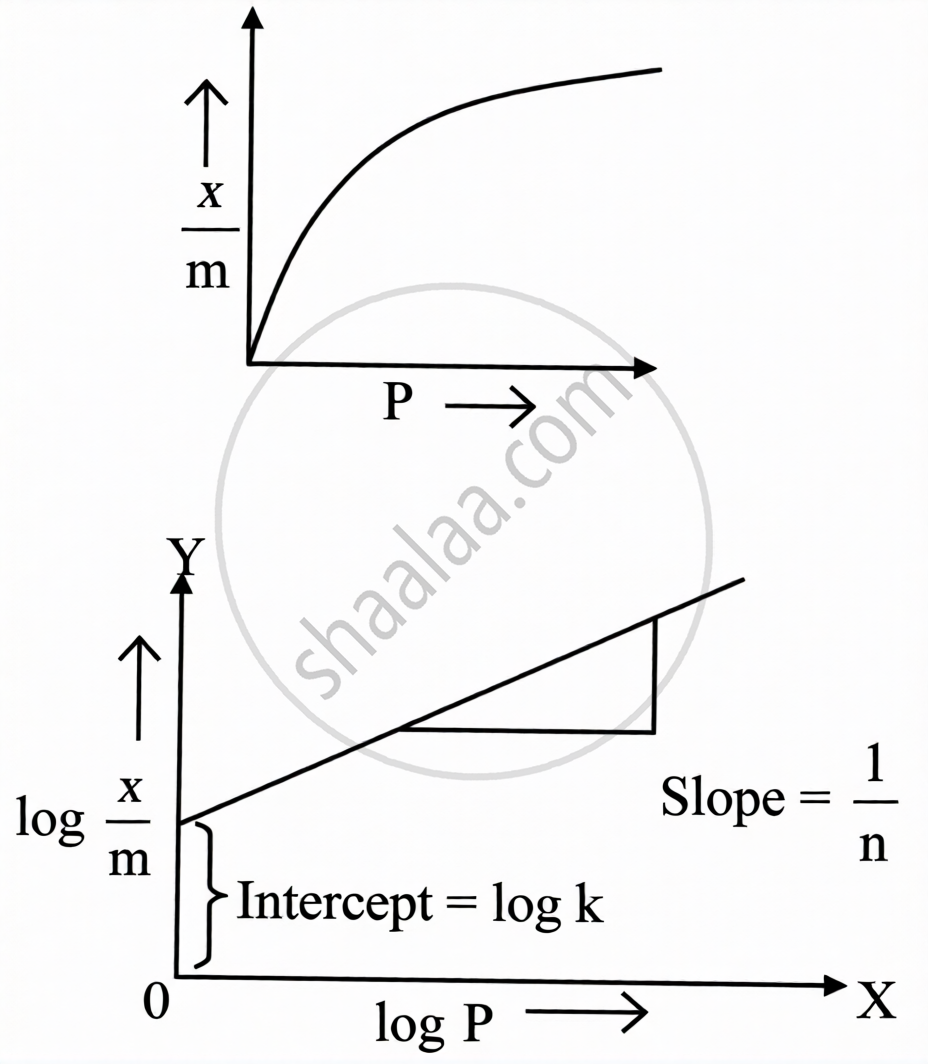
The relationship between the extent of adsorption (x/m) and the pressure of gas at constant temperature is called an adsorption isotherm.
Define the term Catalysis.
The phenomenon of increasing the rate of a chemical reaction with the help of a catalyst is known as catalysis.
Define the term Inhibition.
The phenomenon in which the rate of a chemical reaction is reduced by an inhibitor is called inhibition.
A catalyst is a substance that alters the rate of a chemical reaction without being consumed. The phenomenon is called catalysis.
Define the term Electrophoresis.
The movement of colloidal particles under an applied electric potential is called electrophoresis.
A substance is said to be in colloidal state when one substance of heterogeneous system is dispersed (dispersed phase) as very fine particles in another substance (dispersion medium).
Key Points
| Feature | Physisorption | Chemisorption |
|---|---|---|
| Force | Van der Waals' | Covalent / ionic bond |
| Specificity | Non-specific | Highly specific |
| Heat of adsorption | 20–40 kJ mol⁻¹ | 40–200 kJ mol⁻¹ |
| Temperature | Low temp favoured | High temp favoured |
| Reversibility | Reversible | Irreversible |
| Layers | Multilayer | Monolayer |
- Nature of adsorbent — Substances with large surface area per unit mass (porous solids like silica gel and charcoal) are more effective adsorbents
- Surface area — Greater the surface area of the adsorbent, greater is the extent of adsorption
- Temperature — Adsorption is exothermic, so it decreases with rise in temperature (and vice versa)
- Pressure of the gas — At constant temperature, extent of gas adsorption increases with increase in pressure
- Nature of adsorbate (gas) — Gases that are more easily liquefiable (e.g., SO₂, Cl₂, NH₃) get adsorbed to a larger extent compared to gases like N₂, O₂, H₂
Freundlich Adsorption Isotherm:
Empirical equation: \[\frac{x}{m}=kP^{1/n}\quad(n>1)\]
where:
- x = mass of the gas adsorbed
- m = mass of the adsorbent
- `x/m` = mass of gas adsorbed per unit mass of adsorbent
- P = equilibrium pressure
- k and n = constants depending on the nature of the adsorbate, adsorbent, and temperature
For solutions: \[\frac{x}{m}=kC^{1/n}\] where C = concentration of the solution
Logarithmic (linear) form: \[\log\frac{x}{m}=\log k+\frac{1}{n}\log P\]
In the log x/m vs log P graph:
- Slope = `1/n` (value between 0 and 1)
- Y-intercept = log k
- When `1/n` = 0: adsorption is independent of pressure
- When `1/n` = 1: adsorption is directly proportional to pressure
| Application | How Adsorption Helps |
|---|---|
| Adsorption indicators | Dyes like eosin and fluorescein act as indicators through adsorption |
| Separation of inert gases | Inert gases can be separated on coconut charcoal (different adsorption at different temperatures) |
| Froth flotation process | Hydrophobic pine oil preferentially adsorbs sulphide ore particles, allowing separation from gangue |
| Chromatographic analysis | Powdered adsorbents like silica or alumina gel are used to separate mixtures |
| Heterogeneous catalysis | Contact process (SO₂ → SO₃), hydrogenation of oils |
| Gas masks | Activated charcoal or mixture of adsorbents to avoid inhaling poisonous gases |
| Control of humidity | Silica and alumina gels used to adsorb moisture |
| Production of high vacuum | Coconut charcoal adsorbs traces of air or moisture to create high vacuum |
| Type | Description |
|---|---|
| Homogeneous |
Reactants and catalyst are in the same phase \[\ce{\underset{}{2SO2(g) + O2(g)} ->[NO(g)][]\underset{}{2SO3(g)}}\] |
| Heterogeneous |
Reactants and catalyst are in different phases \[\ce{\underset{}{N2(g) + 3H2(g)} ->[][Fe(s)]\underset{}{2NH3(g)}}\] |
| On the basis of the mechanism of catalysis: |
|
| Positive catalysis | Catalyst enhances the rate of reaction |
| Negative catalysis | Catalyst retards the rate of reaction |
| Auto-catalysis | One of the products acts as catalyst |
| Induced catalysis | One reaction induces the rate of another reaction |
The reaction occurs on the surface of the solid catalyst. Steps involved:
- Diffusion — Reactant molecules diffuse towards the surface of the catalyst
- Adsorption — Reactant molecules adsorb onto the surface of the catalyst
- Intermediate formation — Chemical reaction on the catalyst surface proceeds via intermediate formation
- Desorption — Products are desorbed (released) from the catalyst surface
- Product formation — Products diffuse away from the surface
Heterogeneous catalytic reactions are also called surface reactions. Heterogeneous catalysts are used in automobile catalytic converters.
